Visa
About Akademia Podlaska
Akademia Podlaska and the university today
Akademia Podlaska is a historical name of the public higher-education institution in Siedlce, Poland, now called Uniwersytet w Siedlcach, or Siedlce University. The university’s official chronology places the Akademia Podlaska period between 1999 and 2010. From 2010 to 2023 it operated as Uniwersytet Przyrodniczo-Humanistyczny w Siedlcach, before adopting its present name. The successive names belong to the continuing Siedlce institution.
The institution began in 1969 as a higher teacher-training school. It became a pedagogical higher school in 1974 and an agricultural and pedagogical higher school in 1977. Its history connects that development with a regional shortage of university-trained teachers and a much older local tradition of teacher education. These successive forms explain how an institution initially centred on teaching expanded into agriculture, sciences and other academic fields.
Sources: Institutional history and successive names ↗
The contemporary academic institution
The present university describes itself as a public institution serving eastern Mazovia through education, scientific research, artistic work and cultural activity. Its academic fields include humanities, social sciences, medicine and health sciences, agriculture, exact and natural sciences, and art. Postgraduate education complements its degree programmes.
Doctoral education is organised through a doctoral school. The university’s overview lists disciplines including biology, chemistry, history, security studies, agriculture and horticulture, animal science and fisheries, mathematics, health sciences, pedagogy, management and quality studies, and literary studies. International cooperation also forms part of its educational work: Erasmus+ provides opportunities for study periods and professional placements abroad, alongside exchanges for academic and administrative staff. The institution presents civic and social development as part of education, connecting academic learning with participation in contemporary society.
Sources: About Siedlce University ↗
Computing during the academy years
Computer science provides a detailed example of the university’s expansion. Its institutional history begins with a computing laboratory established in 1976, followed by a university computing centre in 1979. Undergraduate computing studies started in 1993, and the Institute of Computer Science was formed in 1998.
During the Akademia Podlaska period, the subject developed beyond its earlier teacher-training emphasis. A curriculum introduced for 1999/2000 included computer systems and networks, systems and database programming, management information systems, and computing teacher preparation. Approval for master’s-level education followed in November 2000. In 2004/2005 the academy undertook a high-performance computing-centre project and acquired a computing cluster for advanced scientific and engineering work. The institute’s chronology also records the introduction of engineering-level first-cycle studies and second-cycle master’s studies in 2007.
Agriculture and horticulture
Agricultural education was established in 1977, and the first graduates in agriculture completed their studies in 1982. The official institute chronology records doctoral-awarding authority in agronomy from 1986 and habilitation authority from 1996. These milestones preceded the Akademia Podlaska name and show the research development behind its later academic identity.
Within the academy period, agrotourism became a specialisation in 2000 and the Institute of Plant Production became the Institute of Agronomy in 2004. A two-cycle structure began with first-cycle studies in 2007/2008 and second-cycle studies in 2010/2011. Later developments included ecological engineering in 2018, agroforestry in 2019 and food management and production in 2024. The institute now uses the name Agriculture and Horticulture, reflecting the continuity of this substantial part of the Siedlce institution.
Animal science and food-related education
Animal science is another longstanding strand. The agricultural faculty created in 1977 included biology, agriculture and animal science, together with an institute concerned with animal breeding and production technology. The first students graduated in 1982, and the institution gained doctoral-awarding authority in animal science in 1990.
The Akademia Podlaska years brought further changes: the institute became the Institute of Bioengineering and Animal Breeding in 2000, habilitation authority followed in 2004, and four-year doctoral studies were introduced in 2006. Food-production bioengineering began at first-cycle level in 2009, with second-cycle provision added in 2013. A 2019 reorganisation established the Institute of Animal Science and Fisheries. This chronology connects the academy’s agricultural research tradition with subsequent education concerning animals and food production.
Access and student support
The university’s Centre for Support of People with Disabilities provides individual assistance to candidates and students. Its published services include sign-language interpreters, supporting assistants, adapted transport, specialist classes and adapted accommodation in student residences. The centre also assists candidates during recruitment, extending its role beyond support once classes have begun.
The service describes support for people with recognised disabilities, people with chronic illnesses who provide medical documentation, and those temporarily unable to study following circumstances such as accidents or sudden illness. Applications can be made through the centre’s questionnaire, online or in person. These arrangements are a concrete part of the university’s educational infrastructure, addressing communication, travel, accommodation and participation in learning rather than treating access as a single adjustment.
The rectorate in Ogiński Palace
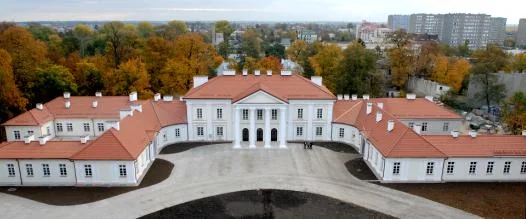
Ogiński Palace links the academy’s development with Siedlce’s architectural heritage. The university’s palace history records a restoration project beginning in the first quarter of 2005 and concluding in April 2008. At the turn of 2006/2007, the rectorate and university administration moved from 3 Maja Street to the palace at Konarskiego 2.
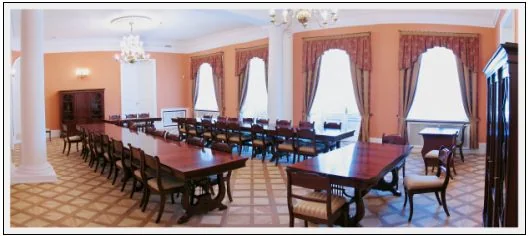
The restoration project also included development of the academy’s Institute of Computer Science. Following renovation, the palace accommodated university leadership and spaces for scientific conferences and exhibitions. The official archive illustrates the restored exterior and interior meeting rooms, preserving the connection between this building and the Akademia Podlaska period. The palace remains identified with the present university’s administration, bringing an important historic Siedlce building into the institution’s academic and cultural life.
Sources: Ogiński Palace history and restoration ↗