Visa

About Air University
A public university in Islamabad
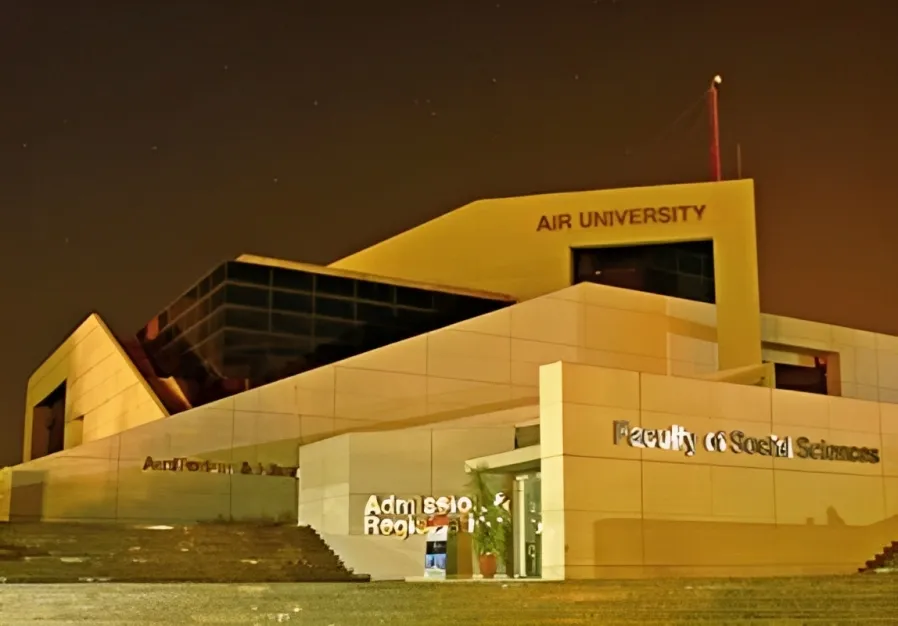
Air University is a federally chartered public-sector university established in Pakistan in 2002. Its main Islamabad campus is located in the PAF Complex in Sector E-9, near the Margalla foothills. The university’s official description places its entrance near the junction of Agha Shahi Avenue and Khayaban-e-Iqbal. Its academic development began with an emphasis on engineering and applied sciences and expanded into a wider range of disciplines.
The institutional timeline records the first classes beginning in September 2002 and the presidential signing of the university charter in October that year. The administration moved into a new block in 2003, and the university was formally inaugurated that June. Subsequent milestones included the first convocation in 2007, an initial project exhibition in 2008 and the opening of a student services centre. These stages show teaching, research activity and student support developing together.
Sources: University setting and foundation ↗ · University historical timeline ↗
Engineering and laboratory learning
The Faculty of Engineering’s institutional introduction connects its work with electronics, telecommunications, power, mechatronics and computer engineering. It also notes the presence of mechanical engineering within the university’s Institute of Avionics and Aeronautics. The faculty describes engineering education as a combination of classroom knowledge and practical work supported by laboratories.
Its educational account gives laboratory infrastructure an important role in developing students’ ability to handle equipment and apply ideas, rather than limiting learning to theoretical explanation. Faculty development and academic enrichment are also described as continuing activities. This combination places specialist technical knowledge, the development of teaching and practical learning within the same educational framework. Engineering is therefore one part of the university’s broader academic organization, with several related areas contributing to its technical profile.
Sources: Engineering faculty introduction ↗
Mathematics, physics and applied science
The Faculty of Basic and Applied Sciences is organized around mathematics and physics. Its official introduction describes study at bachelor’s, master’s and doctoral levels in these subjects. The faculty’s listed areas of specialization span both abstract and applied work, demonstrating the range of questions addressed within its mathematical and physical-science departments.
Mathematical interests listed by the faculty include topology, numerical analysis, modelling and simulation, cryptography and image processing. Other areas include materials science, radiation physics, solar energy and computational fluid dynamics. These fields connect mathematical methods with problems involving information, materials, energy and physical systems. The combination gives the faculty a role in scientific education as well as specialist research, alongside the university’s engineering and computing-related areas.
Sources: Basic and Applied Sciences faculty ↗
Library spaces and research resources
The Air University Central Library supports teaching, learning and research through printed and electronic material. Its official description identifies a dedicated multistorey library building, discussion rooms for group study, individual study carrels and computers for research. These different spaces accommodate both collaborative work and quieter individual investigation.
The collection includes books, periodicals and newspapers, while electronic journals and books are accessed through the Higher Education Commission’s National Digital Library programme. The library serves students, faculty and administrative staff and describes paid membership options for Pakistan Air Force personnel, academics and research scholars. Its services therefore connect the university’s own academic community with a wider group of readers and researchers. The emphasis on different formats reflects the range of materials used in higher education.
Sources: Air University Central Library ↗
Research support and industry connections
The Office of Research, Innovation and Commercialization, or ORIC, was established at Air University Islamabad in 2011 and registered with the Higher Education Commission in 2013. Its role is to connect university research groups with funding organizations and other partners, helping research activity develop beyond individual departments.
The office’s published account identifies support from organizations including HEC, IGNITE and the Pakistan Science Foundation. It also describes entrepreneurship-related seminars, workshops and training. Its website organizes information about funding opportunities, completed and ongoing projects, formal collaborations and innovation and commercialization. This provides an institutional framework for seeking support, sharing research activity and building relationships with industry and other stakeholders. Research administration and entrepreneurial learning are consequently linked within the university’s support structure.
Sources: Office of Research, Innovation and Commercialization ↗
Educational purpose and institutional values
The university’s mission places education and research alongside intellectual development and ethical conduct. It describes interdisciplinary collaboration with industry, government and international partners as part of its contribution to economic, technological and social development. Its vision also includes creativity, inclusion and sustainable development.
Four values are listed: integrity, ingenuity, diversity and devotion. These statements give a wider context to the technical and professional subjects taught at the university. They connect the pursuit of knowledge with the responsibilities involved in using it and with participation in a diverse academic community. The mission also identifies entrepreneurship and collaboration as directions for educational development, bringing independent initiative and work with others into the university’s account of its purpose.
Sources: University vision, mission and values ↗
A wider academic network
Air University’s current website presents Islamabad as the main campus within a wider Pakistani campus network. It also identifies campuses in Multan, Kamra, Kharian, Karachi and Bahu. The institutional navigation distinguishes campuses from constituent and affiliated institutions, reflecting several forms of educational organization within the university’s wider system.
The current academic navigation covers aerospace and strategic studies, engineering, basic and applied sciences, computing and artificial intelligence, social sciences, management and health sciences. Research links include journals devoted to corpus linguistics, language and literature, and business and economics. This range shows an academic identity extending beyond its original engineering emphasis into scientific, social and professional fields.