Visa
About Agricultural University of Szczecin
The agricultural university and its successor
The Agricultural University of Szczecin was the Polish institution known as Akademia Rolnicza w Szczecinie. Its origins date to 17 July 1954, when the Higher School of Agriculture was established in the city. It adopted the agricultural university name on 1 October 1972, marking an important stage in the development of agricultural higher education in the region.
On 1 January 2009, it merged with the Szczecin University of Technology to form the West Pomeranian University of Technology in Szczecin, abbreviated ZUT. The former agricultural university is therefore a historical predecessor of today's institution. It does not continue as a separate university with its own present-day admissions.
ZUT's statute explicitly recognizes the academic heritage of both predecessor institutions and the responsibility to preserve it. For the agricultural university, that heritage includes scientific work and professional education connecting farming, animal science, fisheries, food and the economic organization of production. Its contribution remains visible in the histories of departments, faculties and collections now within ZUT.
Sources: ZUT statute: institutional heritage and establishment ↗
Animal breeding and genetics
A department of general animal breeding was established within the Higher School of Agriculture in 1955. Professor Zdzisław Śliwa organized the unit and became its first head. In 1967, it took the name Department of Genetics and General Animal Breeding, bringing genetics explicitly into its academic identity.
That name continued through the 1972 transition to the agricultural university and through the 2009 creation of ZUT. Specialized laboratories included molecular genetics and the genetic foundations of biotechnology. The latter operated from 1998 to 2019, spanning the two institutional periods. The unit became the Department of Genetics in 2021. Its history provides a clear example of continuity: a field established within the original agricultural school developed new specialisms and continued within the successor university.
Sources: History of the genetics department ↗
Economics and the organization of food production
The economics faculty traces its roots to political economy and mathematics departments formed in 1954. Agricultural enterprise economics and organization followed in 1956, while a fisheries-economics department developed within the marine fisheries faculty in 1966. These units supported study of management, decision-making and mathematical methods in the food economy.
An interfaculty institute concerned with economics, organization and management was established in 1973. It brought together work on agricultural enterprises, fisheries, animal production, computing, accounting and agricultural policy. Field-based research was also carried out in agricultural enterprises, providing settings for investigations and master's work.
A separate Faculty of Economics and Organization of the Food Economy was created in 1987 within the Agricultural University of Szczecin. Its first academic-year inauguration followed in 1988, and its first graduates completed their studies in 1993. The development of this faculty shows the institution's interest in how agricultural and food-related activity was organized, managed and studied economically.
Sources: History of the economics faculty ↗
Fisheries and food sciences
The fisheries tradition had a different geographical beginning. A fisheries faculty was established at the Higher School of Agriculture in Olsztyn in 1951. It moved to Szczecin in 1966 and entered the structure of the local agricultural school, later the agricultural university. Its subject interests developed across fisheries, aquaculture, food technology, human nutrition and microbiology.
The Faculty of Food Sciences and Fisheries name was adopted in 2002, before the 2009 merger. ZUT's anniversary account includes recollections from former students and staff, giving the history a social as well as an academic dimension. Those recollections describe accommodation, cultural activity and experiences of practical study. The faculty's continuing history illustrates how an academic field could move between institutions, develop new subjects and retain a recognizable community of graduates and teachers.
Sources: Food Sciences and Fisheries:70th-anniversary history ↗
A library grown from the agricultural tradition
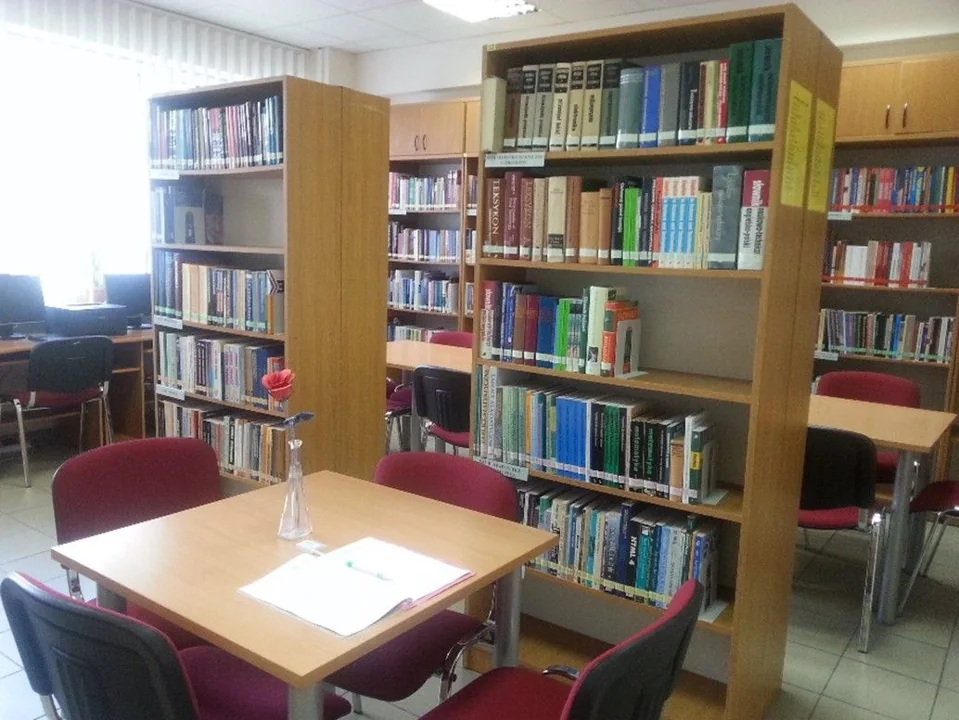
The faculty-library history records a marine fisheries reading room operating from 1980. As food technology developed, a separate collection was needed to support its students and teachers. A new faculty building received library space in 1999, and the new library opened to users in the early months of 2000.
Its initial collection drew on departmental resources, the agricultural university's main library and the fisheries reading room. It subsequently grew through purchases, journal subscriptions, donations and exchange. After the 2009 merger, the faculty library became part of ZUT's library and information system.
The official history describes later computerization, open-access shelving and refurbished study space. Its collections cover food technology, nutrition, fisheries and related sciences, alongside access to electronic books, journals and databases. These successor-era services continue a collection-building tradition that began within the agricultural university, while reflecting changes in how students and researchers find and use academic information.
Sources: Two histories,one future: faculty-library history ↗
The present university context
Today's ZUT combines engineering with agriculture, economics, life sciences and other fields. Its official international introduction describes first-cycle, second-cycle and doctoral study, together with postgraduate provision. Agricultural subjects therefore sit within a broader technological university created by the union of the two predecessor institutions.
The university's buildings are distributed across Szczecin rather than gathered on a single central campus. Its faculty structure includes biotechnology and animal sciences, environmental management and agriculture, food sciences and fisheries, and economics, alongside engineering and technological fields. This contemporary setting helps explain where the agricultural university's academic traditions continued after 2009. The current provision belongs to ZUT, while the former name identifies the institution that contributed those traditions to the merger.
Sources: Welcome to the successor university,ZUT ↗