Visa
About Agricultural University of Cracow
The university behind the Cracow directory name
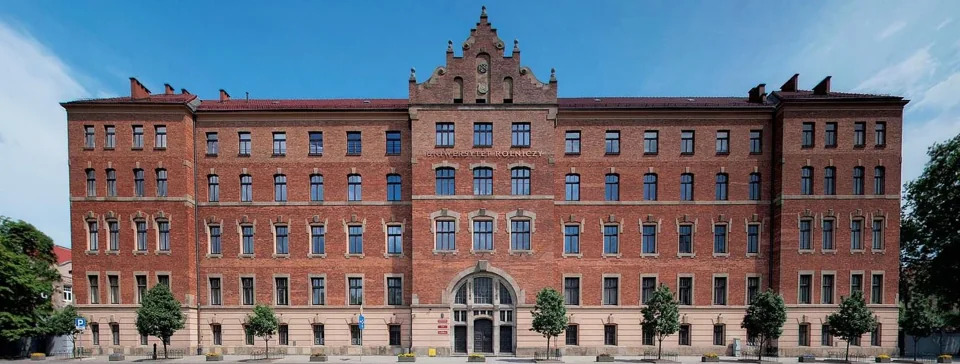
The Agricultural University of Cracow entry refers to the institution now presented in English as the University of Agriculture in Krakow, or URK. Its full Polish name is Uniwersytet Rolniczy im. Hugona Kołłątaja w Krakowie. Cracow and Krakow are alternative English renderings of the same city, and this profile concerns that university rather than a separate institution. Its main administrative headquarters is at Aleja Mickiewicza 21 in Kraków, Poland.
The university’s history distinguishes its independent establishment from the older tradition of agricultural teaching from which it developed. A three-year agricultural course began at Jagiellonian University in 1890 and became a Faculty of Agriculture in 1923. After wartime disruption and the resumption of teaching, that faculty provided the basis for the Higher School of Agriculture established in 1953. The institution became an Agricultural Academy in 1972, received the name of Hugo Kołłątaj in 1978 and acquired its present university status in April 2008. These changes link the current university with successive forms of agricultural higher education in Krakow.
Sources: Institutional history ↗ · Official accessible university introduction ↗
An academic mission across agriculture and the environment
URK is a public higher education institution whose mission covers agriculture, food, forestry and environmental protection and management. It approaches these fields through natural science, technology, social questions and economics. Its stated purpose includes developing and sharing knowledge and creating innovations connected with food security, climate neutrality and an economy using biological materials and processes.
The mission emphasises cooperation with businesses, social organisations, public administration and local government, alongside international academic collaboration. Teaching is intended to connect current scientific knowledge with practical technical skills and social competence. The university also identifies humanism, freedom, tolerance, ethical standards and openness to others as academic values. Its patron, Hugo Kołłątaj, is presented as an educational reformer whose intellectual legacy connects the institution with the history of the Krakow Academy. The mission therefore combines specialist professional fields with a broader account of the responsibilities of a university community.
Sources: Mission of the university ↗
Academic fields and locations
The university’s official introduction describes academic units concerned with agriculture and economics, forestry, animal science, environmental engineering and geodesy, biotechnology and horticulture, production and power engineering, food technology and veterinary medicine. These fields bring the study of living organisms together with land management, engineering, food production and economic decision-making. Doctoral education forms part of its activities alongside other university study.
URK’s teaching and research premises are distributed across several locations. In addition to buildings in Krakow, its official introduction identifies facilities in Prusy, Garlica Murowana and Krynica-Zdrój. The institution consequently has a physical presence extending beyond its central administrative building. This geographical spread is part of its organisation as a university with agricultural, environmental and related scientific interests.
Doctoral education and individual investigation
The Doctoral School describes its purpose as developing research competence, interdisciplinary education and scientific independence. Its published fields include agriculture and horticulture, forestry, nutrition and food technology, animal science and fisheries, and biological science. Engineering subjects encompass civil engineering, geodesy and transport, mechanical engineering, and environmental engineering, mining and energy. Economics and finance and veterinary science also appear in the school’s scope.
Education combines a structured programme with an individual research plan and concludes with the submission of a doctoral dissertation. The school describes an eight-semester course of education. Its curriculum page relates learning outcomes to level eight of the Polish Qualifications Framework and publishes programme and course documents, including material for European Horticulture, known as EUROHORT. The combination of common educational requirements and an individual plan provides an organised framework for pursuing a specific research subject.
Sources: Doctoral School purposes and tasks ↗ · Doctoral School education programme ↗
Moving research towards practical use
The Technology Transfer Centre is a university unit focused on connecting science with business. Its stated tasks include commercialising research results, protecting intellectual property and building cooperation networks that facilitate the movement of knowledge and technology into economic activity. It also undertakes national and international projects concerned with scientific development and business competitiveness.
The centre’s account identifies participation in the Polish association of academic technology transfer centres, PACTT. That network provides a setting for exchanging knowledge, experience and working practices and representing the interests of university technology transfer units. URK also identifies membership in the Life Science Krakow cluster, whose activities concern entrepreneurship, innovation and the commercialisation of research and development. Within the university, an intellectual property commission addresses relevant disputes, provides opinions and helps shape institutional policy. These arrangements show how the use of research involves legal, organisational and collaborative work as well as scientific investigation.
The centre also has a supervisory council with advisory responsibilities. Its remit includes considering directions of activity, reviewing annual and longer-term plans and receiving reports on the centre’s work. This provides an institutional structure for overseeing the relationship between research and its practical application.
Sources: Technology Transfer Centre: about ↗
Learning through visits and shared experience
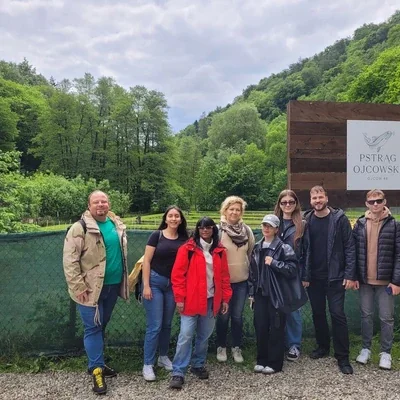
The university’s official gallery records activities that take participants beyond the campus. One documented example is a study visit to the Ojcowski Trout Farm, presented in its English-language photograph collection in 2025. The photographs show a group visiting the farm and its outdoor setting. Such records provide a concrete view of the university’s educational community engaging with a setting connected to food production, complementing the academic subjects and research activities described elsewhere in its institutional information.
Sources: Study visit to the Ojcowski Trout Farm: official gallery ↗