Visa


About Afghan University
Institutional identity and educational purpose
Afghan University is the public website name of the Afghan Institute of Higher Education, an Afghan private higher education institution. Its official Pashto introduction describes its establishment through the joint efforts of the Afghan Foundation and national business supporters. The history records a Ministry of Higher Education activity licence in Solar Hijri year 1391, with registration number 311 and serial number 63. Its stated educational structure comprises four faculties: Sharia, Law and Political Sciences, Economics, and Engineering. The institution's public motto connects its work with service to religion and the country.
The institution's mission combines teaching and research with Islamic and academic values. Its published objectives include developing research that responds to social and economic needs, preparing knowledgeable and responsible graduates, and connecting religious and contemporary education. Commitment, adherence to principles and transparency are identified among its institutional values. The introduction describes teaching through a credit-based system and identifies Pashto and Dari as principal teaching languages, with Arabic or English used where needed. These features place its academic work within the linguistic and educational context of Afghanistan.
Sources: Institutional introduction ↗ · Vision, mission and values ↗

Sharia and Islamic education
The Sharia faculty traces its activity to the institution's establishment in Solar Hijri year 1391. Its faculty description presents an eight-semester course over four years, organised through two departments: Jurisprudence and Law, and Islamic Education. The first concentrates on jurisprudence, principles of jurisprudence and related legal interpretation. The second gives greater attention to belief, Quranic interpretation, hadith and the principles used in studying hadith. These related departments provide different emphases within the faculty's religious and legal education.
The broader faculty description also identifies Islamic culture, history, civilisation and religious communication among its subject interests. Its published aims include close study and analysis of religious, jurisprudential and judicial questions. Teaching and research are presented together, with an emphasis on professional responsibility and service. The faculty's organisation therefore combines foundational religious texts and interpretive methods with the study of their relationship to legal and social questions.
Sources: Sharia faculty profile ↗ · Sharia departments ↗
Law and political science
The Law and Political Sciences faculty also describes a four-year, eight-semester credit-based programme. It contains separate departments for Law and Political Science. The Law department's published curriculum areas include domestic and international law, public and private law, crimes and penalties, court procedures and principles of legislation. The Political Science department identifies international relations, politics, diplomacy, the state and national and international institutions as its main areas of study.
The faculty places research, debate, reasoned argument and practical skills alongside teaching. Its stated objectives include developing analysis grounded in evidence and increasing understanding of the role of law and responsibility in society. This description gives its programmes an emphasis on how institutions operate as well as the texts and principles that govern them. Legal and diplomatic education are presented as related contributions to the country's professional and public life.
Sources: Law and Political Sciences faculty profile ↗ · Law and Political Sciences departments ↗
Economics and business administration
The Economics faculty offers departments in Business Administration and National Economy. Its published profile describes a four-year programme across eight semesters. The Business Administration department focuses on financial affairs, human resource management and marketing. National Economy covers economic growth, economic policy, international economics, statistics, taxation and general economics. These areas distinguish the management of organisations from the wider study of economic systems and policy, while retaining shared interests in finance and the use of economic information.
Islamic economics and banking are specifically identified among the faculty's educational priorities. Its mission also refers to research into economic problems and sharing findings with relevant organisations. The faculty description presents language development as part of its teaching structure, with Pashto and Dari used in the earlier part of the published course and English identified for later study. Its wider purpose is to connect economic knowledge, professional skills and questions arising from the country's social and business environment.
Sources: Economics faculty profile ↗ · Economics departments ↗
Civil and electrical engineering
The Engineering faculty identifies civil and electrical engineering as its two departments. Its civil engineering description covers the use of physical principles, mathematics and mechanics in the design, construction and maintenance of infrastructure. Examples include buildings, dams, bridges, tunnels, roads and water supply systems. The department also discusses the use of available resources and attention to time, costs and environmental considerations in construction projects. These topics connect theoretical knowledge with practical planning and engineering decisions.
Electrical engineering is described through three principal areas: energy, electronics and communications. The departmental account includes theoretical lessons alongside practical teaching and fieldwork, with curriculum review intended to reflect changing needs. Across the faculty, the published objectives include research in civil and electrical engineering, practical work and experiments, professional ethics and the application of scientific knowledge. This gives engineering a place within the institution's broader emphasis on professional education and service.
Sources: Engineering faculty profile ↗ · Engineering departments ↗
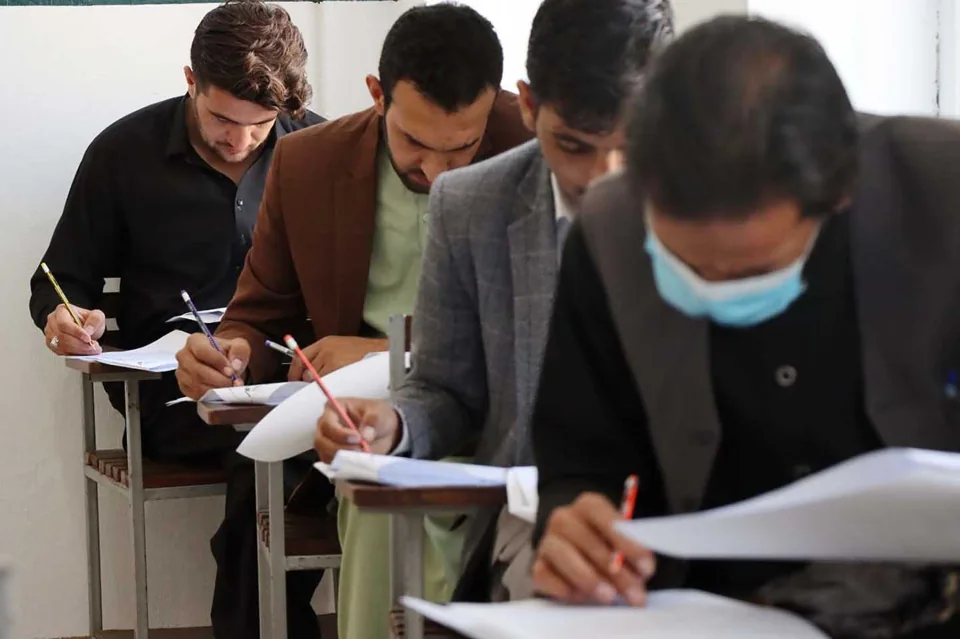
Research and the published learning environment
The Scientific Research Centre's description identifies scholarly articles, authored books and translations of useful works among its activities. It seeks to respond to national needs and describes an intended audience extending beyond universities to religious schools and other academic centres. The institution's introduction also records a library, computer laboratory, internet facilities and a hall for seminars and academic meetings among its educational resources. Together, these published descriptions show an institutional model combining faculty teaching, written scholarship and spaces for study and discussion. They are an account of the institution's documented educational provision rather than a statement about present-day access to particular facilities.
Sources: Institutional introduction ↗ · Scientific Research Centre ↗