Visa


About Adelaide University
A new university with shared foundations
Adelaide University is a new South Australian institution bringing together the University of Adelaide and the University of South Australia. It began operations in January 2026, following the establishment of its legal entity in March 2024 under the Adelaide University Act 2023. The two foundation universities contribute their communities, facilities and academic experience to the new institution. Adelaide University's own history therefore begins with its creation and opening, while the earlier achievements of its predecessors form the foundations on which it builds.
The university's January 2026 welcome publication presents education, research and community engagement as connected parts of its purpose. Its teaching approach is designed to accommodate students who combine study with employment, caring responsibilities and other commitments. The publication describes flexible study structures, pathway programmes and online education within the Adelaide Attainment Model. Academic support, wellbeing services and opportunities to connect with peers accompany this approach, recognising that the experience of university extends beyond individual classes or examinations.
Sources: About Adelaide University ↗ · Welcome! Introducing Adelaide University, January 2026 ↗ · Establishment of Adelaide University, annual report ↗
Six colleges and a broad academic range
Academic activity is organised into six colleges: Business and Law; Creative Arts, Design and Humanities; Education, Behavioural and Social Sciences; Engineering and Information Technology; Health; and Science. Each brings together discipline-based schools. This structure allows the university to cover professional subjects, creative practice, scientific investigation and the study of societies within a common institution. Schools provide a more specific academic home for students and researchers while the colleges connect related areas of teaching and discovery.
The Business and Law college includes accounting and finance, economics, law, management and marketing. Creative fields encompass architecture, communication, art and design, humanities and the Elder Conservatorium of Music and School of Performing Arts. Education, psychology, social work and social care are represented alongside society and culture. Engineering and information technology form another substantial area. The structure gives students access to distinct disciplinary communities while creating opportunities for researchers to work across the boundaries between established subjects.
Sources: Colleges and schools ↗
City and suburban campuses
Adelaide City Campus combines eastern and western precincts along North Terrace. The western precinct includes creative studios, the Architecture Museum and SASA Gallery, close to the city's biomedical research area. The eastern precinct lies beside the Adelaide Botanic Gardens and includes historic university buildings. Libraries, individual and group study spaces, student lounges and collaborative areas support learning across both precincts. Sports facilities at Adelaide City West include a heated swimming pool, a gym, courts and a climbing wall. Adelaide City East also has gym facilities and outdoor sporting fields. Campus support includes career counselling, wellbeing assistance, mentoring and access and inclusion services. Galleries and nearby cultural institutions also connect campus life with Adelaide's wider artistic and public life.
Mawson Lakes provides a different environment, alongside wetlands and neighbouring Technology Park. Its laboratories and workshops support practical study, while its library and student lounges offer spaces for independent and informal learning. The Adelaide Planetarium is located on this campus and provides an interactive setting for exploring astronomy. The university's campus network also includes Magill, Roseworthy, Waite, Mount Gambier and Whyalla, extending its presence from metropolitan Adelaide into regional South Australia.
Sources: Adelaide City Campus ↗ · Mawson Lakes Campus ↗ · Welcome! Introducing Adelaide University, January 2026 ↗

Agriculture, plant science and shared research facilities
Waite Campus, in the Adelaide foothills, specialises in an environment shaped by agriculture, horticulture and viticulture. Its laboratories and greenhouses support practical learning, and its library collections cover plant biotechnology, agriculture, wine science and related subjects. The campus also houses industry partners working in these fields. The Waite Arboretum occupies 27 hectares and contains about 2,500 specimens representing more than 800 plant species. This living collection sits alongside the teaching and research spaces, giving the campus a distinctive relationship between cultivated landscapes and scientific activity.
Shared research infrastructure supports work across the university. Adelaide Microscopy provides microscopy and microanalysis facilities, while OptoFab Adelaide offers specialist optical-glass fabrication and fibre-related capabilities. Plant SynBio Australia supplies infrastructure and expertise for plant synthetic biology. Other listed facilities include Adelaide RNA and a central biobank for securely housing research material. The facilities directory also identifies partnerships with nationally supported research infrastructure, connecting university researchers and external organisations with specialised equipment and services.
Sources: Waite Campus ↗ · Research facilities ↗
Libraries, First Nations knowledge and student support
The university library brings together books, journals, articles, databases and other resources through a common search service. Its online guidance covers referencing, study, teaching and research, with education and training services alongside collections. Students can book study rooms and use libraries across the campus network. City locations include the Barr Smith Library, Brookman Library, Law Library and Jeffrey Smart Library. The university also maintains library provision at campuses such as Magill, Mawson Lakes, Roseworthy and Waite.
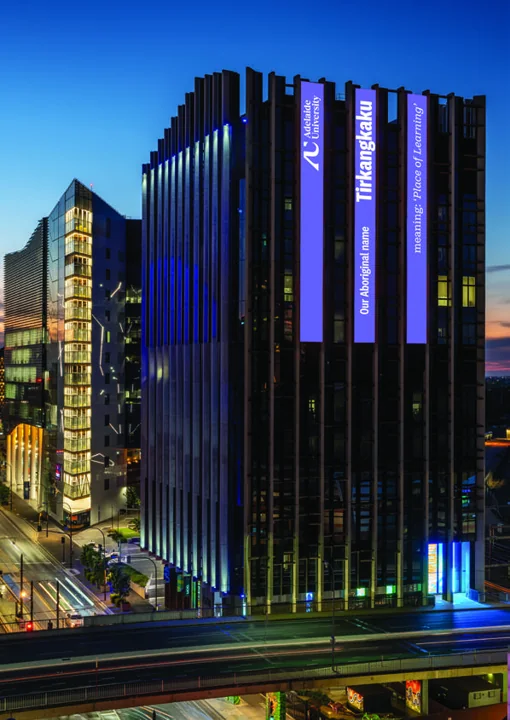
Adelaide University bears the Kaurna name Tirkangkaku, meaning Place of Learning. Its First Nations work emphasises relationships with Aboriginal and Torres Strait Islander Peoples and communities across teaching, research and governance. Dedicated student services include the Elevate tutoring programme and study spaces, alongside scholarships and access pathways. The university acknowledges the Kaurna, Boandik and Barngarla First Nations Peoples as Traditional Owners of the lands where its South Australian campuses are located, placing these relationships within the identity of the new institution.
Sources: University Library ↗ · First Nations at Adelaide University ↗ · Welcome! Introducing Adelaide University, January 2026 ↗