Visa
About Academy of the Social Sciences in Australia
An independent learned academy
The Academy of the Social Sciences in Australia is an independent membership organization and national peak body for the social sciences. Established in its academy form in 1971, it brings together elected Fellows whose work spans universities, research institutes and policy agencies. Its activities concern research, public policy, scholarly exchange and education. The national office is in Turner in the Australian Capital Territory, with a Canberra postal address.
The organization’s origins extend further back. A Social Science Research Committee was established within the Australian National Research Council in 1943. It became an autonomous Social Science Research Council of Australia in 1952, and the new council first met in 1953. The council recommended adopting the academy form in 1970; incorporation followed on 7 July 1971, with its members becoming Fellows. This history connects the present academy with a longstanding effort to organize and advance Australian social science research.
Sources: About the academy and its history ↗
The fields represented by the Fellowship
The academy understands the social sciences as a broad study of people, institutions, structures and histories. Its disciplinary scope includes society, politics and culture, encompassing sociology, anthropology, geography, Indigenous studies and linguistics. Business and economics form another major grouping, with commerce, management, accounting and tourism included. History, philosophy and law sit alongside education, psychology and public health.
Its published disciplinary list uses the Australian and New Zealand Standard Research Classification of 2020 to identify fields relevant to Fellowship and grant and award programmes. Examples extend from econometric methods and education systems to archaeology, demography, development studies, human geography and social work. This breadth provides a basis for bringing different methods and kinds of expertise into a shared discussion of social questions.
Sources: About the social sciences ↗
Supporting research through workshops
The Workshops Program provides assistance for multidisciplinary meetings that advance research and policy agendas on issues of national importance. Its purpose includes developing new ideas, strengthening the capabilities of younger researchers and building networks across disciplines. It also encourages connections with practitioners in government, private organizations and the community sector. The emphasis is on focused scholarly collaboration around a shared problem.
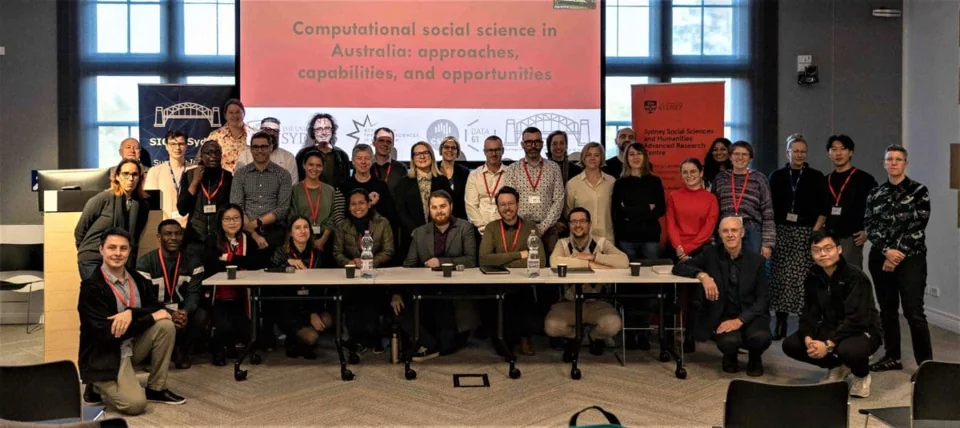
The programme is open to social science researchers across Australia, with an Academy Fellow required as a co-convenor. Its guidance encourages a mix of disciplines, career stages and stakeholders rather than a narrowly defined participant group. International researchers can contribute, while funded workshops take place in Australia. The programme’s published example of computational social science at the University of Sydney in June 2022 illustrates this approach. Its workshop reports and previous-recipient lists cover subjects ranging from artificial intelligence and housing to environmental governance, education and Indigenous knowledge.
Sources: Workshops Program ↗
Connecting research with public policy
The academy organizes its policy activity into three streams. Roundtables and forums convene people from different sectors and disciplines for evidence-based conversations about national priorities. Submissions and briefings offer targeted written advice during government inquiries and reviews. Projects and collaborative initiatives bring the academy together with government, research institutions and other partners on more substantial programmes of work.
The published policy remit covers both the social science system itself and the application of social science to broader challenges. It includes assessing the implications of proposals for teaching and research, supporting research infrastructure and contributing to discipline plans. The academy identifies independence, transparency and evidence as standards for its advice. A policy committee provides strategic guidance, while the Canberra-based policy team coordinates activity and engagement with researchers and partners. These arrangements connect the Fellowship’s disciplinary expertise with formal routes into public decision-making.
Sources: Policy ↗
Education through Seriously Social
Seriously Social is the academy’s education initiative for teachers and students. It provides freely available resources designed to support teaching and learning in the social sciences. Academy Fellows inform and review the resources in their areas of expertise, while collaboration with teachers, students and curriculum authorities helps connect the material with classroom needs. The initiative translates research knowledge into resources for school education.
Its modules include educational videos, reading materials, differentiated classroom activities, teacher guidance and assessment tools. The academy describes these resources as curriculum aligned and accessible to educators and parents through online platforms. The programme also seeks to address shortages of specialist social science teachers, strengthen participation across social science subjects and develop information about career pathways. An education committee advises on this work, and the academy’s education team develops resources and partnerships to expand the initiative.
Sources: Education and Seriously Social ↗
Reconciliation and First Nations knowledge
The academy’s reconciliation vision centres on recognition of Aboriginal and Torres Strait Islander knowledge systems and custodianship. It links this vision with representation in education, research and leadership, including the election of First Nations scholars to the Fellowship. Its public statements acknowledge Traditional Owners and continuing connections with lands, waters and communities.
The academy launched its first Reflect Reconciliation Action Plan in June 2021 and an Innovate plan in June 2024. Its account describes these plans as frameworks for relationships, organizational learning and practical action. Communications and events highlight Aboriginal and Torres Strait Islander social scientists and their contributions. The academy also commissioned artwork from Indigenous design agency ingeous studios to express inclusion, knowledge sharing and understanding within its work.
Sources: Reconciliation ↗