Visa
About Adam Mickiewicz University in Poznań
A university rooted in Poznań
Adam Mickiewicz University in Poznań is a multidisciplinary university in western Poland. Its teaching and research encompass the humanities, social sciences, natural sciences and life sciences. The institution’s identity is closely connected with Poznań and the wider Wielkopolska region, while its mission also emphasises international academic cooperation. It takes its name from Adam Mickiewicz, the Polish Romantic poet whose name was adopted by the university in 1955.
The modern university was established in 1919, after Poland regained independence. Initially called Wszechnica Piastowska, it became the University of Poznań in 1920. The institution places this foundation within a much longer local tradition, including the Lubrański Academy of 1519 and the Jesuit College founded in 1573. These earlier institutions form part of the city’s academic heritage rather than an uninterrupted history of the present university. During the Second World War, clandestine university teaching continued through the University of the Western Lands. In 2019 AMU marked its centenary alongside three other universities that developed from the former University of Poznań.
Sources: University history ↗ · Mission statement ↗
Research, teaching and public purpose
The mission statement treats research and teaching as connected activities. It calls for study informed by both established scholarship and new investigations, with interdisciplinary work and internationalisation contributing to the development of courses. Students’ ability to shape their own educational paths is also part of this account. Rather than limiting the university’s role to awarding qualifications, the statement describes a community comprising researchers, students, doctoral candidates, technical staff and administrators.
AMU also presents itself as a contributor to the cultural and intellectual life of its city and region. Its mission includes cooperation with business, lifelong learning and participation in joint international research and educational programmes. Independent thought, freedom of academic discussion, human rights, democracy and tolerance appear among its declared values. This framework links specialist scholarship with a wider responsibility towards society and cultural heritage.
Sources: Mission statement ↗
Three campus settings
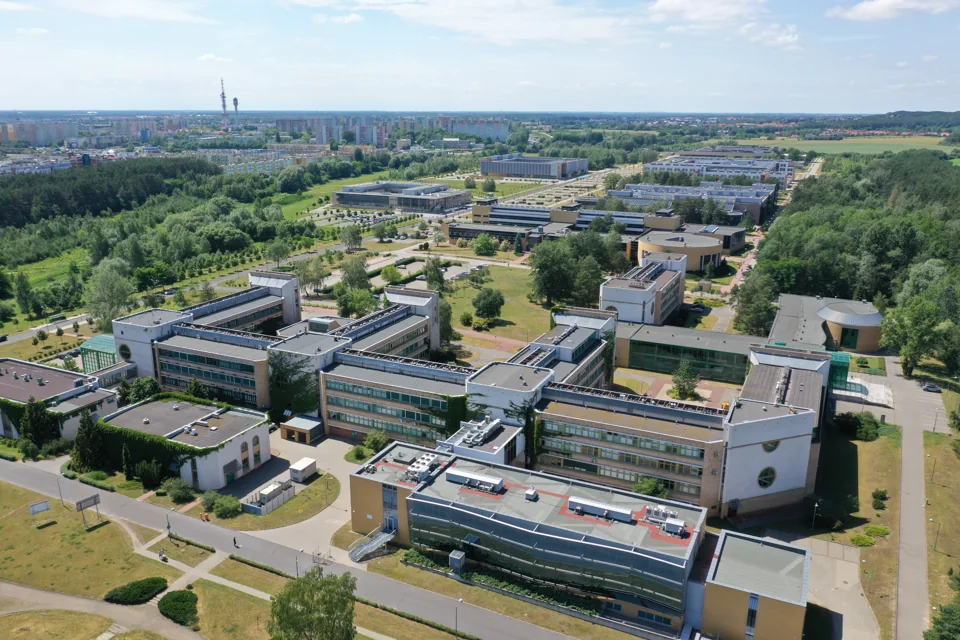
University life in Poznań is distributed across three principal campus areas. Morasko, in the northern part of the city, brings together facilities serving numerous scientific and humanities disciplines. The campus description includes biology, chemistry, mathematics and computer science, geographical and geological sciences, history, archaeology, political science and journalism, and human geography and planning. This setting places teaching facilities from different fields within a broad academic district.
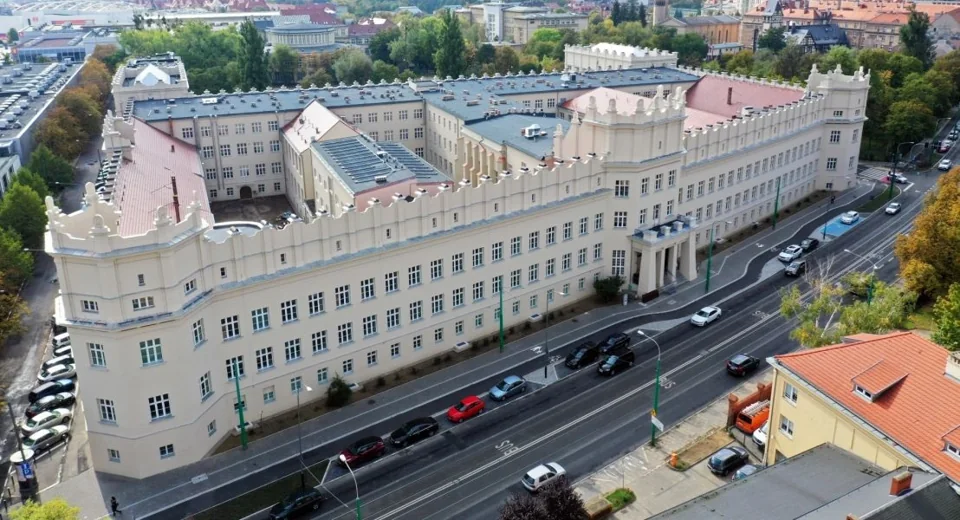
The downtown, or Śródmiejski, campus consists of buildings in and around the city centre. Subjects represented there include English, modern languages, Polish and classical philology, law and administration, and arts studies. Ogrody, also known as Szamarzewo, accommodates educational studies, anthropology and cultural studies, philosophy, sociology, and psychology and cognitive studies. Its park surroundings provide outdoor space between classes. The campus account also identifies a building on Międzychodzka Street used for language classes and other study activities.
Sources: Campuses ↗
Languages and life sciences
The Faculty of English illustrates the university’s combination of language education and research. Its programme overview includes English Studies and Dutch Studies, alongside specialised study involving linguistics, literature, culture and combinations with Celtic or Chinese studies. Students can participate in reading groups exploring topics such as phonology, syntax, lexicography, translation and British or American literature. The faculty also describes experimental work concerned with language and cognition. Its scholarly publications include Studia Anglica Posnaniensia and Poznań Studies in Contemporary Linguistics.
At Morasko, the Faculty of Biology connects biological education with research ranging from molecules to ecosystems. Its areas include genetics, biochemistry, microbiology, cell biology, plant and animal physiology, and relationships between organisms and their environments. Evolutionary perspectives and computational methods also inform this work. Collections include a herbarium and zoological and skeletal material. Specialist facilities described by the faculty include electron and confocal microscopy, molecular biology techniques and biological spatial information. Staff and students also conduct environmental research at the monitoring station in Jeziory.
Sources: Faculty of English ↗ · Faculty of Biology ↗
Libraries and scholarly materials
The library network combines the University Library in Poznań with subject-focused faculty libraries. This arrangement supports the different ways disciplines use books, journals, maps, reference works and electronic materials. The Collegium Geographicum library, for example, provides geographical and geological literature as well as digital and printed maps. Collegium Historicum covers fields including history, archaeology, ethnology, art history and musicology, with additional holdings of older printed and audiovisual materials.
Other collections serve modern languages, mathematics and computer science, law, political science and the sciences. The Law and Administration library describes both physical and digital access, together with guidance in using information resources and support for research. These specialised services give students access to materials organised around their academic field, complementing the university’s wider library resources.
Sources: University and faculty libraries ↗
Polish language and cultural learning
The university’s Polish language teaching centre for international students was established in 1985 within the Institute of Polish Philology. Its courses address different proficiency levels and bring together participants from varied national and cultural backgrounds. The centre describes language learning as an opportunity for exchanging ideas and experiences as well as developing communication skills. Teachers work with multicultural groups, connecting formal language instruction with the experience of meeting other learners in Poznań.
Sources: School of Polish Language and Culture for Foreign Students ↗