Visa

About Acatech
Germany’s national engineering academy
Acatech is Germany’s National Academy of Science and Engineering. It brings expertise from science, industry and civil society into discussions about technology and innovation. Its mandate from the Federal Government and the Länder centres on contributing scientific knowledge to policymaking and public debate. Its work takes the form of expert collaboration, publications and dialogue about strategic technological questions.
The academy’s interests range from resources and energy supply to emerging technologies, qualified specialists and communication about science. Joint project groups connect academic researchers with industrial research and development expertise. The academy presents the opportunities and risks of technological change and publishes the results of its work. Institutional funding from federal and state governments is complemented by project funding and donations.
At the international academy level, acatech represents Germany’s technological sciences through Euro-CASE in Europe and CAETS globally. These relationships place its national advisory work within a wider community of engineering and technology academies.
Sources: Mission ↗
From a technical sciences convent to national status
The modern organisation grew from a meeting held in Berlin on 21 November 1997. The resulting Convent for the Technical Sciences arose through an initiative of the Berlin-Brandenburg and North-Rhine-Westphalian academies. Günter Spur became its first chair, and its initial membership brought together engineering expertise from the founding academies.
A broader organisational foundation followed in February 2002, when the Convent for the Technical Sciences of the Union of the German Academies of Sciences and Humanities was established. Joachim Milberg chaired its board, with Franz Pischinger as deputy. The short name originally appeared as akatech before changing to acatech for international use. At the beginning of 2008, the organisation became a national academy supported by the Federal Government and Länder. Its development gave engineering sciences a dedicated national academy structure.
Sources: History ↗
An elected community of experts
Members come from engineering and natural sciences, medicine, humanities and social sciences. They participate in academy projects alongside external experts and contribute to discussions within topic networks. This combination allows technical questions to be considered together with their social and policy implications.
Membership is based on invitation through a structured nomination process. Existing members may propose candidates with supporting reasons, a curriculum vitae, publications and suggested referees. The Membership Committee reviews nominations and obtains references before presenting candidates to the Executive Board. Approved candidates are then proposed to the General Assembly for a vote. This process connects recognition of individual scientific achievement with participation in the academy’s collective work.
Sources: Membership ↗
Governance and thematic collaboration
The academy’s formal organisation includes the General Assembly, Topic Networks and Working Groups, Executive Board, Management Board, Senate and Board of Trustees. This framework combines the elected scientific community with bodies supporting the academy’s direction and operation.
Topic networks connect academy members with corporate experts. Their scope includes biotechnology and bioeconomy, energy and resources, healthcare technologies, information and communication technology, materials science, and mobility, logistics and aerospace engineering. Other networks address society and technology, nano and quantum technologies, product development and production, and safety and security. These groups discuss specific technical developments as well as broader questions of technology policy, providing settings for exchange across institutional and disciplinary boundaries.
Sources: Organisation ↗ · Topic networks ↗
Quality assurance for advice and publications
Quality procedures have accompanied the academy’s national role since 2008. They include review of project work, authorisation of results by the Executive Board, transparency about funding and publication of findings. These processes underpin the way collaborative expertise is developed into publicly available conclusions.
A quality management system was developed during 2012 and 2013, and the Executive Board approved the system and its guide in February 2014. The handbook was subsequently revised as the academy’s work evolved, including revisions in 2020 and 2022. The official account links these changes with efficient working methods, dependable quality assurance and timely results. The procedures form part of the academy’s institutional approach to science-based advice.
Sources: Quality management ↗
Learning to communicate technology
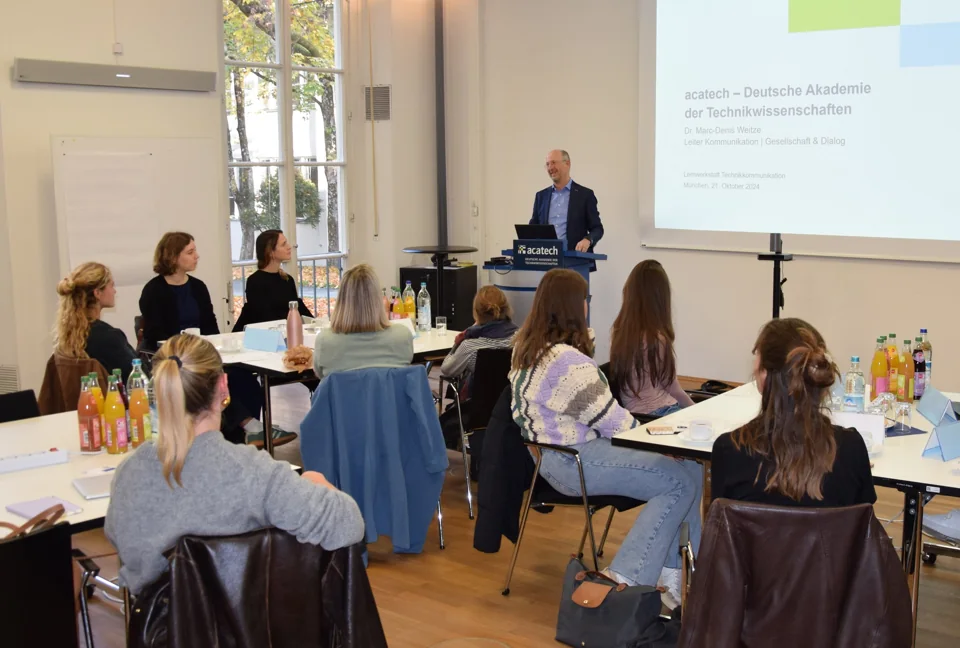
Acatech and Wissenschaft im Dialog organise a Technology Communication Workshop connecting participants from technology, communication and social sciences. The 2024 programme brought young participants to Munich for three days of lectures, discussion and practical work. It examined how researchers can explain their findings clearly while listening to the interests and concerns of different audiences.
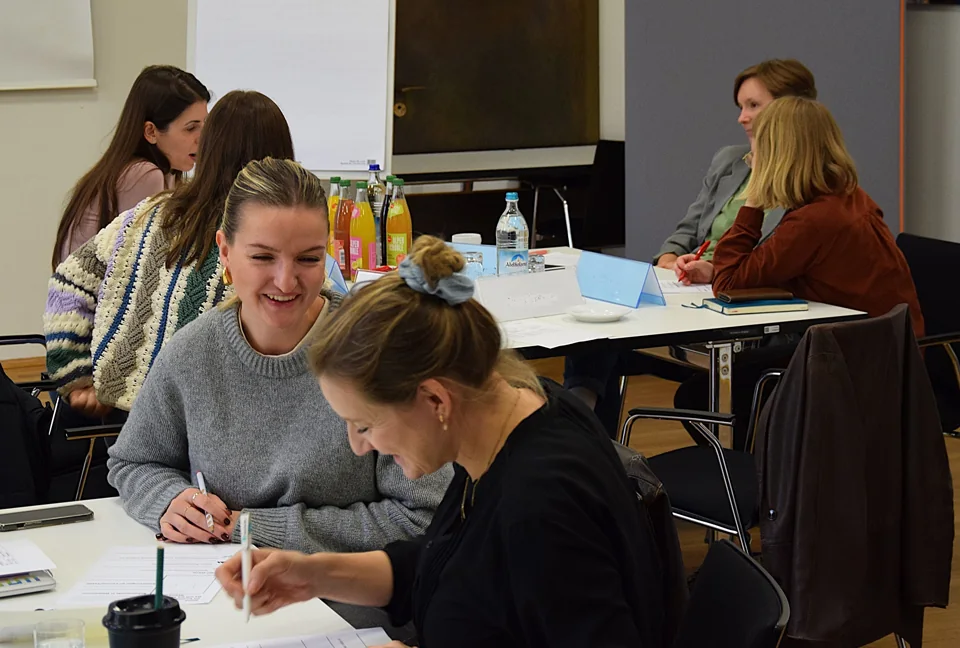
Sessions considered social science perspectives, robotics communication, university communication and the work of a science ministry. Discussion also addressed the independence of science-based policy advice and how interdisciplinary groups develop options for action. In a practical workshop, participants formulated social visions and related communication plans to intended effects. The event connected conceptual discussion with exercises on how communication can support meaningful exchanges between researchers and society.
Sources: Technology communication workshop 2024 ↗
Supporting international research encounters
International cooperation also includes opportunities for early-career researchers. On 3 and 4 September 2025, acatech hosted a preparatory meeting in Munich for the Japan–Germany Frontiers of Engineering Symposium. Participants exchanged expectations, discussed experiences and developed shared ideas before the planned symposium in Tokyo.
The preparation included an introduction to Japanese culture and guidance on interaction in scientific and business settings. The symposium’s announced theme concerned advanced materials and systems for a sustainable society. As a project partner and host of the preliminary meeting, acatech contributed a setting for researchers to build familiarity across disciplines and national contexts before their subsequent scientific exchange.