Visa
About Academy of Music in Łódź
A specialist music academy in Łódź
The Academy of Music in Łódź bears the names of Grażyna and Kiejstut Bacewicz, two musicians born in the city who also studied and taught within its musical institutions. Grażyna became known as a composer and violinist, while her brother Kiejstut was a chamber pianist, teacher and long-serving rector. The Academy combines musical creation, performance and education with stage arts and contemporary approaches to music production. Its concert activity brings students into orchestras, choirs, chamber ensembles, jazz groups, opera productions and dance performances.
The institution was established in 1945, drawing on the prewar conservatory tradition associated with Helena Kijeńska-Dobkiewiczowa. It continues to contribute to musical life in Łódź through public performances, specialist training and educational projects for younger audiences.
Sources: About the Academy ↗ · History ↗
Historical foundations and institutional development
Helena Kijeńska took over an existing music school in 1912. It developed into a music lyceum in 1917 and a conservatory in 1922. The conservatory attracted musicians who combined teaching with professional artistic work, helping establish a substantial local tradition before the Second World War. Wartime closure interrupted its official activities and led to the confiscation of instruments and library collections.
Classes at the postwar state conservatory began on 24 March 1945, followed by its formal inauguration on 18 April. Kazimierz Wiłkomirski became its first rector, with Kijeńska-Dobkiewiczowa serving as vice rector. The institution subsequently operated as the State Higher School of Music. It became an Academy of Music in 1982 and adopted the names of Grażyna and Kiejstut Bacewicz in 1999. The annual institutional celebration commemorates the March date when teaching resumed.
Sources: History ↗
Four faculties and varied musical pathways
The educational offer is organized across four faculties. The Faculty of Musical Creation, Interpretation, Education and Production lists composition, film-music composition, conducting and music theory alongside rhythmics, artistic education and music therapy. Its offer also includes music in the media, music-production management and sound engineering. This grouping connects musical ideas and teaching with the processes through which music is created, recorded and distributed.
The Faculty of Instrumental Performance covers piano, organ, church music, harpsichord and historical instruments, orchestral instruments, accordion and guitar. Stage Arts includes vocal and acting work, musical theatre, choreography and dance techniques, and somatics in dance and therapy. The Faculty of Jazz and Popular Music lists jazz instruments and jazz and popular singing. The Academy also identifies postgraduate opportunities in instrumental and vocal performance and a doctoral school within its educational provision.
Sources: Educational offer ↗
The historic palace as a working musical environment
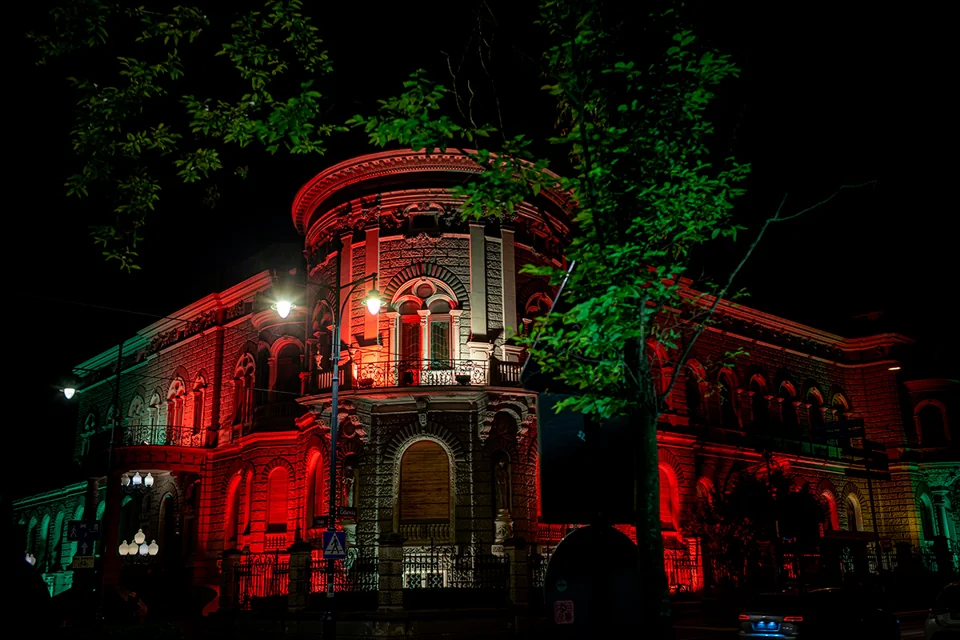
The main headquarters occupies Karol Poznański’s palace at 32 Gdańska Street. Built between 1904 and 1908 to a design by Adolf Zeligson, it combines Italian Renaissance and Baroque influences with Art Nouveau elements. Its recognizable corner projection, decorative interiors and surrounding garden give the Academy a distinctive architectural setting. Former reception rooms and dining spaces now accommodate concerts and teaching, while the attic contains practice rooms.
The palace has served the institution since its beginnings in 1945. Its current uses include concert, lecture and practice spaces, the Electronic Music Computer Studio and an electroacoustic laboratory, as well as university leadership and administration. Additional practice rooms occupy the former guardhouse. The building therefore remains part of everyday artistic work rather than serving solely as a historic landmark.
Sources: Palace ↗
Concert Hall and technical resources
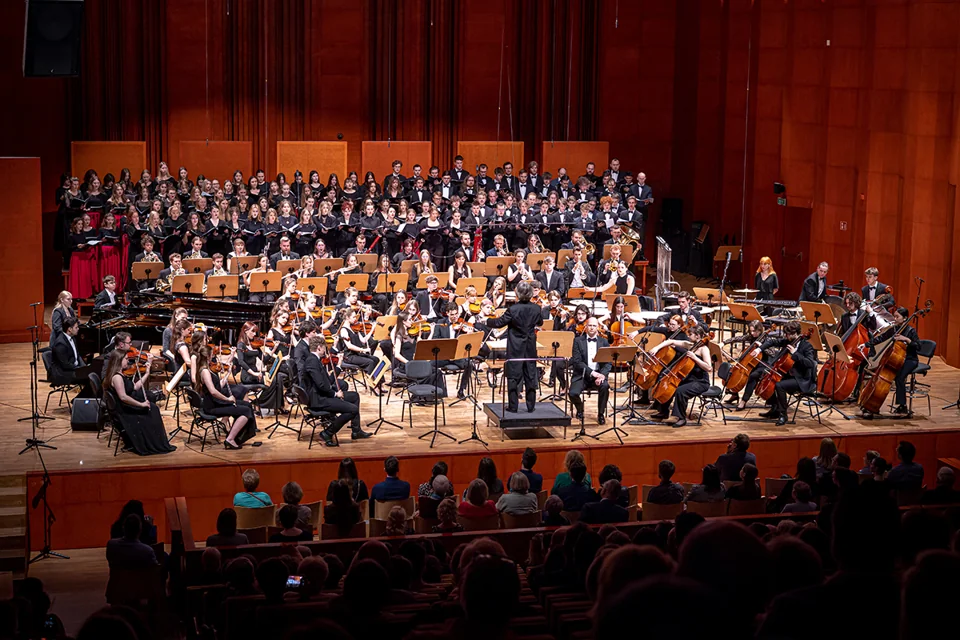
The Academy opened its modern Concert Hall in October 2013. Located on Żubardzka Street, it accommodates nearly 300 listeners and has a stage designed for substantial combined forces, including an orchestra and choir. An orchestra pit supports opera and dance productions. Rehearsal rooms, teaching spaces and movement rooms accompany the main auditorium, providing facilities for work before it reaches the public stage.
The building includes professional sound reinforcement and recording systems. Its technical description identifies multitrack recording, video capture and facilities for broadcasts, alongside acoustic treatments intended for musical performance. The recording-studio team covers sound recording, mixing and mastering, and image production. The hall is also associated with the AŻ Festival, whose name refers to the Academy on Żubardzka Street. The festival has presented new artistic projects and invited guest performers since 2013.
Sources: Concert Hall ↗ · Recording studio ↗
Music documentation, study resources and wider learning
The Regional Centre for Culture, Education and Music Documentation stands beside the palace at 4 Aleja 1 Maja. It combines an adapted older building with a new structure, linked by a glass-roofed courtyard. Its facilities include a chamber hall for 180 people, the library and sound library, archives, recording and sound laboratories, computer and language rooms, and a specialist room for ear training and research into musical perception. These spaces extend the Academy’s resources for both study and cultural activity.
The library offers lending and reading-room services, interlibrary lending and access to its catalogue. An additional computerized card catalogue complements the main catalogue, while links connect readers to periodicals and other libraries in the Łódź academic network. Beyond regular programmes, the Academy organizes masterclasses, workshops and seminars, participates in Erasmus+ exchanges and belongs to the European Association of Conservatoires. Its Summer Academy and Youth Academy provide further opportunities for musicians from outside the institution to learn with its teachers.
Sources: Regional Centre for Culture, Education and Music Documentation ↗ · Library and sound library ↗ · Library catalogues ↗ · About the Academy ↗