Visa

About Academy of Media Arts Cologne
An academy for art across media
The Academy of Media Arts Cologne, known as Kunsthochschule für Medien Köln or KHM, is a public art university in North Rhine-Westphalia, Germany. Founded in 1989, it opened on 15 October 1990 with 25 students in an advanced diploma programme in Audiovisual Media. An undergraduate diploma followed in 1994, while doctoral study was introduced in 2004. The diploma programmes adopted the Media Arts name in 2010, and literary writing became part of the study profile from 2017/18.
KHM’s approach developed around artistic projects, interdisciplinary supervision and movement between art, film, media and theory. It does not organise teaching through traditional master classes. Its central main building moved to Heumarkt 14 in January 2024, with other premises distributed around Filzengraben. The academy’s buildings therefore form a group of teaching, production and exhibition settings within Cologne rather than a single enclosed campus.
Sources: About KHM ↗
Two routes through a project-based diploma
KHM offers its Media Arts diploma through two routes: a nine-semester undergraduate programme, Diploma 1, and a four-semester postgraduate programme, Diploma 2. Both place the student’s artistic development and individual projects at the centre of study. Mentoring, close supervision and optional classes allow students to build a personal combination of interests rather than follow one narrowly separated medium throughout their education.
For Diploma 1, the first three semesters introduce foundations in theory and artistic practice and include a pre-diploma project. The main course then develops individual artistic emphases through subject seminars, theory seminars, further projects and the final diploma project. Diploma 2 provides direct entry into advanced project study for applicants with suitable prior preparation. A philosophical doctorate supplies a further academic route beyond the diploma, connecting artistic concerns with sustained theoretical research.
Sources: Studying at KHM ↗
Artistic forms and critical inquiry
The Media Arts concept permits combinations of painting, animation, photography, film, video, performance, sound and literature. Work may use analogue, digital, generative or interactive technologies. Students can develop a particular artistic specialisation while also moving between forms and techniques as their project requires. This makes the relationship between an idea and its means of expression a central part of the programme.
The curriculum brings practice into conversation with art and media theory, film studies, aesthetics, philosophy and technical questions. Studios and laboratories are important working environments, while theoretical and scientific perspectives support critical reflection on what students make. The institution’s programme description consequently treats making, analysis and experimentation as connected activities. Its range includes both established artistic media and technological approaches that can be tested, combined or reworked within an individual project.
Sources: Media and Fine Art ↗
Studios, workshops and production resources
KHM’s facilities directory shows the breadth of production environments available within the academy. It includes animation and computer graphics facilities, computer workspaces, an exMedia laboratory, film studios, photographic facilities, grading, camera resources, editing suites and recording studios. Electronics, workshop and multispecies studio facilities extend that range beyond conventional film production.
The directory also identifies an auditorium and a central lending office. Its building plan links these resources to the academy’s different addresses, helping students locate the spaces associated with a project or teaching activity. Rather than presenting technology as a separate subject alone, this infrastructure supports the practical movement between image, sound, computation, physical construction and other artistic processes. The facilities reflect the variety of media brought together within the diploma programme.
Sources: Laboratories and facilities ↗
The library in the Overstolzenhaus
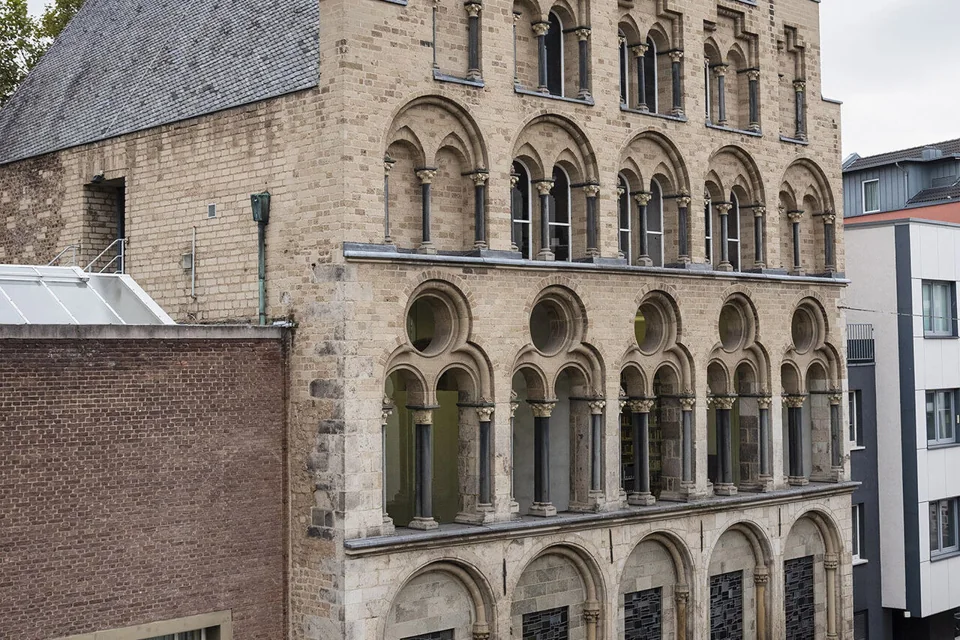
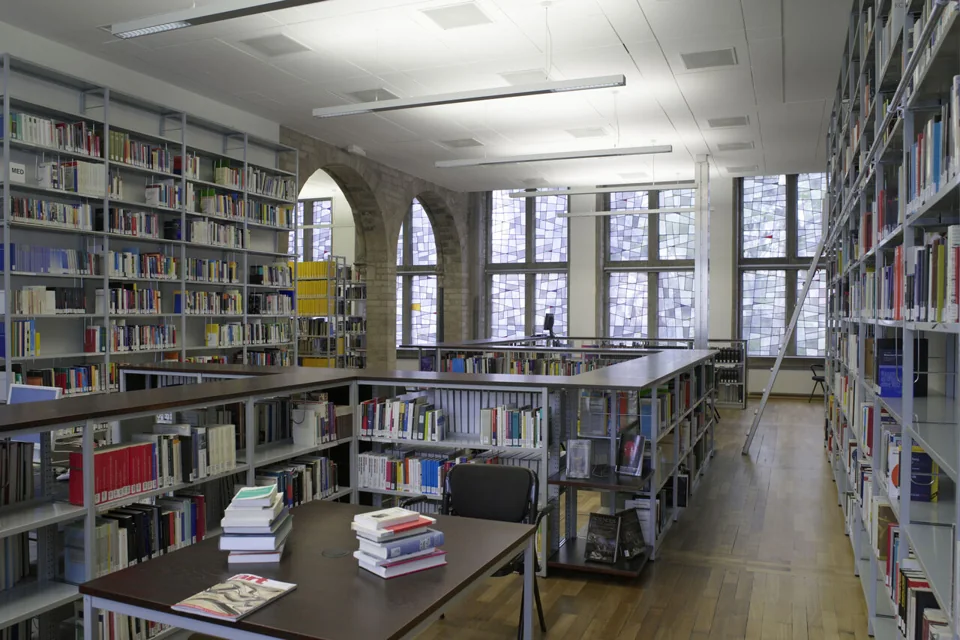
The KHM library is located in the Overstolzenhaus at Rheingasse 8. It brings together books, films, periodicals, sound material and digital collections. The library also provides reserved reading shelves associated with teaching and access to KHM publications. Its public pages connect readers with acquisition recommendations, new material, staff publications and selected rare holdings.
A discovery search combines several kinds of resource: physical holdings, streaming material, electronic books and articles, tutorials, learning courses and open-access publications. Readers can sign in through Shibboleth to renew loans or place requests. Separate service routes explain borrowing, acquisition suggestions, access for guests and open-access publishing. These services support both the practical investigation of artistic media and the theoretical reading undertaken alongside production work. The library’s combination of film, print, sound and electronic resources mirrors the academy’s wider interdisciplinary approach.
Sources: Library ↗
Exhibition and public discourse
Glasmoog is KHM’s space for art and discourse, with its address now at Heumarkt 14. Its public programme includes exhibitions and related activity, with separate hall and project-room presentations. The academy maintains a Glasmoog archive and information on associated publications, providing routes into earlier programmes as well as current exhibitions.
The space connects the academy’s artistic environment with public presentation and discussion. Exhibition information identifies participating artists, opening arrangements and the relevant venue, while the archive preserves a record beyond the duration of an individual show. Its position within KHM places exhibition-making alongside teaching, production, writing and critical exchange, adding another setting in which artistic work can be encountered.
Sources: Glasmoog ↗
Applying with artistic work
Artistic aptitude is central to selection for both diploma routes. Applicants submit work samples, which may include films, photographs, drawings, texts, animation, compositions or other relevant material. Diploma 1 includes a response to a specified theme, while Diploma 2 applicants prepare a proposal outlining a possible project and their intended artistic development.
The academy normally requires non-German-speaking applicants to demonstrate German at B2 level because most teaching is in German, although some teaching is available in English. Courses begin in the winter semester. The application guidance emphasises independent artistic decisions and the ability to realise individual projects, making the portfolio and project outline substantive parts of the assessment.
Sources: Application ↗