Visa

About Academy of Fine Arts Prague
A public art university in Prague
The Academy of Fine Arts in Prague, usually known by the Czech abbreviation AVU, is a public art university in Czechia. Its teaching encompasses fine art, architecture and the restoration of artworks, with doctoral work also extending into the theory and history of contemporary art. Fine-art education is organised around close studio mentorship across painting, sculpture, drawing, printmaking, intermedia and newer artistic forms.
The Academy describes three schools: Fine Arts, Restoration and Architecture. The Department of Theory and History of Art contributes courses connecting artistic work with historical interpretation and contemporary social questions. At the end of each semester, students present work in exhibitions known as klauzury, where internal and external specialists discuss their progress. The academic year culminates in a public graduation exhibition. This pattern combines sustained individual development with recurring opportunities to present, review and discuss artistic decisions.
Sources: About AVU ↗
An institution founded in 1799
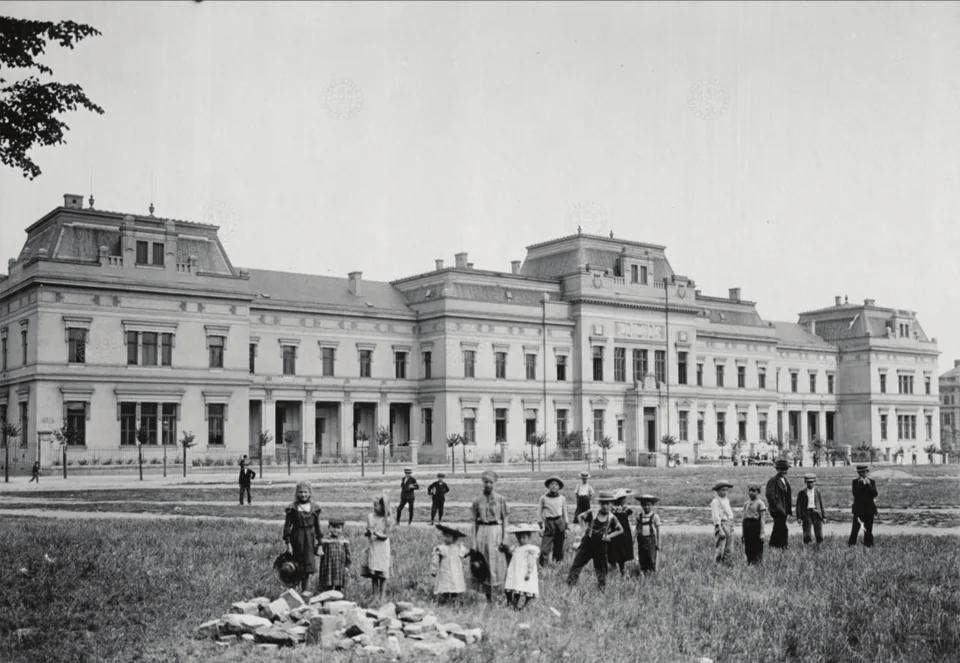
AVU was founded in 1799 through the initiative of the Society of Patriotic Friends of the Arts. Imperial approval came on 10 September, and teaching began in 1800 in the Klementinum. Drawing initially occupied a central position, with landscape painting and printmaking subsequently widening the school's approach. Nineteenth-century reforms brought renewed theoretical teaching and a separate sculpture school.
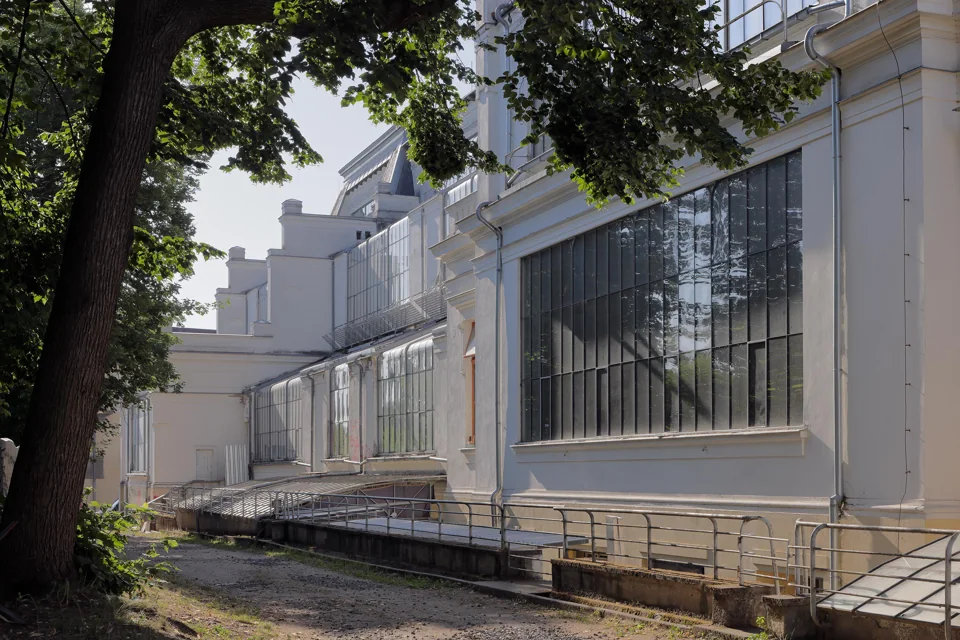
Nationalisation in 1896 established its status as a higher education institution. The Academy moved into its Letna building, designed by Vaclav Rostlapil, at the beginning of the twentieth century. Architecture and specialist printmaking teaching developed in 1910, while restoration became a department in 1947. Changes after 1990 expanded the range of artistic positions and media. These developments connect the Academy's long history with its present combination of traditional studio disciplines, contemporary practice and research.
Sources: History ↗
Art in Context in English
Art in Context is a three-year, English-language master's programme for students who already hold a bachelor's qualification. Its focus is practice-based research, experimentation and collaboration across fine-art practices. Two years of intensive studio learning lead into a third year devoted to creating and exhibiting a diploma project. Graduates receive the Czech MgA. qualification, described by the Academy as equivalent to an MFA.
The curriculum combines a core studio programme with seminars, projects, workshops and individual consultation. Contextual study and art-history and critical-theory teaching accompany the work developed in the studio. Students can use the Academy's workshops and facilities and participate in off-site activities, excursions and exchange opportunities. Reading and writing are considered alongside artistic practice. The programme therefore connects independent work with shared discussion, collaboration and an understanding of the local and international settings in which contemporary art is produced.
Sources: Art in Context ↗
Doctoral research and public discussion
Doctoral study at AVU is organised in Fine Arts, Theory and History of Contemporary Art, Artworks Restoration and Architectural Practice. The programmes are conducted in Czech and have a standard full-time duration of four years. Each candidate follows an individual study plan under an advisor, with an annual colloquium presenting dissertation progress to academic and general audiences.
Research can develop through artistic outcomes, historical and theoretical investigation, or technological and analytical work. Candidates participate in a studio or research department and in the activities of the Doctoral Research Department. They also draw on the Academy's technical and research infrastructure. Restoration projects typically emphasise analytical and technological questions, while artistic programmes investigate cultural and social phenomena through visual art and architecture. This structure places doctoral inquiry within an interdisciplinary institution while retaining the particular methods required by each field.
Sources: Doctoral studies ↗
Workshops for material and digital processes
Practical learning extends beyond individual studios into workshops and laboratories. Digilab supports information and audiovisual technologies, while the printmaking workshops in the Modern Gallery provide facilities for relief and intaglio printing, screen printing and lithography. Craft provision includes wood, metal, plaster, plastics and composites, and stone carving. Students can also book shared workspace and borrow equipment through the relevant arrangements.
The 3D Centre offers scanning, virtual modelling, advanced printing and CNC cutting of softer materials. The photography studio includes a darkroom and instruction in analogue black-and-white methods. Technical support assists with documentation and materials planning for artworks. Separate practical-skills classes introduce painting, drawing and modelling from live models and casts. Together, these facilities connect artistic concepts with the tools, processes and material understanding needed to realise them.
Sources: Workshops and laboratories ↗
A specialist library and a public gallery
The Academy library, in the main building, specialises in fine art, architecture and restoration. Its historical reading room, catalogue, research assistance, databases and interlibrary loans support both study and independent investigation. Readers can locate books and journals in the online catalogue and arrange reservations with library staff. These services bring published research and historical material into contact with studio activity.
Galerie AVU has occupied the Veletrzni 63 premises since autumn 2024. It presents contemporary work by students, alumni and teachers, including exhibitions organised with art schools abroad. An annual open call leads to selection by an exhibition committee elected for a two-year term. Since 2024, Kino GAVU has added moving-image screenings to this programme. The gallery's exhibitions and accompanying activities extend the Academy's educational environment into public cultural life, giving artistic work an audience beyond the studio.
Sources: Library ↗ · Galerie AVU ↗