Visa


About Academy of Arts, Architecture and Design in Prague
An academy shaped by studio learning
The Academy of Arts, Architecture and Design in Prague, widely known as UMPRUM, was founded in 1885. Its history connects the institution with changing political and cultural circumstances, from the Austro-Hungarian period through the Czechoslovak Republic and the communist era. Today its central educational principle remains the individual development of students through creative studios, supported by theoretical study. The Academy emphasises independent thinking, creative ability and responsibility towards society and the environment.
The Czech-language study offer includes bachelor’s programmes in design, graphics and fine arts, an architecture master’s programme, and follow-on master’s study across design, graphics, fine arts, architecture, and theory and history of art. Doctoral study extends across these subject areas. The Academy also maintains English-language programme information and international-exchange services. Studio work is therefore situated within a wider academic structure that combines making, research, historical knowledge and critical discussion.
Sources: About UMPRUM ↗ · Study in Czech ↗
Architecture in dialogue with other arts
The Department of Architecture has four studios, each with its own educational focus. Its approach benefits from the Academy’s wider artistic environment: students encounter craft techniques, sculpture, painting and drawing while developing architectural work. Technical education and collaboration with specialists accompany these connections with fine and applied arts. This places architectural thinking in contact with materials, visual practice and the expertise needed to develop projects.
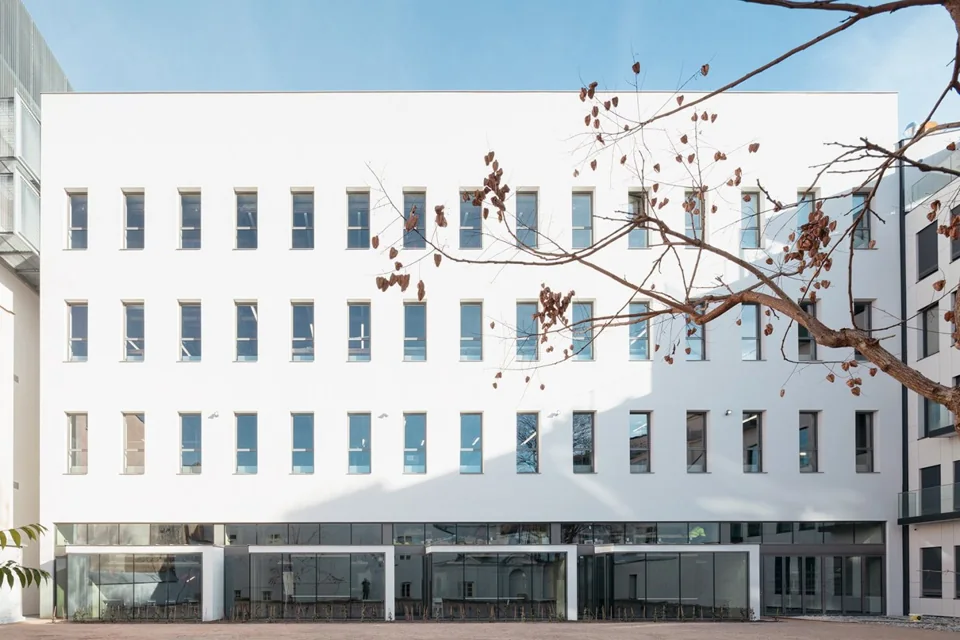
The departmental structure makes different approaches to architecture available within the same school. Rather than treating the discipline as detached from other forms of making, its introduction stresses relationships with the Academy’s art and applied-art departments. The department currently lists its address at Kasárna Karlín, alongside other academic activity operating there during the renovation of the historic main building.
Sources: Department of Architecture ↗
Graphics, images and material production
The Graphics department includes illustration and graphics, graphic design and new media, graphic design and visual communication, animation and film, type design and typography, photography, and design and digital technology. Its studios support the development of designers, typographers, illustrators, photographers, screen-graphics practitioners and artists working with newer media. The department describes them as places for experimentation and exchange supported by technical facilities and teaching staff.
Practical work includes printmaking techniques such as lithography, typography, screenprinting, offset and photogravure, together with bookbinding. Theoretical subjects and external specialists contribute to this preparation. The department’s history records a specialised school of applied graphic arts from 1919, while the institution acquired university status in 1946. Later development brought photography and digital technologies into its educational work, extending a longstanding connection between graphic communication and the production of physical objects.
Sources: Department of Graphics ↗
Design and applied arts
The Design department’s studios focus on industrial design, furniture and interior design, and product design. Its teaching combines studio learning with workshops involving faculty and external practitioners. Cooperation with Czech manufacturers and institutions is part of its work, alongside competitions and exchanges with foreign partner schools. Its historical roots include the School of Art established in Zlín in 1939 on the initiative of the Baťa company, followed by the creation of a separate design department in 1981.
Applied Arts develops a closely related but materially distinctive approach. Its subjects include glass, ceramics and porcelain, K.O.V., fashion, footwear, textiles, and the conservation and restoration of applied arts. The department describes learning through sustained contact with materials and workshop production. Its history traces ceramics, glass and metal to applied sculpture, while textile and fashion subjects developed through another departmental grouping. These traditions connect artistic conception with the properties of materials and the processes through which work is made.
Sources: Department of Design ↗ · Department of Applied Arts ↗
Libraries and academic resources
The Academy’s library was founded in 1885. Its collection covers the subjects taught in the studios, including architecture, industrial and product design, sculpture, painting, photography, glass, ceramics, fashion, textiles, illustration, typography, animation and art history. The library reports a basic collection of approximately seventy thousand books, alongside Czech and international periodicals, foreign-language literature, rare material and early prints.
An online catalogue supports discovery and requests, while digital resources include the Kramerius digital library, Building Types Online, EBSCO Art & Architecture Source and other specialist databases. The library also provides access to citation-management tools. Materials are generally requested with staff assistance, reflecting its organised collections rather than unrestricted browsing. Its current contact listing places the service in Kasárna Karlín, with borrowing, reservations and renewals managed through the catalogue and library staff.
Sources: Library ↗
Buildings and public presentation
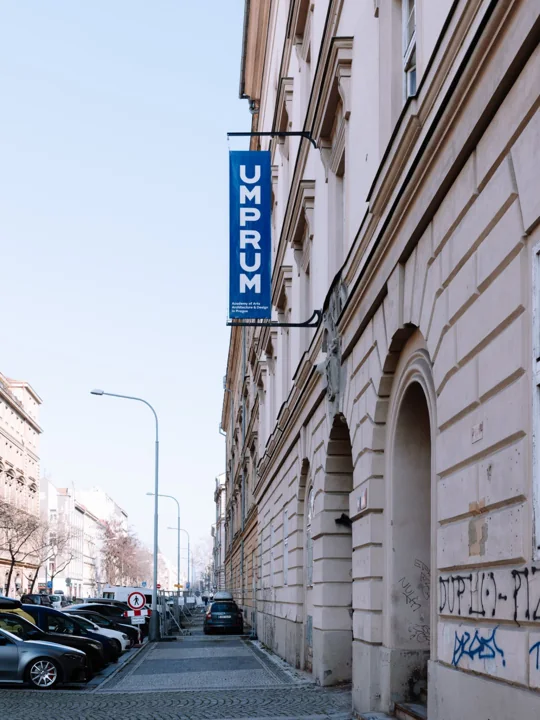
UMPRUM’s buildings page identifies Kasárna Karlín at Křižíkova 20/12, the Technology Centre at Mikulandská 134/5, and Kafkárna, its Centre for Arts and Ecology, in Prague 6. The historic building at Jan Palach Square is listed as undergoing reconstruction. These locations support the Academy’s present activity while the original main building is being renovated, so the historic address alone does not describe its current working geography.
The Academy shares student work with the public through Artsemestr, the exhibition held twice a year. Its institutional introduction also describes a broader programme of exhibitions in Prague and abroad. These presentations connect studio development with audiences beyond the school, allowing projects from different disciplines to be encountered together. Public exhibitions sit alongside the Academy’s teaching and research as a recurring part of its cultural role.
Sources: Academy buildings ↗ · About UMPRUM ↗