Visa
About Academy of Fine Arts In Łódź
An academy shaped by art and design
The Academy of Fine Arts in Łódź is officially the Strzemiński Academy of Fine Arts Łódź. Established in spring 1945 as the State Higher School of Visual Arts, it developed from the work of artists including Władysław Strzemiński and Stefan Wegner. The founding school combined applied and fine arts, initially through textile, ceramics and graphic-art faculties. Its early ambitions drew consciously on Bauhaus traditions and on cooperation with industry.
The academy moved from its earlier Narutowicza Street premises into a purpose-designed building by Bolesław Kardaszewski in 1976. It took Strzemiński’s name in 1987 and gained Academy of Fine Arts status in 1996. Further development included the opening of the Fashion Promotion Centre and the Centre of Science and Art in 2013. These milestones connect its postwar beginnings with a broader infrastructure for artistic education, design and public presentation.
Sources: Academy history ↗
Graphic communication and digital media
The Institute of Graphic Design presents a full-time first-cycle programme addressing both established graphic disciplines and newer media. Areas of study include visual identity, branding, packaging, editorial design, typography and calligraphy. Digital subjects extend to applications, games, websites, virtual reality and user experience. The range connects the organisation of printed information with forms of interaction and communication on screens.
Learning combines individual assignments with workshops, lectures, evaluations and internships. Facilities described by the institute include computer laboratories, multimedia projection rooms and a photography studio used for advertising photography. Software provision includes Adobe, Affinity and Maxon tools. The educational aim is to prepare designers able to work independently and in teams, whether in their own practice, a design studio, publishing or media-related settings.
Sources: Institute of Graphic Design ↗
Fashion as a studio discipline
Fashion design is offered through full-time first- and second-cycle programmes. Its specialist studios encompass clothing, footwear and leather accessories, knitwear, stage costume, sportswear and special-purpose garments, and lingerie and recreational clothing. This structure makes the design of dress a collection of related practices rather than a single studio subject.
Practical classes include sewing, knitting and footwear work, supported by photography and computer workshops. Painting, drawing and sculpture form part of the general artistic foundation, alongside theoretical subjects. These areas provide a basis for the specialist decisions made in fashion projects. The institute also describes cooperation with fashion and footwear companies, participation in competitions and the development of students’ and graduates’ own design brands. Professional design and individual creative work are both part of its educational outlook.
Sources: Institute of Fashion ↗
Textile and interior decoration
The Institute of Textile, Printing and Interior Decoration offers full-time first- and second-cycle education in textile and interior decoration. Its teaching follows a master-and-student approach, placing emphasis on the development of each designer. General art studios contribute artistic experience and sensitivity, while specialist teaching supplies knowledge needed to solve textile and interior-design problems.
Cooperation with Polish research institutes and textile companies gives the subject a connection with production. Students can develop projects in factories and gain practical knowledge of manufacturing processes. Competitions and exhibitions provide further settings in which work is presented. The institute’s approach therefore joins individual artistic development with the ability to collaborate professionally, treating the creative properties of textiles and their production context as connected aspects of design education.
Sources: Institute of Textile, Printing and Interior Decoration ↗
Jewellery design and material processes
Jewellery is another field taught at both first- and second-cycle level through full-time programmes. Specialist design studios form the core of the education, supported by goldsmith workshops and computer-design facilities. The curriculum includes general art and theoretical classes, giving technical processes a wider visual and conceptual foundation.
Students encounter traditional and contemporary jewellery technologies and a variety of ways to realise their own designs. The institute identifies cooperation with the International Amber Association in Gdańsk, the Yes Gallery in Poznań and jewellery-producing companies. Internships, competitions, fairs and exhibitions connect this studio education with other practitioners and audiences. Its emphasis encompasses both designing for professional contexts and developing a personal body of creative work.
Sources: Institute of Jewellery ↗
An art-focused research library
The academy library is a publicly accessible research library serving scientific, teaching and information needs. Its collections follow the academy’s subjects, including art history and theory, painting, drawing, printmaking, sculpture, architecture, fashion, jewellery, textiles, photography and industrial design. Applied topics such as textile technology and printing accompany broader resources in culture, philosophy, psychology and other fields.
Polish and foreign-language periodicals cover art, photography and design. Exhibition catalogues include individual and collective shows, with particular attention to the academy’s teachers. An electronic catalogue supports discovery, while an institutional bibliography records the academy’s scholarly and artistic output. The library participates in NUKAT, the central catalogue of Polish research and academic libraries. It also preserves access to older subject catalogues that were digitised in 2009.
Sources: About the library ↗
Exhibitions within the library
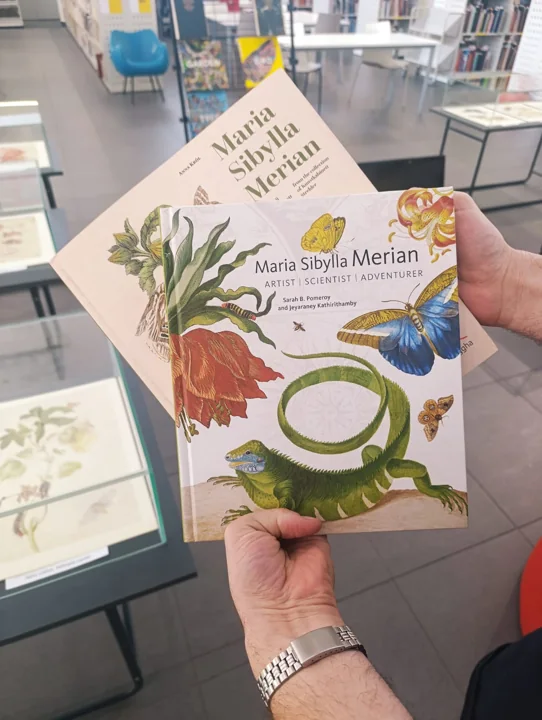
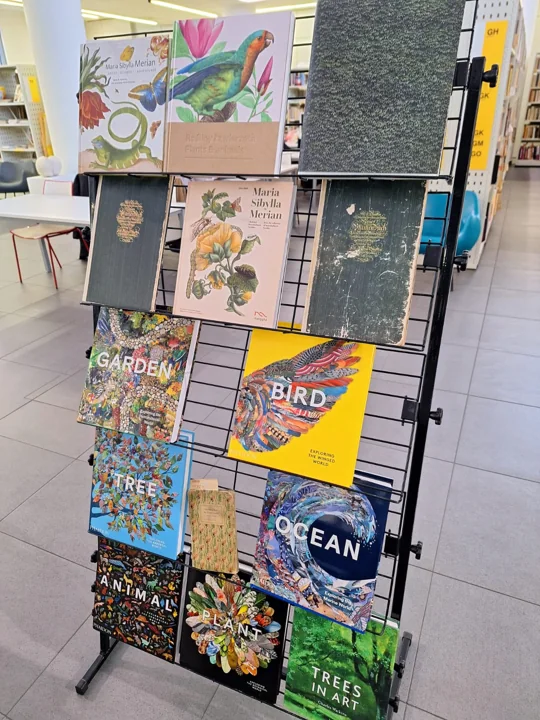
The library also provides a setting for presenting artistic and historical subjects. Its March 2025 exhibition devoted to Maria Sibylla Merian brought together material about the artist and naturalist’s depictions of flowers, birds and insects. Announced for 17–28 March, the exhibition connected botanical and entomological illustration with the relationship between artistic observation and scientific knowledge. Official photographs show illustrated publications, reading-room surroundings and display cases, documenting how library resources can become part of an exhibition encounter.
Sources: Library exhibition: Maria Sibylla Merian,March2025 ↗