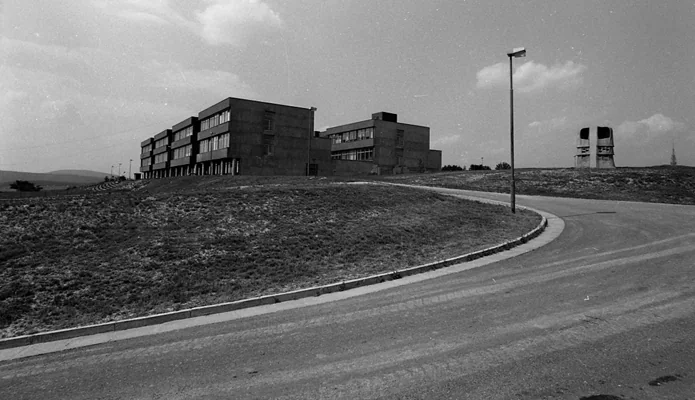
Visa
About Academy of Fine Arts and Design in Bratislava
Art education rooted in 1949
The Academy of Fine Arts and Design in Bratislava is a public artistic higher education institution in Slovakia, commonly known in English as AFAD and in Slovak as VŠVU. It was established by the Slovak National Council on 9 June 1949. Its early teaching included painting, sculpture and restoration, followed by printmaking. From the beginning, its development involved the relationship between independent fine art and applied artistic practice.
Architecture became a department in 1960, bringing further opportunities to connect different media and design disciplines. The political changes of 1989 marked another turning point, opening the way to new teaching concepts, staff and activities. The academy's historical account describes the subsequent development of a joint-school model with permeable boundaries between departments and studios. Photography, fashion, jewellery and intermedia were among the fields that expanded its artistic landscape.
Sources: Academy history ↗
Studio study and interdisciplinary education
AFAD describes education at bachelor's, master's and doctoral levels in fine arts, design, architecture and restoration, with doctoral study also extending to the theory and history of art and architecture. Its profile explains the adoption of a four-year bachelor's and two-year master's structure within the European credit-based framework.
Rather than organising its teaching through faculties, the academy works through departments and studios, alongside drawing provision. This structure is intended to support contact across disciplines. Its mission emphasises creative and critical thinking, independent artistic and scholarly research, and the development of artistic work. Educational activity is connected with the practice and research of teachers and students. The resulting environment brings studio production, intellectual enquiry and technical knowledge together within the same artistic institution.
Design from experimentation to production
The Design department addresses the creation of useful objects across individual, small-series and mass production. Its teaching takes account of social, environmental and cultural questions, as well as the identity and needs of individual people. This gives design study a context extending beyond an object's appearance.
A preparatory course leads into specialist studios in experimental, industrial, interior and transport design. The department describes cooperation with producers in Slovakia and abroad and with design departments at other schools. Study visits abroad and exhibitions of student work also form part of its published educational approach. These activities link the development of personal ideas with materials, production conditions and public presentation, allowing students to encounter different scales and purposes of design practice.
Sources: Design department ↗
Conservation and restoration
Restoration was one of the academy's founding areas. Its preparatory teaching develops understanding of painting and sculpture while introducing students to the broader restoration process. The department places artistic and ethical responsibility at the centre of study and considers the restorer's role in heritage care, galleries and museums.
Its specialist studios cover works on paper, easel and panel painting, wall painting, stone sculpture and architectural elements, wooden sculpture, textiles and photography. A laboratory addresses modern and contemporary painting restoration. This range connects knowledge of artistic media with the particular demands of caring for different materials. The department's organisation therefore combines preparation in artistic expression with specialised study of objects, surfaces and processes encountered in cultural collections and architectural heritage.
Visual communication across media
Visual Communication combines graphic expression with analytical and critical thinking. Its description addresses lettering, graphic signs, illustration, photography, multimedia and work in space. Students are expected to develop craftsmanship as well as the technical ability to work through both analogue and digital processes.
The department's published bachelor's sequence moves from preparatory graphic design into studios concerned with identity, typography and space, culminating in a thesis presented in a chosen studio. Master's students work within a studio or laboratory on their final project. The department also lists multimedia and typographic laboratory provision. Its approach connects intuitive and creative decisions with logical problem solving and practical methods, preparing students to develop communication projects through an informed choice of materials, media and tools.
Sources: Visual Communication department ↗
Library resources for artistic research
The Academic Library specialises in fine art, architecture and related subjects. Located at Hviezdoslavovo Square, it supports teaching and research through reference, retrieval, bibliographic and consultation services. Its collections include books, periodicals, theses, dissertations and electronic documents, while the academy's photographic archive is also held there.
The library uses an online catalogue and an automated cataloguing system, with keywords in Slovak and English. Its information work includes access to licensed electronic resources and the recording of publishing and artistic activity. Audiovisual equipment supports consultation of different media. These services give studio-based students access to historical, theoretical and contemporary material, and provide researchers with ways to locate and document sources connected with artistic practice.
Sources: Academic Library ↗
MEDIUM Gallery and public exchange
MEDIUM Gallery was established on 8 January 1991 as part of the academy. At Hviezdoslavovo Square, it functions as both an exhibition venue and a communication space reaching beyond the school. Its programme covers contemporary artistic forms connected with the academy's broad range of study.
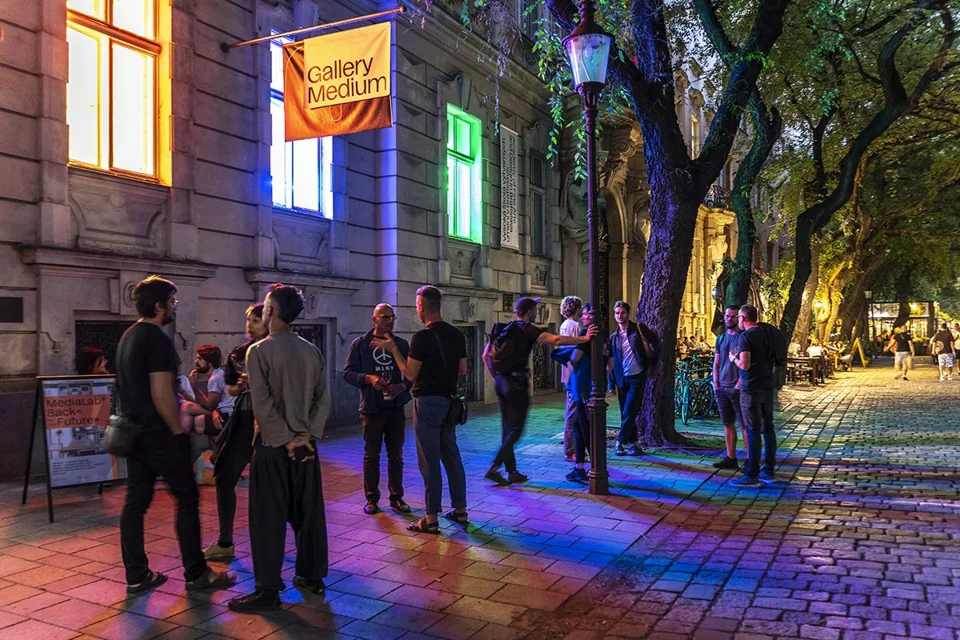
Exhibition proposals are selected through an annual process with oversight from a gallery board. The gallery seeks a balance among student and teacher work, curatorial projects, and established artists from Slovakia and abroad. This creates opportunities for different generations and professional contexts to meet within the academy's public programme. A documented example is the 2023 opening of MediaLab*: Back to the Future, photographed by Michaela Prablesková outside the gallery.
Sources: About MEDIUM Gallery ↗
Three locations within Bratislava
The academy's building guide identifies three Bratislava locations. Hviezdoslavovo Square houses the rectorate, academic library, architecture, painting, and theory and history of art. Drotárska cesta accommodates many of the studio and workshop disciplines, including design, textiles, applied art, intermedia, conservation, photography, printmaking and visual communication.
The smaller Koceľova Street premises provide additional painting studio space. This distribution combines the historic city-centre setting with a larger concentration of practical departments at Drotárska. The locations support the academy's variety of working methods, from library research and theoretical teaching to specialised studio activity. They also give the institution several physical settings within the city through which its academic and public cultural work takes place.
Sources: Academy buildings ↗