Visa
About Academy of Economics in Wroclaw
From an economics academy to a university
The Academy of Economics in Wroclaw is the institution now presented in English as Wroclaw University of Economics and Business, or WUEB. Its history began with the Higher School of Trade in 1947. This was initially a three-year professional higher school with a single faculty and specialisms related to commerce, cooperatives, public administration and insurance. Its first inaugural lecture was delivered by Wincenty Stys, later a rector of the institution.
Nationalisation in 1950 brought the name Higher School of Economics and faculties concerned with industry and finance. The institution expanded into engineering and economics for the food industry, and a branch in Jelenia Gora opened in 1969. The Oskar Lange Academy of Economics name followed in 1974. Legislation adopted in March 2008 changed the name to a university, taking effect on 6 May. These successive names explain the historical academy listing for the present university.
Sources: Institutional history ↗
Economics, management and production engineering
The current faculty presentation identifies Production Engineering, Business and Management, and Economics and Finance. Production Engineering connects research in food and nutrition technology with industrial processes and the development of food products. Its published research interests include responsible manufacturing, production technologies and digital transformation in enterprises. This gives the institution a technological strand alongside its economic subjects.
Business and Management works in management and quality sciences, with interests extending across information technology, projects, taxation, human resources, marketing, logistics and business law. Economics and Finance addresses economic processes, financial institutions and cooperation with businesses and public authorities. Its teaching areas include international economics, data analysis, real estate, corporate finance, banking, insurance and accounting. Across the faculties, academic research is connected with expert projects and partnerships, placing disciplinary knowledge in contact with practical organisational and economic questions.
Sources: Faculties ↗
Degrees and progression
The university's degree-study introduction presents both its Wroclaw location and the branch in Jelenia Gora. At first-cycle level, students can pursue a three-year bachelor's degree or a three-and-a-half-year engineering degree. Teaching is available in Polish or English. The distinction between the two qualifications reflects the university's combination of business and economic study with engineering-related education.
The published introduction describes opportunities to select a specialisation or study module from the second year. Master's programmes last two years and allow graduates to continue in their earlier subject or move into another area of study. This structure creates a progression from initial university education into more focused advanced work. Programme choice, language and the relationship between a student's previous preparation and later specialisation are therefore visible parts of the university's description of its educational offer.
Sources: Degree study ↗
Individual learning with tutors and practitioners
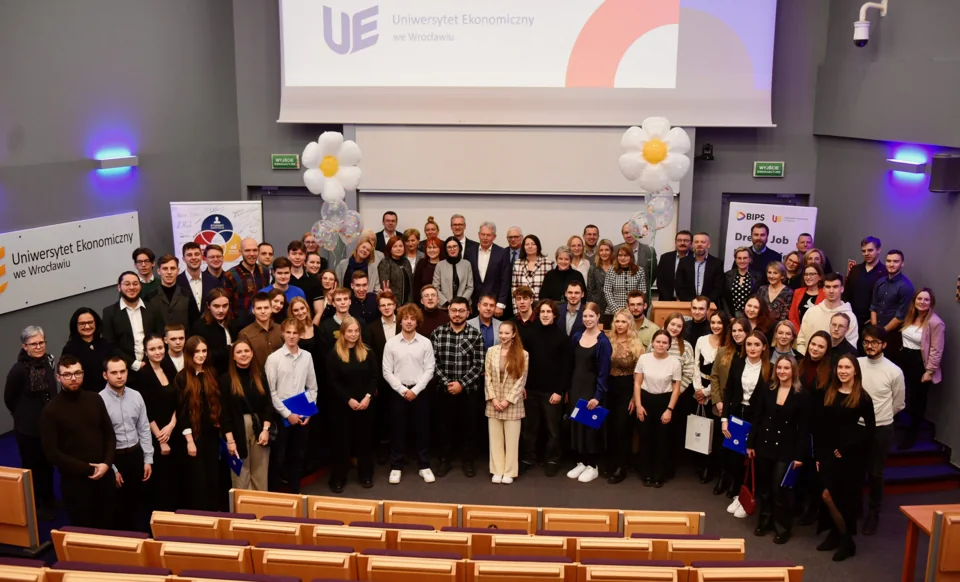
The Business Individual Study Program, abbreviated BIPS, adds a mentoring format to the university's ordinary degree teaching. It is designed around a year of work with an academic tutor and a practitioner mentor. Students develop goals and a work plan while participating in additional workshops, training and simulations. The university presents it as a way to individualise learning and connect student ideas with experience from professional and social life.
The programme emphasises initiative, persistence and openness to other people. It encourages projects and the exploration of business or social ventures, with feedback and reflection forming part of the learning process. Its published description identifies Polish as the course language. Recruitment dates appearing on the page concern an earlier cycle, while the broader description explains the mentoring model. Academic staff and external practitioners contribute different perspectives, connecting subject study with questions about projects, teamwork and personal development.
Sources: Business Individual Study Program ↗
Organisations and student participation
The university's student-life directory brings together representation, cultural activity, travel and international exchange. Student Government works on initiatives for the university community, while its cultural and sports information group helps organise events such as academic runs and theatre activity. The BIT travellers' club lists projects including Auto Stop Race, Travellers' Days and the Economist Rally, adding student-led exploration to campus life.
ESN UE Wroclaw supports exchange students and promotes international mobility through events and peer participation. The university also identifies the Independent Students' Union, active locally since 1980, and AIESEC among its organisations. Academic clubs offer another setting for investigating interests beyond scheduled classes. These groups give students ways to take responsibility for projects, meet peers and contribute to university activity. They complement formal teaching with organised opportunities for cultural participation, collaboration and practical experience.
Entrepreneurship through inQUBE
The university's inQUBE business incubator is based at Wielka Street 67 in Wroclaw. It supports people developing business ideas through practical knowledge, consultations and access to a community of entrepreneurs and specialists. Its institutional introduction describes work on refining business concepts and turning them into early products and ventures. The team includes responsibilities for entrepreneurship advice, events, startup support and student-community activity.
The incubator offers workspace, meeting rooms and event facilities, alongside virtual-office services. Its current website also publishes individual advisory consultations for people considering a company or testing a product or business model. Event listings include pitch meetings, demonstrations and workshops, giving the incubator a role as a meeting place as well as a physical facility. This activity connects the university's teaching and professional environment with the practical development of enterprise ideas in the city.
Sources: University business incubator ↗ · About inQUBE ↗