Visa
About Academy of Applied Studies Belgrade
Applied professional education in Belgrade
The Academy of Applied Studies Belgrade, known in Serbian as Akademija strukovnih studija Beograd, developed through the combination of colleges specialising in health sciences, tourism and hotel management. Its educational identity centres on applied professional study, practical knowledge and cooperation with organisations in the fields its students enter. The colleges contributed established disciplinary traditions within a shared academy structure. Its Serbian abbreviation is ASSB; its English-language material also uses AASB.
The Academy’s introduction emphasises curriculum development, multidisciplinary approaches and continuing professional development for students and teaching staff. Its president’s welcome highlights cooperation with health institutions and tourism and hospitality businesses. A dual-study approach, available within its educational provision, connects learning with workplace experience. Collaboration among the colleges also creates scope for work across their subject boundaries, including the relationship between health and tourism. Undergraduate and applied master’s studies provide successive levels of professional education.
The institution’s structure changed in June 2026. A government decision adopted on 19 June and effective from 20 June separated the College of Tourism from the Academy and attached it to the Academy of Applied Studies Polytechnic. Polytechnic’s announcement states that integration covered students, programmes, staff and documentation while maintaining continuity of study. The tourism programmes below describe the Academy’s earlier three-college provision; health sciences and hospitality remain central to its published profile.
Sources: About the Academy ↗ · Academy English introduction ↗ · College of Tourism transfer to Polytechnic, 24 June 2026 ↗
Undergraduate study in three professional fields
Undergraduate applied studies generally last three academic years, organised into six semesters. The health-sciences portfolio includes nursing, midwifery, nursing in preschool settings, dental prosthetics, aesthetic cosmetology, medical radiology and medical laboratory technology. Other listed fields include nutrition and dietetics, occupational therapy, sanitary and environmental engineering, and physiotherapy. These subjects represent distinct professional programmes within the health-sciences college.
Before the June 2026 transfer, the tourism programme had four modules: tourism, tourism management, tour operation and tourist guiding, and hotel management. Its published programme description identifies the first two years as shared across those modules. Its hospitality college lists three undergraduate programmes: hotel management, restaurant management and gastronomy. Together, these areas cover the organisation of travel and visitor services as well as accommodation, restaurant operations and food preparation. The undergraduate studies page directs readers to each college for its detailed programme objectives.
Sources: Undergraduate applied studies ↗ · College of Tourism transfer to Polytechnic, 24 June 2026 ↗
Applied master’s pathways
At master’s level, the Academy’s health-sciences offer includes nursing with modules in clinical care, anaesthesia and resuscitation, operating-room instrumentation, public health and teaching methodology. It also lists occupational therapy focused on therapeutic rehabilitation and sanitary and environmental engineering focused on sanitary engineering. Physiotherapy pathways include sports rehabilitation and therapeutic rehabilitation.
The earlier tourism-college offer included Business Economics and Tourism, while the hospitality college offers Hospitality Management. These pathways extend the Academy’s three main subject areas beyond undergraduate preparation. The published structure brings advanced clinical and rehabilitation interests together with tourism economics and the management of hospitality organisations, retaining the practical disciplinary focus of the constituent colleges.
Sources: Master applied studies ↗ · College of Tourism transfer to Polytechnic, 24 June 2026 ↗
Hospitality teaching spaces documented by the Academy
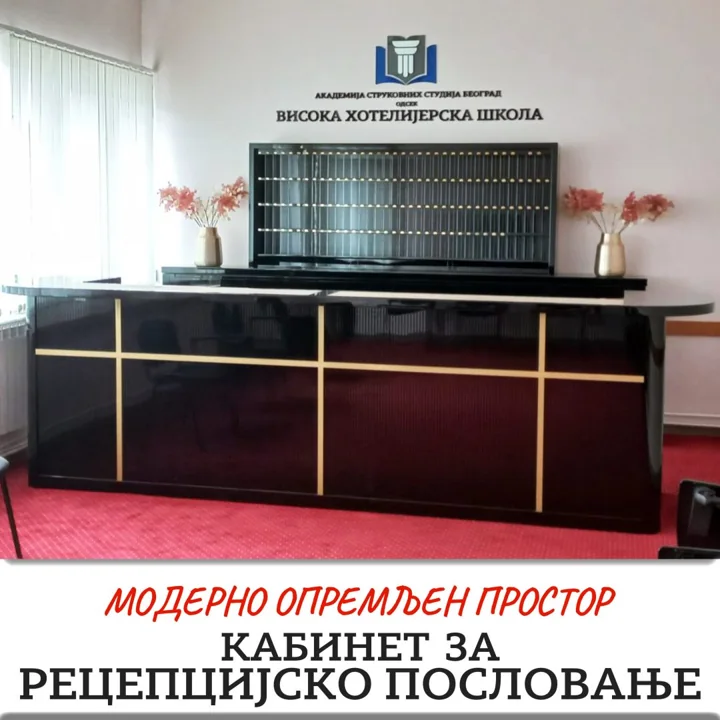
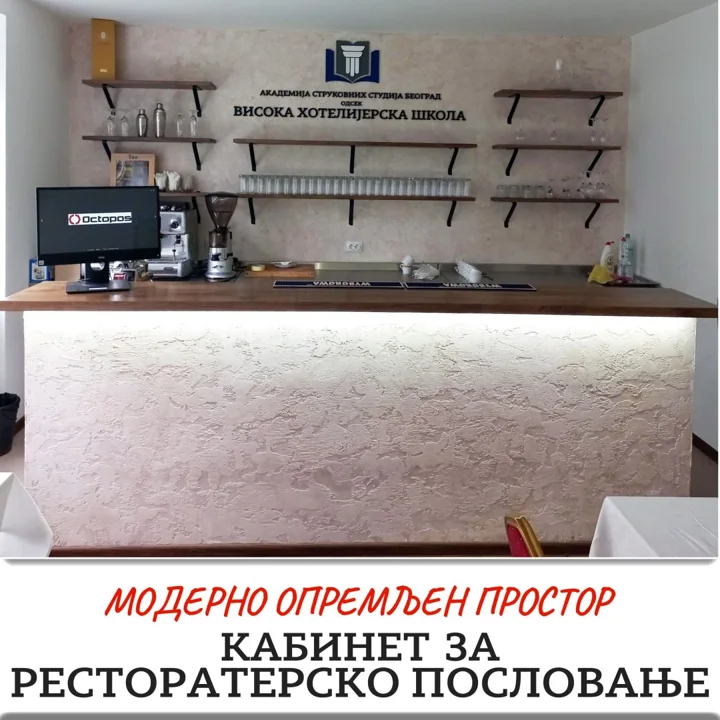
The College of Hotel Management’s facilities include specialist rooms for learning professional operations. In the reception-training room, students practise realistic situations with practitioner guidance and use RoomExpert reception software. Restaurant subjects are supported by a dedicated training room equipped with restaurant-service materials, a touchscreen computer and Octopos operating software. Computer instruction includes an introduction to both systems before further practical work.
Gastronomy teaching uses a specialist kitchen-training room with an associated pastry room. Shared lectures for the three undergraduate hospitality programmes take place in an auditorium described as accommodating 330 people. The college also has a subject library and a reading room with 48 places. Its facilities presentation connects these rooms with practical exercises and subsequent work in partner hotels, showing how the college links classroom instruction, simulated operations and industry experience.
Sources: Academy teaching buildings and facilities ↗
Library support and access to knowledge
The Health Sciences College library reports more than sixteen thousand library items and a reading room with fifty places. Its collection is developed with current professional literature to support students, teachers and research staff. Membership of Serbia’s university-library community places the college within a wider academic information network.
Electronic access includes KoBSON services and a catalogue within COBISS.RS, the cooperative bibliographic system associated with the Virtual Library of Serbia. These services supplement printed holdings with searchable academic material. The library’s role therefore spans access to course literature, bibliographic discovery and information support for educational and scientific work, alongside a dedicated place for reading and study.
Sources: Library ↗
Publishing and international exchange
The Academy’s publishing activities include Education and Research in Health Sciences, jointly issued by its health-sciences college and the University of Kragujevac’s Faculty of Medical Sciences. This open-access publication covers health research and higher education in the health sciences. The hospitality college publishes e-HotelLink, an interdisciplinary journal concerned with hospitality and gastronomy. Its scope connects management, food science, culinary practice and related social and cultural questions.
The Academy also welcomes Erasmus+ students nominated by partner higher education institutions. Incoming study mobility operates through inter-institutional agreements and a learning agreement approved before the exchange. Applications include an academic transcript, curriculum vitae and study plan. An international-mobility rulebook, selection regulations, internationalisation strategy and Erasmus policy statement are among the documents published for this activity. These arrangements support cooperation and exchanges alongside the Academy’s professional teaching.
Incoming students are normally expected to demonstrate English at B2 level or above, with the Academy identifying exceptions for mobility from Croatia, Bosnia and Herzegovina, and Montenegro under its language policy. The host and sending institutions confirm course availability before approving the study agreement. A practical-information brochure is also provided to help visiting students prepare for their stay in Belgrade.
Sources: Academy journals ↗ · Incoming Erasmus students ↗ · International mobility documents ↗