Visa
About Aarhus School of Business
Origins in business education
Aarhus School of Business is a historical Danish higher education institution whose development forms part of the story of Aarhus University. Its official successor history dates the school's foundation to 15 September 1939. It also traces an earlier tradition of commercial education through Den Jyske Handelshøjskole, which offered business training before the institution acquired its higher education form. At the beginning, the school's provision centred on the HD business diploma. Its range subsequently expanded: a language programme began in 1940, and daytime teaching for the three-year HA business degree started in 1951. These milestones show how commercial training grew into a broader academic institution serving business and language education. In 1968, the school moved into a newly constructed complex at the corner of Ringgaden and Viborgvej. In 2007, it merged with Aarhus University, becoming Aarhus School of Business, University of Aarhus.
From the former school to Aarhus BSS
The school's later history involves further changes within the university. In 2011, Aarhus School of Business and the Faculty of Social Sciences were brought together in the School of Business and Social Sciences. The reorganisation aimed to connect traditional business subjects with wider social science approaches to complex business and societal questions. Departments were reorganised during a transitional year, and the two constituent units were fully merged on 1 January 2012. The shorter Aarhus BSS brand was adopted in April 2015. Further changes followed in 2017, when business languages moved to the Faculty of Arts and corporate communication joined the Department of Management. Consequently, the historical Aarhus School of Business name should be understood in its institutional context. Present-day course choices and organisational information belong to the university's current faculties and departments rather than to a separately operating school under the former name.
Sources: History of Aarhus BSS ↗
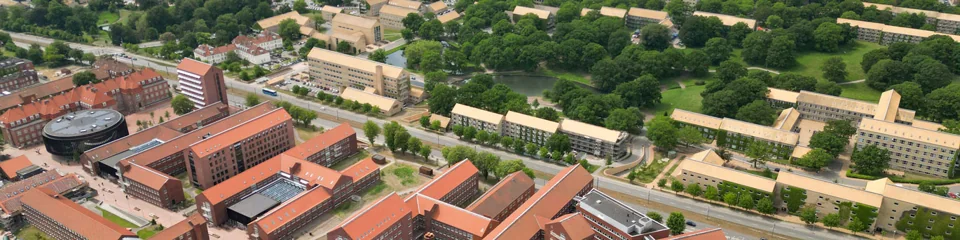
A broader business and social sciences faculty
Today, Aarhus BSS is one of Aarhus University's five faculties. Its name abbreviates Business and Social Sciences, reflecting an academic scope that extends beyond commercial management alone. The faculty brings together six departments: Business Development and Technology; Economics and Business Economics; Political Science; Law; Management; and Psychology and Behavioural Science. This structure connects questions about organisations and markets with questions about legal systems, public institutions and human behaviour. The official overview describes research-based education across areas including finance, accounting, logistics, human resource management, marketing, innovation, entrepreneurship and business communication, alongside the social science disciplines. For someone researching the former business school, this broader structure explains where its academic legacy now sits. It also helps prospective students identify the appropriate department when exploring a particular subject, instead of assuming every programme is administered through an unchanged historical organisation.
Sources: About Aarhus BSS ↗
Degree routes and subject choices
The current English-language programme overview provides a practical starting point for international applicants. It lists bachelor-level Economics and Business Administration in both Aarhus and Herning, alongside a range of master's programmes. Master's study includes Business Administration, Economics and Technology-Based Business Development, while specialist Economics and Business Administration routes cover subjects such as Finance, International Business, Digital Business Management, Management Accounting and Control, and Marketing Analytics and Strategy. Other options address business intelligence, supply chains and organisational leadership. Doctoral study is organised across the faculty's business and social science subjects, with interdisciplinary projects also identified. This variety allows applicants to compare broad foundations with more specialised postgraduate directions. The individual university programme pages remain essential for checking entry qualifications, language requirements and the precise curriculum, since the faculty overview introduces the available routes rather than determining an applicant's eligibility.
Sources: Degree programmes ↗
Research into decisions and behaviour
One concrete example of the research environment associated with Aarhus BSS is the Cognition and Behavior Lab, commonly called COBE Lab. Its official introduction explains that researchers use it to investigate how people react, make decisions and solve problems. This focus provides a useful illustration of how business and social science research can examine actual behaviour rather than relying only on abstract descriptions of organisations or markets. The lab invites people to register as research participants and provides information about experiments, participant rights and data protection. It also directs students to information about considering experiments for a thesis. For a prospective researcher, these resources offer an initial view of experimental work within the university. Participation in an individual study, research access and thesis arrangements should be explored through the relevant lab guidance and academic contacts.
Sources: Cognition and Behavior Lab ↗
Connections with organisations and working life
Aarhus BSS describes cooperation with private companies and public organisations in Denmark and internationally as an important part of its education and research. Its cooperation portal brings together several routes into that relationship, including student collaboration, recruitment, internships, research-based consultancy and longer partnerships. Employers can also use the university's job and project bank to connect with students and recent graduates. For organisations, the faculty offers assistance in identifying the appropriate contact and form of collaboration, whether the need concerns recruitment or a research question. These links show how academic knowledge can be connected with practical organisational challenges. They also give students a route for exploring projects and professional contacts during their studies. The existence of a collaboration portal does not determine a particular placement or employment outcome; individual opportunities depend on the project, organisation and student's own circumstances.
Sources: Cooperation ↗

Student community and international experience
The current student life pages describe an environment supported by academic events, social activities and student organisations. New students are invited to an introduction week combining academic and social events, and the school identifies a buddy arrangement as another way to become familiar with the institution and city. Clubs and associations cover social, academic and political interests, with activities including talks, student parties and the annual Spring Regatta. Many of these events are organised by students themselves. The university also offers an ambassador network through which international students can share their experiences with prospective applicants and meet other international students. Many programmes provide opportunities to study abroad, adding another dimension to the study experience. Together, these resources explain how joining the successor faculty involves both an academic programme and participation in a wider university community.
Sources: Study environment and student life ↗