Visa


About Aalborg University
A Danish university developed through collaboration
Aalborg University, commonly known as AAU, is a university in Denmark whose institutional identity connects knowledge, real-world problems, and collaboration with society. Its official profile presents research and education as ways to address challenges through sustainable solutions. The university’s history dates its opening as Aalborg University Centre to 1974, with problem-oriented and project-based learning forming part of its approach from the beginning.
The institution changed status to Aalborg University in 1994. Its development continued through a merger with the engineering school in Esbjerg in 1995 and the opening of a Copenhagen department in 2003. The Danish Building Research Institute joined the university in 2007, and the School of Medicine was established in 2010. These milestones show the expansion of both its geographical presence and academic scope, while retaining the emphasis on engagement with the surrounding world that features in its institutional account.
Sources: Aalborg University profile ↗ · A brief history of Aalborg University ↗
Degree study across three campus cities
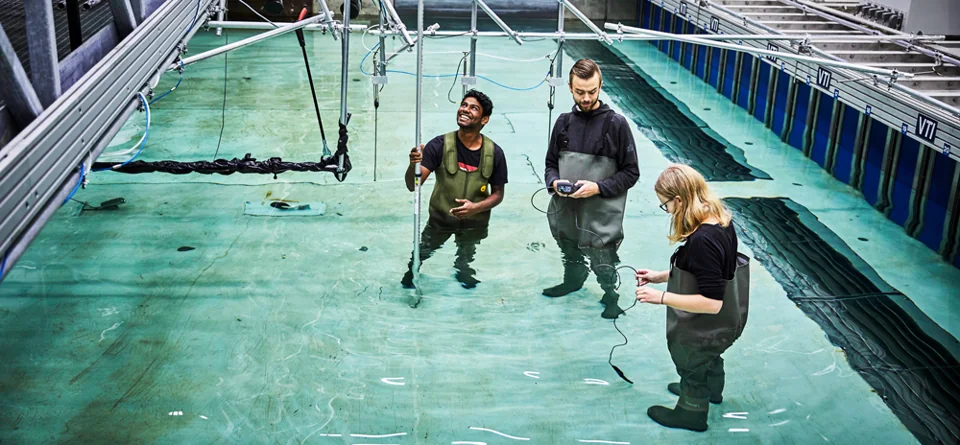
The university’s education directory identifies Aalborg, Esbjerg, and Copenhagen as its three campus cities. Its published provision includes bachelor’s, master’s, doctoral, guest, exchange, and joint master’s opportunities, together with continuing education. Bachelor’s subjects span technical science, engineering, natural sciences, social sciences, and humanities. The master’s directory also includes health sciences, illustrating the range of fields represented within the institution.
The same education pages describe research, library, and laboratory facilities for doctoral students and routes for cooperation with industry. They provide admissions guidance, student guidance, welcome-day information, and links to student life and accommodation resources. A buddy network is presented as a way for international students to settle into the university community. These resources connect the choice of an academic program with practical support and social participation, while the three-city structure gives AAU a presence in different parts of Denmark.
Sources: Education at Aalborg University ↗
Problem- and project-based learning
A distinctive feature of AAU is its pedagogical model of problem- and project-based learning. The university describes this through a combination of teacher-directed courses, case-based learning, and student-directed project work. Its principles guide the organization of programs while allowing variation between disciplines. Students are expected to engage actively with research-based theories and methods and apply them to problems with academic and wider social relevance.
Problem-oriented work involves identifying, formulating, and investigating a question in its context, drawing on disciplinary and interdisciplinary knowledge. Collaboration, independence, communication, and reflection on the learning process are part of this approach. The university also emphasizes moving from a specific example toward knowledge that can be used in broader situations. Its shared principles were reassessed during 2023–2024 and the revision was approved in August 2025. This documents an educational tradition that is periodically reviewed as teaching practice and institutional priorities develop.
Sources: Principles for problem- and project-based learning ↗
Research organization and scholarly development
AAU’s research portal provides access to researchers, publications, projects, research units, and facilities through its VBN research information system. The university describes research ambitions that extend to both local and global challenges. Its research website identifies interdisciplinary work and specialized centers, including the Center for Neuroplasticity and Pain and PREDICT, alongside pathways to the wider directory of research centers and units.
Doctoral education is organized through four doctoral schools specializing in the disciplines represented by the faculties. The university also describes AAU Excellence, a two-year talent program for early-career researchers, intended to develop academic qualifications, research competencies, and original research ideas. Other linked resources include doctoral theses, open-access journals, open publishing, and research facilities. Together, these arrangements show research as an organized activity involving infrastructure, training, information access, and scholarly communication, as well as the individual investigations carried out by academic staff and research students.
Sources: Research at Aalborg University ↗
International alliances and educational cooperation
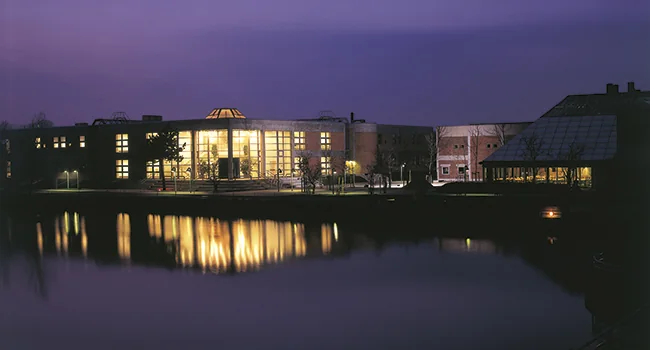
The university’s international alliances account identifies participation in Erasmus+, supporting opportunities to seek funding for student and staff mobility and international projects. AAU also lists membership in the European University Association and CESAER, connecting it with wider higher education and science and technology networks. These associations form part of the institutional relationships through which universities exchange knowledge and develop cooperation.
Other published partnerships include cooperation with the University of Greenland in education and research, and participation in the Nordic Centre associated with Fudan University in Shanghai. The alliances page also describes the Sino-Danish Centre for Education and Research as a collaboration connecting Danish universities with Chinese research and education. Nordic cooperation for university administrators adds an organizational dimension to these links. The resulting network therefore extends beyond student exchange to include research relationships, educational collaboration, and professional contact among university services and institutions.
Sources: International alliances ↗
Sustainability as a theme in student learning
AAU’s sustainability education page connects student learning with challenges that cross traditional disciplinary boundaries. It describes students developing insights and addressing problems with the broader aim of contributing to a sustainable world. This theme gives an example of how the university’s educational approach can be directed toward societal questions, linking subject knowledge with challenges extending beyond an individual course.
The university highlights student work related to the United Nations Sustainable Development Goals and opportunities to participate in larger collaborative initiatives described as mega projects. Its published material includes examples and student accounts of participation. These initiatives sit alongside the university’s broader degree programs and research activity, illustrating a practical connection between its stated commitment to sustainable solutions and the topics students can explore through collaborative academic work.
Sources: Sustainability in education ↗