Visa
Phuket Town or a beach base?
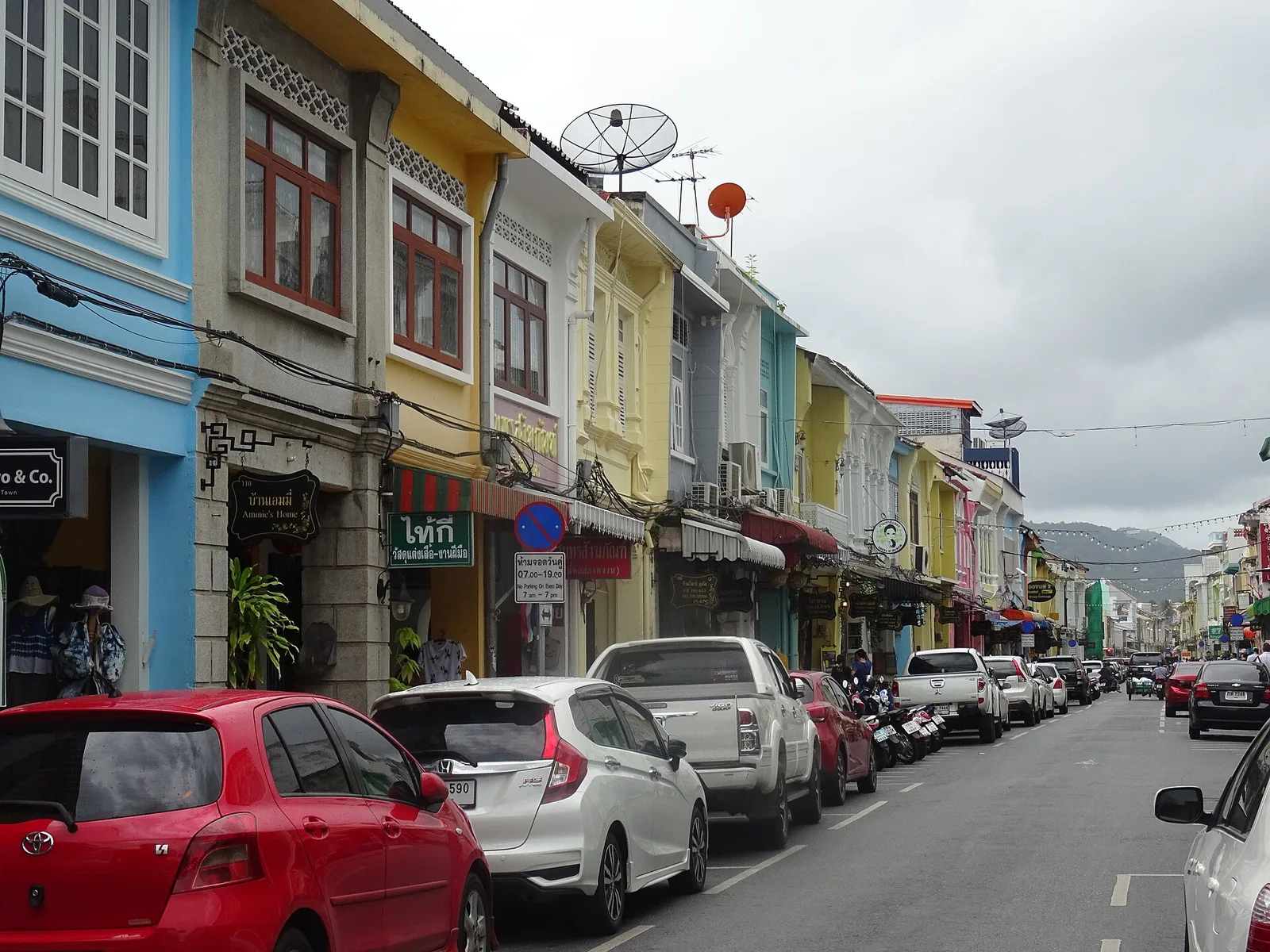
Phuket Town is the island’s provincial capital, with a historical centre shaped by commerce rather than a beachfront promenade. Its shophouses, museums and Peranakan food give visitors reasons to stay in town. A holiday built around swimming at Patong, Karon or Kata has a different geography: those beach destinations need separate journeys from the city. Decide which routine you want before choosing accommodation.
For a short stay, put the old-town streets and the places you want to enter on one map. Then add the arrival point and the accommodation. That simple exercise makes the choice more concrete than a property description saying only “Phuket”. For a possible move, add the workplace or campus and daily services instead. A visitor base chosen for an evening walk can be a useful temporary introduction, while the residential decision needs evidence about the actual commute and home. Continue with VisaWand's Thailand country guide, the Thailand destination page and consultant listings. Its Thailand location directory helps compare places.
Old-town streets and the tin trade
The Tourism Authority of Thailand's historic-streets article links the old town's prosperity to tin mining and its architectural character to several cultural influences. Mansions and shophouses give the walk its substance: look at the relationship between a commercial frontage and the building behind it, rather than using every façade simply as a colourful background.
The provincial government’s old-town overview identifies Thalang, Phuket, Ratsada, Ranong, Phang Nga, Montri, Satun, Yaowarat and Thepkasattri roads as reference points for the historical area. Choose a manageable circuit rather than attempting all of them in one walk. Jui Tui Shrine, on Soi Phuthorn off Ranong Road, brings Chinese religious heritage into that circuit. The provincial account connects its name with water and a mortar for pounding rice, recalling an earlier pond and rice-processing activity. Treat a shrine visit as entry to a religious place and follow the directions there, rather than expecting access to every interior.
Three museums with different stories
TAT's February 2025 cultural itinerary introduces Museum Phuket through the city's history and Peranakan life, including kebaya clothing. It also describes the Moh Seng Historic House Museum, with household objects from the Vuttichayan family and the history of a former watch business. These offer a way to connect the street architecture with the people who used it.
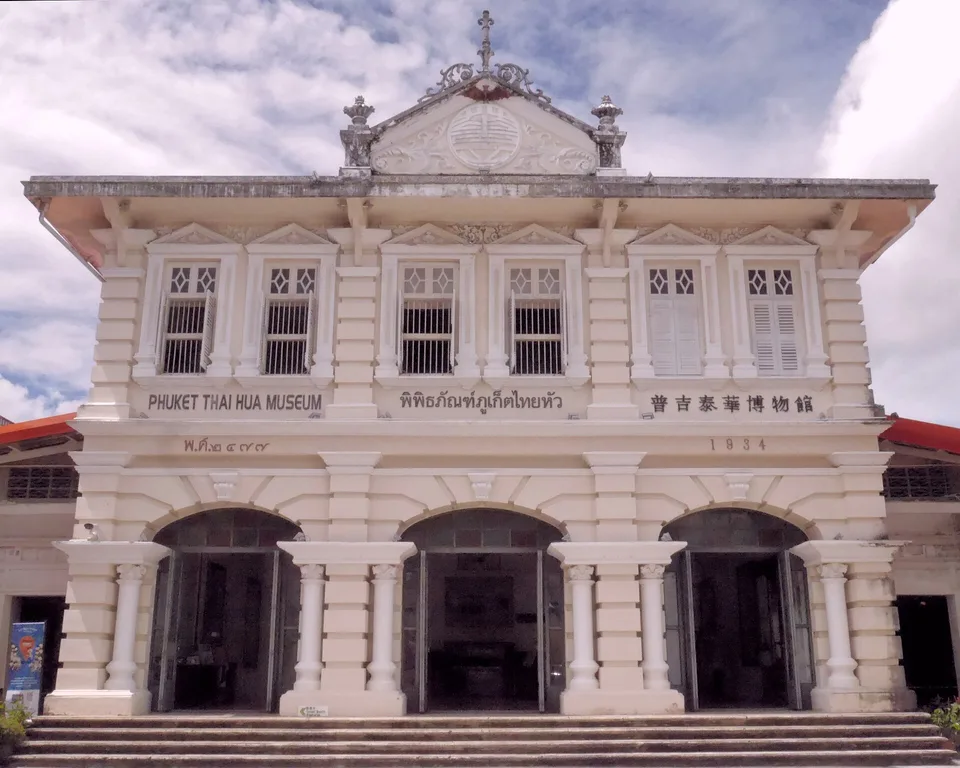
Thai Hua Museum on Krabi Road offers another perspective on the Chinese community. Its two-storey Sino-Portuguese building dates from 1934 and housed the province’s first Chinese school, established by Hokkien immigrants. The government’s account describes exhibitions about migration, beliefs, traditions, culture and relations with Phuket’s wider community. This makes it a useful choice for understanding the people behind the town’s architecture. Museum Phuket, Moh Seng and Thai Hua have distinct subjects; choose one for a short visit instead of treating them as interchangeable stops. Confirm current admission and access with the institution: the older tourism descriptions establish the historical context, but not today’s ticket price.
Peranakan culture and the Sunday walking street
Thailand’s government account of the old town connects its Peranakan character with Chinese, Malay and Thai influences. Architecture is one expression of that mixture; clothing is another. The account describes Baba dress using lace shirts and embroidered batik sarongs. Looking at buildings alongside museum displays of dress and household objects gives the walk more depth than concentrating entirely on colourful façades.
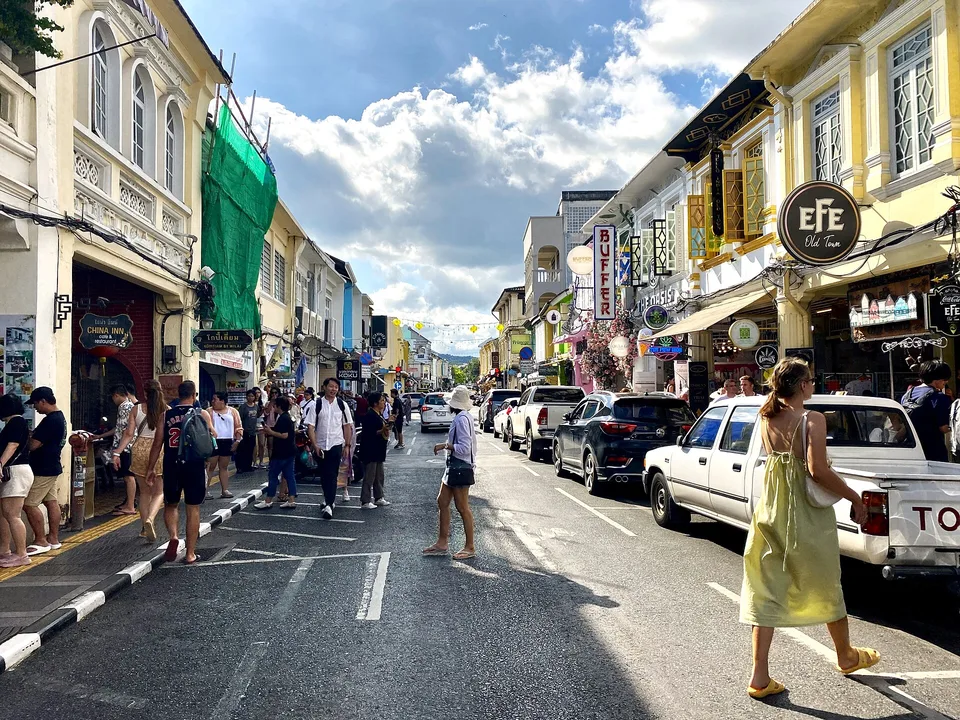
The same account describes a Sunday walking street selling food, local snacks and souvenirs. It provides a reason to arrange a town evening around browsing and eating, rather than immediately returning to a beach base. Confirm the current event notice when choosing the date, and leave space for a meal as well as smaller tastings. For purchases, compare displayed prices and think about luggage space; food intended for immediate eating and something to carry home make different demands. The market is an opportunity to explore the town’s commercial life, without assuming that every stall offers handmade or locally produced goods.
Hokkien noodles, o-tao, lo-ba and o-aew
A May 2026 government feature on Phuket's food culture adds useful detail to the dish names. It describes Hokkien noodles as thick yellow noodles stir-fried with seafood and sauce; o-tao combines batter, taro, egg and oysters; lo-ba is fried pork served with a dipping sauce. O-aew, a jelly dessert with syrup and shaved ice, offers another direction after a savoury meal.
That ingredient list matters when choosing what to try. Someone avoiding shellfish or pork needs a conversation with the kitchen, rather than relying on a broad description such as “local food”. Plan one or two dishes that interest you and leave space to discover another on the day. The town's breakfast places, noodle shops and cafés in historic buildings also let food become part of the street itinerary. The attraction is the connection between buildings, everyday business and culinary heritage, rather than a claim that every historic address serves an exceptional meal.
Where to stay for a town-based visit
Start with the experiences you want to repeat. A room near the old-town streets can make museum visits, meals and evening walks easier to organise; a beach-based stay serves a different routine. Compare the route between the actual property and the places you expect to use, rather than accepting “central” or “near Phuket” as sufficient detail.
A private hotel room, hostel bed and self-catering accommodation provide different levels of space and privacy. Ask about room occupancy, bathrooms, windows, air conditioning, luggage storage and late-arrival arrangements. For a longer visit, cooking and laundry provision may matter more than a decorative lobby. Compare complete quotations for the same dates, including any additional charges and cancellation conditions. If the visit is preparation for a move, a temporary room can give you time to inspect homes. Do not make a long residential commitment solely because the short-stay photographs and visitor location look appealing.
The orange airport bus to Phuket Town
Airports of Thailand identifies the orange airport bus, route 8411, as a connection to Phuket Town. The airport's instructions direct passengers towards the public-transport parking area from exit 3. It says tickets can be purchased on board or through the operator's website, with fares calculated by distance; payment information includes cash and QR payment.
Establish the town stop and the final journey to the room before choosing this service. Do not apply another bus company's beach-route price to route 8411. The airport listing contains inconsistent operating-status fields, so confirm the departure through the operator rather than treating the page's displayed hours as a reliable last-bus promise. For a late arrival or several people with luggage, compare a complete transfer quotation against the bus and onward travel. Include baggage collection and reaching the boarding point when estimating when you will reach the accommodation.
Bus Terminal 1 and Terminal 2
Phuket Smart Bus's September 2026 terminal guide places Bus Terminal 1, the old terminal, in Phuket Town close to the historical centre. It distinguishes Terminal 2 as a point for long-distance services, including connections with Bangkok and other provinces. The guide describes its own route linking the terminals with the journey towards Patong.
Use the terminal printed on the actual coach booking, then plan the onward route from that address. “Phuket bus station” is insufficient detail when arranging collection or calculating a transfer. If changing services, allow time to locate the boarding point and account for luggage. The old-town end of a journey and the place where an interprovincial coach arrives can be different, even when both are described broadly as Phuket. Keep the return departure terminal just as clear.
The Dragon Line and connections to Patong
Phuket Smart Bus's route information distinguishes three services. Its airport-to-Rawai route runs through west-coast beach areas including Patong, Karon and Kata. Route 2 connects Bus Terminal 2, Phuket Town and Patong. The Dragon Line is a free city shuttle described as linking Central Festival, the old town and the OTOP market. These are different routes with different purposes.
For a city-based visitor, start with the Dragon Line's stops and Route 2 if Patong is part of the plan. Use the operator's timetable images and live tracking to establish the departure and boarding point; the operator warns that times can vary with traffic. A route passing through the town does not establish that it stops outside your property. Plan the final walk and the return before setting off, particularly when a meal or event will finish after the convenient daytime connection.
Bus fares and payment methods
Phuket Smart Bus's payment page publishes a flat ฿100 fare for its airport–Patong–Rawai service, ฿50 for the bus-terminal–Patong route and free travel on the Dragon Line. It lists contactless Visa, Mastercard and JCB cards, cash, and QR payment through Thai banking applications. Having a foreign banking app does not itself establish that its QR function will work with that payment method.
Choose a method you can use and carry a workable alternative. The operator appreciates the exact cash fare and says a receipt can be requested from the driver. Check that the displayed fare corresponds to the route you are boarding, especially where several services appear in the same itinerary. Keep the figures as transport costs rather than turning them into an unsupported daily budget for accommodation and food. Any issuer charges associated with a payment card belong in your own calculation.
Andaman weather and seasonal rain
The Thai Meteorological Department's climate explanation distinguishes the southern west coast from the east coast. It describes the west coast as receiving more rain during the southwest-monsoon rainy period, with a typical peak in September. This regional pattern is useful background for Phuket; it is not a forecast for a particular afternoon or evidence that the remaining months are rain-free.
Build a city itinerary that can move between a street walk and an indoor visit. For an island or boat outing, use the current marine forecast and operator's decision, rather than inferring sailing conditions from whether it is raining in town. Protect an irreplaceable flight connection from dependence on a weather-sensitive excursion. Pack for walking in humid conditions and keep plans flexible enough to change the longest outdoor activity. The climate explanation's older regional averages should not be presented as newly measured city conditions.
Rang Hill and Saphan Hin: two outdoor alternatives
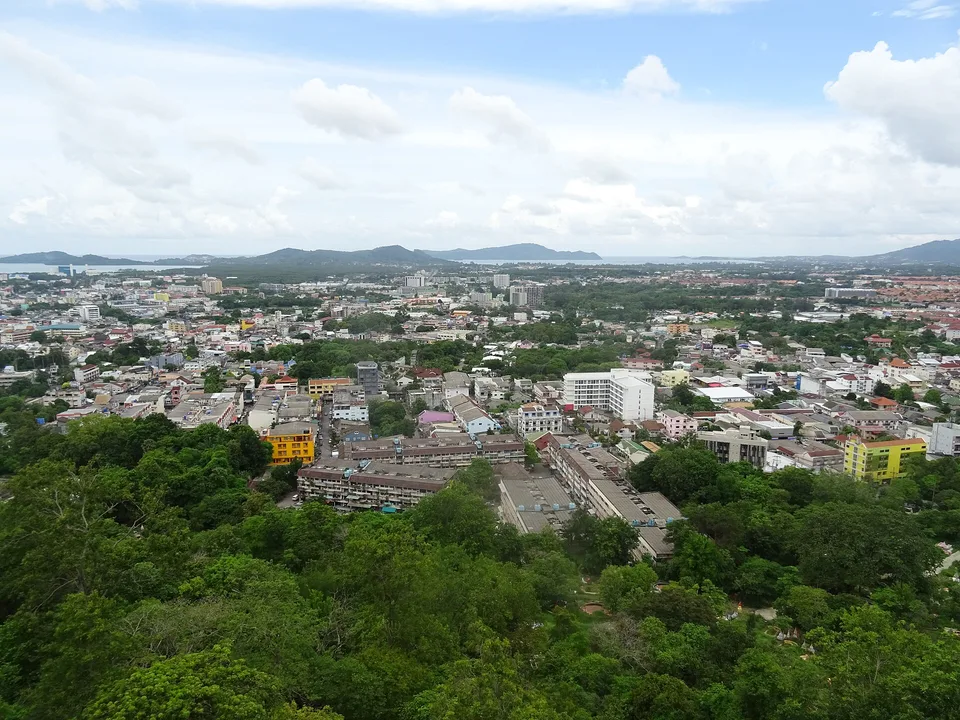
The provincial government's Rang Hill page describes views over Phuket Town, an exercise park on the approach and park space on the hill. It offers a change from looking at buildings at street level: the town becomes a wider setting rather than a series of individual façades. Consider the outing when you want that perspective after exploring the historical streets.
For a different outdoor setting, Saphan Hin lies at the end of Phuket Road beside the coast. The provincial government identifies its sports complex and use for exercise, along with a tin-mining monument erected in 1969. The monument commemorates the arrival of the first tin dredge brought by Australian Captain Edward Thomas Miles in 1909. This gives the park a connection to the same industry that shaped the old town’s architecture. Choose Rang Hill for the elevated view or Saphan Hin for a coastal park outing; neither needs to become another full sightseeing programme after a long museum day.
Budgeting for transport, food and accommodation
Two ฿50 journeys on the published bus-terminal–Patong service total ฿100 per person. That is an illustrative return transport calculation, not a package including another route or attraction. A free Dragon Line journey can reduce a particular city transport cost, but it does not make a day of shopping and eating free.
Separate accommodation, airport travel, local journeys, admissions, meals and purchases. Compare room quotations for the actual dates and use current menus for the food allowance; an old island-wide cost estimate is a weak basis for a specific city stay. Keep an allowance for a changed transport plan, especially when luggage or timing makes the cheapest route unsuitable. For shopping, decide what you want to take home before browsing, and check the item's price and transport practicality. A smaller number of deliberate purchases makes the budget easier to understand than an undefined allowance for “extras”.
A three-day itinerary based in town
This suggested plan gives the town its own time and leaves one optional outing. Adjust it to museum opening arrangements, transport departures and the weather.
On the first day, explore a manageable circuit around Thalang and the neighbouring historical streets. Make lunch part of that circuit, with time to read a menu and choose a local dish. If the visit falls on Sunday and the walking street is confirmed, return for the evening rather than trying to complete every stop during one continuous walk.
Use the second day for a museum whose subject interests you, then revisit the streets with that context. Rang Hill can provide a different perspective later, provided the journey and conditions suit the household. Leave the evening open for a meal rather than another distant attraction.
On day three, choose between more city time and a planned trip towards Patong using the appropriate connection. Treat the outing as a complete return journey, with a separate budget. A flight day is better kept for a shorter activity with a dependable route back to the accommodation and airport.
Other island locations worth comparing
Phuket Smart Bus's airport–Rawai route overview identifies Cherng Talay, Surin, Kamala, Patong, Karon, Kata and Rawai among its stops. Those places belong in an island comparison, rather than being presented as neighbourhoods of the historical town. Decide whether repeated city meals and museum visits or repeated beach outings will shape the stay, then compare accommodation and travel around that choice.
A split stay may be worth considering when both experiences matter, but include the cost and time of moving rooms. Pack-up, luggage storage and check-in can consume part of a short trip. For an outing, confirm the return service and any connection back to the town before travelling; the airport–Rawai route is not a direct town-centre shuttle. VisaWand's Patong location page supplies another place to compare, while its Bangkok city guide covers a different urban experience for a wider Thailand itinerary. Compare the journeys between destinations as well as the destinations themselves. Avoid turning a short city visit into a succession of transfers that leaves little time for the food, streets and museums that made Phuket Town appealing.
Housing and the daily commute
For a residential move, mark the real workplace or campus before comparing homes. Test the journey at the time you would normally make it, including the walk, wait and final connection. A town address may fit one household's routine and be inconvenient for another whose daily destination lies elsewhere on the island. Assess the route in person where possible.
Compare proposed rent alongside the deposit, building charges, utilities and any agency fee. Ask how electricity and water are billed and request the terms in writing. Inspect ventilation, air conditioning, signs of damp, storage, cooking and laundry arrangements. Establish responsibility for repairs, an inventory and the condition at handover. A home suitable for a holiday can still leave a resident with an awkward commute or insufficient household space. Use a temporary stay to resolve those questions before selecting a longer contract, and obtain qualified help with terms you cannot confidently interpret.
Water, electricity and household services
The Provincial Waterworks Authority's service page links applications, bill payment and account-checking tools. Its customer FAQ describes making a supply application through the office for the relevant area with supporting property documents. Establish who supplies the particular home and whether you will hold an individual account, use a building arrangement or pay the landlord; do not apply a general new-connection process blindly to an occupied rental.
PEA's document directory separately lists new-service guidance, account-holder transfers and cancellation procedures. Choose the process that matches the existing supply. At handover, retain the account details, meter readings and agreed payment responsibilities. Arrange internet around the provider's actual installation availability, and assess mobile reception where you will work. Healthcare coverage, medicines and any school or childcare requirement also belong in the household plan. Resolve availability and costs with the relevant provider before committing the arrival date to services that have not been arranged.
Thailand Digital Arrival Card: a separate arrival step
The Immigration Bureau's Thailand Digital Arrival Card guidance explains that submission is free and instructs travellers to submit within the three-day window before arrival, including the arrival date. The card is for one entry; a later entry requires a new submission. Its information includes passport details, travel and arrival information, a Thai address and an email for the confirmation.
The guidance distinguishes entering Thailand from transit without passing immigration: that transit does not require the card. It also identifies a crew exemption. Prepare the information from the actual travel documents and accommodation booking, and retain the confirmation. If the flight or address changes, follow the official update or new-submission process so the record is accurate before entry. Completing an arrival card is separate from establishing the appropriate entry permission; it does not make a visitor stay an authorisation for employment, study or permanent residence.
Tourism visas and permitted stay
The Royal Thai Consulate-General in Los Angeles explains the tourism-and-leisure visa as a tourism route, with visa validity and permitted stay treated separately. The distinction matters: the window for using a visa is not necessarily the length of the stay granted on entry. Its instructions also make clear that tourism permission does not authorise work-related activity.
Use that official explanation as an introduction, then check the mission responsible for your nationality and place of residence. The Los Angeles document checklist, fees and processing estimates are not universal requirements for every reader. Establish whether the intended visit requires an application or falls under another applicable entry arrangement before buying non-refundable travel. Keep the route, passport and supporting documents consistent with the actual purpose. Any extension is a separate question for the appropriate authority; an accommodation booking or a wish to remain longer does not establish approval.
Employment, study and longer residence
The same consulate's Non-B guidance separates business visits, teaching and employment or internships. Its employment documentation includes the relevant labour approval or work-permit evidence, with category and nationality qualifications. A company invitation, business meeting and a proposed job should therefore be assessed according to the actual activity, rather than treated as interchangeable reasons for entering Thailand.
Its ED and ED Plus study guidance distinguishes education levels and activities, with supporting letters and enrolment evidence. Confirm the institution, campus, timetable and route before choosing accommodation around a course. The consular pages provide official examples, but their local application requirements must be checked with the mission responsible for you. For a long-term move, separate temporary residence, work permission and any eventual permanent-residence objective. Make the budget from the actual job or course and household needs; none of those permissions follows automatically from renting a home in Phuket Town.
Official planning resources
Reviewed 14 October 2026. Use the official resources linked throughout this guide for admission, transport, housing and immigration decisions. Prices, services and rules can change; confirm the details relevant to your dates. Photography illustrates the locations and is not a live view.
View all official resources
- TAT historic streets and tin-trade context
- Phuket provincial old-town streets
- TAT cultural itinerary and town museums
- Government old-town cultural and food overview
- AOT Phuket Town airport bus route 8411
- Phuket Smart Bus routes, shuttle and timetables
- Phuket Smart Bus fares and payment
- Operator Bus Terminal 1 and 2 explanation
- TMD southern west-coast climate explanation
- Official Thailand Digital Arrival Card guidance
- Government May 2026 Phuket food culture
- Provincial Rang Hill viewpoint information
- PWA service applications and billing tools
- PWA customer supply application guidance
- PEA customer document directory
- Official Los Angeles tourism visa explanation
- Official Non-B purpose and employment documentation
- Official ED and ED Plus study guidance
- Phuket Smart Bus coastal route locations
- Thai government: Thai Hua Museum and Phuket’s Chinese community
- Phuket provincial government: Saphan Hin park and tin-mining monument
- Phuket provincial government: Jui Tui Shrine location and history
Plan the next part of your journey
Explore the Thailand guide, browse other cities or compare consultants for your travel and relocation questions.