Visa


About Asian School of Business
An undergraduate institution in Noida
Asian School of Business, usually abbreviated ASB, is an undergraduate institution in Noida, Uttar Pradesh, India. It is part of the Asian Education Group and offers programmes spanning business administration, computer applications, commerce, computer science and psychology. Its institutional introduction identifies Chaudhary Charan Singh University, Meerut, as the university with which these degree programmes are affiliated. The school describes its teaching as combining academic knowledge with practical work, including live projects, case-based learning, certification courses and communication development. Students encounter professionals from different disciplines through its teaching environment. ASB's stated educational approach emphasises management and technical skills, critical thinking, decision-making and an entrepreneurial outlook. Research aptitude is another expressed aim, linked to analysing emerging issues in industry. The range of subjects brings business, technology and behavioural study into the same institution, while each programme page sets out its own curriculum and learning activities.
Sources: About Asian School of Business ↗
Business administration and applied management
The Bachelor of Business Administration is presented as a three-year, full-time programme organised into six semesters. Its teaching combines management concepts with exercises in applying them to business situations. Lectures are complemented by case studies, role plays, simulations, group discussions and mentoring. The programme description also includes industry visits, conferences, internships and research-based projects. Listed university specialisation choices cover marketing, finance, business analytics, international business, human-resource management and supply-chain management. Separate certification choices include artificial intelligence, entrepreneurship and new-venture creation, family-business management, and real-estate management. The published first-semester subjects include principles and practices of management, business communication, financial accounting, business statistics and logic, general English, Indian knowledge systems, and environmental science and sustainability. Together, these subjects connect the business foundation with quantitative, language and wider contextual study. Practical exposure and communication workshops are incorporated into the programme's described approach to learning and evaluation.
Computer applications and practical projects
The Bachelor of Computer Applications is another three-year, six-semester route. It combines information-technology study with foundations in mathematics and management, placing emphasis on translating concepts into working projects. The programme describes laboratory activities, clubs, programming-language training and industry-specific IT projects as part of learning beyond conventional classroom study. Its university specialisation options are artificial intelligence and machine learning, full-stack development, and data science. Additional certification pathways address cyber security, cloud computing and DevOps, or project management. The first-semester curriculum lists mathematical foundations for computer science, computer architecture, problem-solving techniques and general English, alongside Indian knowledge systems and environmental science. An additional web-analytics certificate is described through topics such as search-engine optimisation, digital metrics and online marketing tools. This combination gives the programme a particular focus on applications, development and the management of digital work, supported by laboratory projects and industry exposure.
Sources: Bachelor of Computer Applications ↗
Commerce, accounting and business understanding
The Bachelor of Commerce is described as a three-year, full-time programme with six semesters. Its academic foundation covers commerce, economics, accounting, finance and the business environment. ASB presents the course as an opportunity to connect commercial principles with practical situations through cases, role plays and integrative exercises. The programme description also addresses policy frameworks, organisational change, entrepreneurship and the increasing use of technology in commercial activity. Its published first-semester papers include business organisation, financial accounting, business communication, introduction to computer applications, general English and environmental studies. Certification options listed alongside the degree cover artificial intelligence, entrepreneurship and new-venture creation, banking and insurance, and financial markets. These provide different areas of additional study around the commerce foundation. Project work, industry visits, workshops and internships appear within the published learning approach, while the course's stated objectives include analytical reasoning and the practical application of commerce knowledge.
Sources: Bachelor of Commerce ↗
Computer science from theory to laboratory work
The Bachelor of Science in Computer Science is a three-year, six-semester programme. Its subject description brings together programming, hardware and software, networking, databases, mathematics, statistics and electronics. Algorithms, data structures and software-engineering principles are part of its account of the technical foundation. The programme's teaching methods include project-based learning, interactive laboratories, collaborative tools, expert sessions and mentoring. Beyond classroom work, the school lists hackathons, coding competitions, research projects, technical conferences, field visits and internships. Additional certification options address artificial intelligence and machine learning using Python, the Internet of Things, data science and back-end engineering. The first-semester outline includes applied mathematics, applied physics, computer fundamentals, Windows and office tools, with separate laboratory exercises in physics and computing. English and professional communication accompany these technical subjects, showing the combination of scientific, practical and communication work within the published course structure.
Sources: Bachelor of Science in Computer Science ↗
Psychology, observation and research
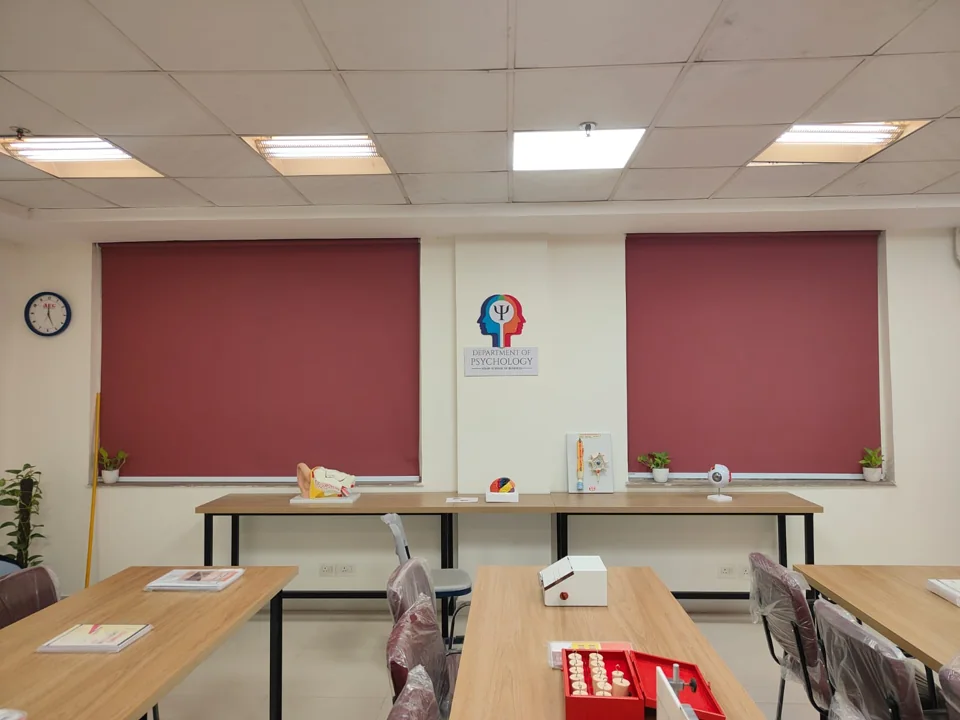
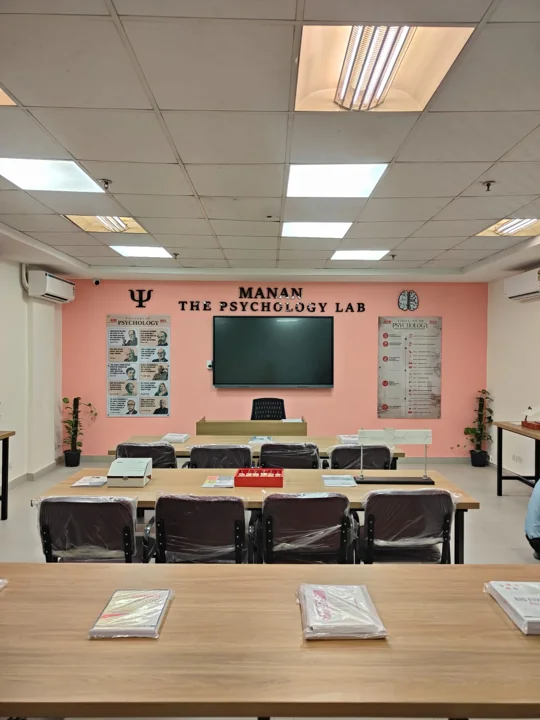
The BA Honours in Psychology is described as a four-year programme with eight semesters. It introduces cognition, emotion, personality, social interaction, wellbeing and applied psychology. Teaching activities include observation, experiments, case discussions, surveys, reflective journals and presentations. Laboratory study involves assessment tools, interpretation and report writing, with consent, confidentiality and responsible reporting explicitly included in the programme's approach. Its first-semester outline includes introductory psychology, psychology in everyday life, basic research methods and statistics, psychological-assessment laboratory work, and life skills and wellbeing. Additional study areas include artificial intelligence and psychology, consumer psychology and advertising, and data analytics and research methods. The department's published laboratory gallery shows teaching spaces and equipment used to connect theoretical learning with structured practical activity.
Sources: BA Honours in Psychology ↗