Visa

About Asian Law College
A law college in Noida
Asian Law College is a legal-education institution in Noida, Uttar Pradesh, within the Asian Education Group. Its campus address is Plot A2, Block C, Sector 125, in India’s Delhi National Capital Region. The college offers B.A. LL.B., B.Com. LL.B. and LL.B. programmes, bringing together integrated undergraduate study and a law course for graduates from other disciplines.
Its institutional mission connects legal theory with practical application, ethical conduct and public-interest concerns. The college describes research, critical inquiry and experiential learning as central to this approach. A skill-development initiative called the Crafting Prodigy Programme uses mentors to help students identify and develop their abilities. The Student Career Development Cell organises interaction with practitioners and visits to professional settings as part of the college’s account of practical legal education.
Sources: Why Asian Law College ↗

Arts and law in one programme
The five-year B.A. LL.B. integrates humanities and social-science subjects with legal study across ten semesters. Its opening curriculum includes English, sociology, political theory, economics and Indian history. International relations, public administration and legal writing extend this foundation, while torts, contracts and constitutional history introduce legal concepts and institutions.
Later subjects include constitutional law, jurisprudence, family law, environmental law and public international law. Professional ethics, alternative dispute resolution, pleading and conveyancing are identified as practical-training components. The final stage includes moot-court work, pre-trial preparation and participation in trial proceedings. The programme’s stated learning outcomes address interpreting legal texts, researching cases and statutes, analysing arguments and understanding legal questions within their wider social and historical settings. Oral and written communication accompany this disciplinary study.
Sources: B.A. LL.B. Programme ↗
Commerce alongside legal study
The B.Com. LL.B. is another five-year integrated programme, combining commerce and management with law. The opening subjects include business environment, managerial economics, organisational behaviour and human-resource development. Sales management, marketing, entrepreneurship, consumer behaviour, auditing, financial management and information systems appear in the earlier semesters, providing a business-oriented context for subsequent legal work.
The legal curriculum includes contracts, constitutional law, jurisprudence, family law, company law, labour law and property. It also addresses banking, taxation and consumer protection. Practical components cover professional ethics, dispute resolution, drafting and moot-court work. The programme description explains its interdisciplinary purpose through the relationship between commercial organisations and legal questions. Its learning objectives include examining financial and legal problems, researching commercial contracts and communicating arguments with attention to ethical responsibility.
Sources: B.Com. LL.B. Programme ↗
The three-year law route
The three-year LL.B. is organised into six semesters and is intended for graduates from different academic disciplines. It begins with legal theory, constitutional principles, torts, criminal law and contracts. Subsequent study develops legal concepts through family law, international law, administrative law, property, company law and labour law.
Practical training is distributed through the programme. The published curriculum includes professional ethics and bar–bench relations, arbitration and other forms of dispute resolution, drafting pleadings and conveyancing, and moot-court and trial-related work. Legal language and writing are also included. Optional areas encompass subjects such as intellectual property, cyber law, information rights and laws concerning women and children. The college’s programme outcomes emphasise legal research, identifying relevant facts, evaluating competing arguments and presenting conclusions clearly in writing and speech.
Sources: LL.B. Programme ↗
Learning through simulated practice
The college’s teaching approach uses mock trials, debates, moot courts, role play and drama alongside conventional lectures. Presentations, group discussion, case studies, seminars and project work provide additional formats for investigating legal problems. Class presentations and research assignments are intended to develop reading, writing and research together, rather than treating them as separate activities.
A workshop model emphasises teamwork, project portfolios and practical integration. The college identifies leadership, managing conflict and working with others among the abilities developed through collaborative tasks. Group projects also bring together students who may not already know one another. Portfolios record work completed in courses and can be used when discussing internships or professional opportunities. These methods give practical exercises a continuing place within the academic programme.
Sources: Teaching Pedagogy ↗
Research organisation and support
The Research and Development Cell coordinates scholarly inquiry among faculty and students in law and related disciplines. It provides guidance, resources and opportunities for publication, collaboration and participation in conferences, seminars and workshops. Its stated aims include socially relevant scholarship, legal reform, policy development and cooperation between disciplines.
The cell’s objectives include supporting research projects, encouraging journal publication and organising training in research methodology, intellectual property and emerging legal questions. Research ethics and academic integrity are explicit concerns, including mechanisms for checking plagiarism. The cell also identifies maintaining a database of publications and research metrics among its functions. Student mentoring covers dissertations, moot-court research and publication. These activities place research support within the college’s wider teaching environment and connect individual work with institutional coordination.
Sources: Research and Development Cell ↗
Moot courts and advocacy exercises
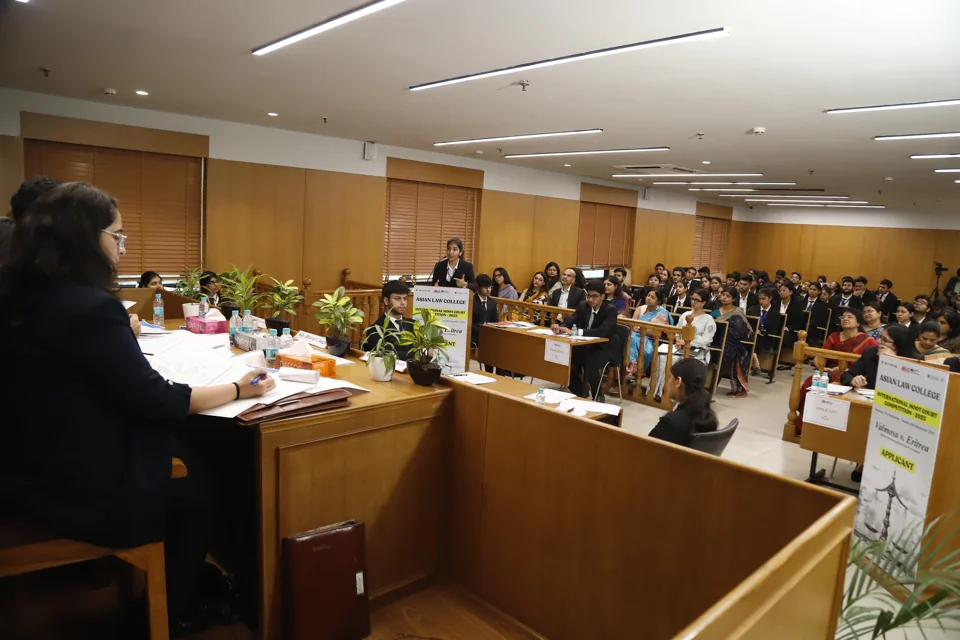
Asian Law College has a dedicated Moot Court Hall with witness boxes, pleading podiums and microphones. Its Moot Court Committee informs students about competitions and coordinates faculty preparation. The committee also arranges interaction with practising advocates, connecting simulated proceedings with discussion of courtroom conduct and legal argument.
The college’s event record illustrates several forms of advocacy training. A novice competition in February 2026 used a constitutional-law problem involving freedom of expression and artificial-intelligence-based content regulation. A public-interest-litigation drafting and presentation competition followed a preparatory drafting workshop. Other documented exercises include judgment analysis, client counselling, mediation and negotiation. The International Moot Court Competition held in September 2025 brought national and international teams together to argue questions of international law, including humanitarian principles and treaty obligations.
Sources: Moot Court Competitions ↗