Visa

About Asia Euro University
A university in Phnom Penh
Asia Euro University is based in Phnom Penh, Cambodia. Its published address is on Kampuchea Krom Boulevard, in the Toul Kork area of the capital. The university identifies three building locations, named Silver, Gold and The Gateway. Its academic provision spans foundation-year study, associate and bachelor’s degrees, master’s study and doctoral education.
The institutional homepage brings together language, computing, business, economics, law and public-affairs subjects. It also describes classrooms, laboratories, meeting rooms, libraries and internet access as parts of its learning environment. Seminars and individual or group projects complement formal teaching. This combination presents a university with several levels of study and a subject range extending across both technical and nontechnical fields, organised around facilities within its Phnom Penh setting.
Sources: Institutional homepage ↗
Institutional direction and educational aims
The rector’s institutional message identifies AEU as a private Cambodian university and describes its development over more than two decades. The account places recent organisational reforms within the Strategic Plan for 2023–2027. Governance, institutional development, teaching, student affairs, research, capacity building and digital innovation are identified as areas of attention.
The message connects academic programmes and research with changing social and employment needs. It describes specialist knowledge, information and communication technology, moral education and physical education as elements of the educational approach. These priorities are presented in relation to Cambodia’s wider higher-education reform agenda. The university also invites students, families and members of the public to learn about its work through the website or a visit, linking institutional information with direct engagement with its educational community.
Sources: Rector’s institutional message ↗
Science, computing and engineering
The Faculty of Science and Technology describes associate-level and bachelor’s education in technological subjects. Its departmental introduction identifies computer science, information technology, and architecture and engineering as organisational areas. Information technology includes computer systems and network administration, while the engineering account identifies electrical and electronic engineering.
The faculty’s published subject headings also include data science, artificial intelligence and machine learning, digital design and cybersecurity. Its educational aims connect these fields with industrial development, innovation and Cambodia’s changing economy. Curriculum modernisation, physical facilities, collaboration and research appear within its goals. The faculty therefore presents technical education as involving both specialist subject knowledge and the organisation of resources that support learning. Its account places these activities within the university’s broader five-year planning framework.
Sources: Science and Technology ↗
Business administration and tourism
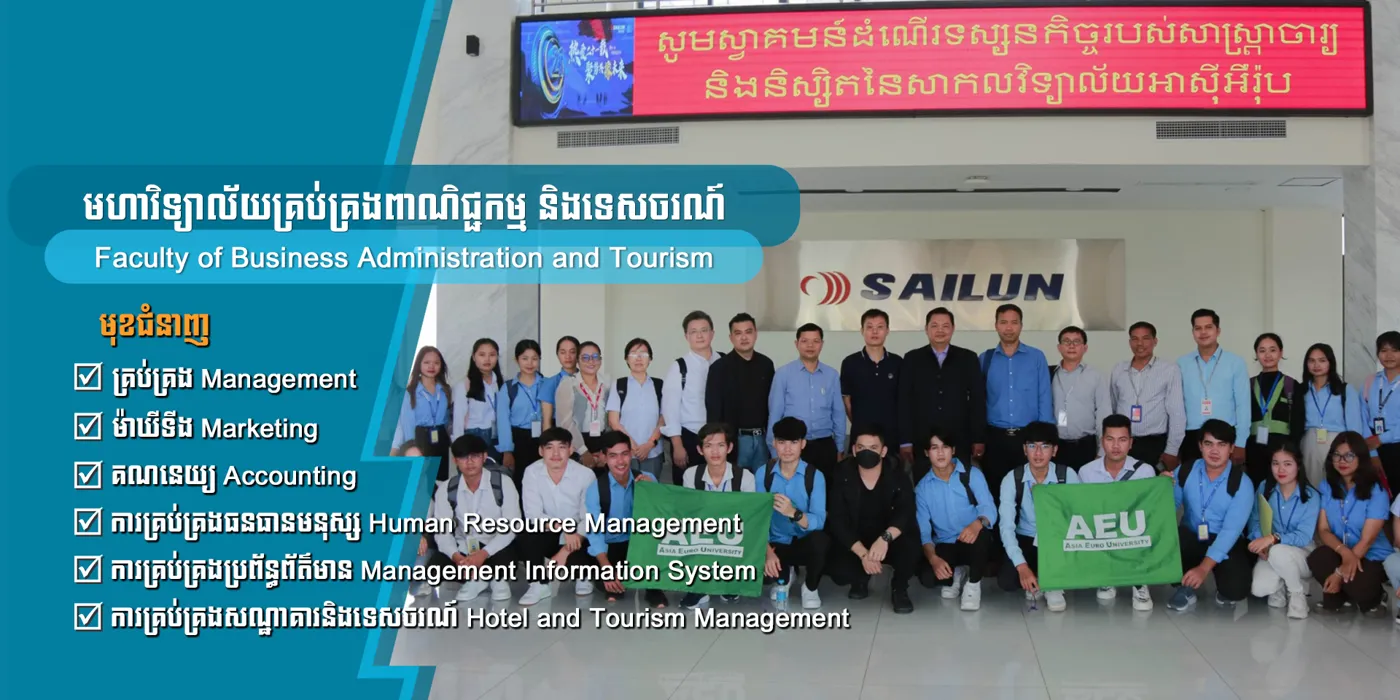
The Faculty of Business Administration and Tourism provides associate and bachelor’s education in business-related subjects. Its published fields include accounting, management, marketing, human resources, information systems, supply chains, and hotel and tourism management. The faculty connects these disciplines with entrepreneurship, practical skills and professional responsibility.
Its stated programme-development approach includes regular curriculum review, technology-supported education, foreign-language learning and research. Cooperation with parents, students, lecturers, university staff and employers is described as part of that process. The faculty’s mission also addresses student discipline, efficient management, service to students and the diversification of short courses. These aims bring the content of business education together with the ways it is taught and administered. The emphasis on theory, practical knowledge and ethics provides a common framework across its different specialisms.
Languages, humanities and active learning
The Faculty of Arts, Humanities and Foreign Languages comprises English, international relations and Chinese departments. Its published subject areas include English teaching, professional communication, translation and interpreting, international business, Chinese literature and business Chinese. The faculty describes outcome-based education as a means of focusing teaching on abilities students can demonstrate.
Learning activities include language and skills competitions, research projects, pedagogical training and practical internships. Critical thinking, problem solving, creativity and professional ethics appear among its educational priorities. The faculty also describes continuing development for lecturers and clearer assessment of student competence. These are presented as components of its improvement programme. Its account connects language learning with practical communication and broader understanding of professional contexts, while maintaining separate departmental areas within the humanities and foreign-language portfolio.
International cooperation and career support
The Office of International Relations and Careers links external cooperation with support for students preparing for professional activity. It is organised into international-relations and jobs-and-careers units. Its account describes institutional agreements concerning exchanges, curriculum development, joint research, cultural activities, study tours and internships.
Career services include counselling, seminars, curriculum-vitae workshops and interview preparation. The office also contacts organisations about internship and employment opportunities and helps prepare documentation for overseas study tours and youth camps. Domestic and international educational visits form another part of its stated services. These activities connect academic experience with organisations beyond the university. The published remit therefore combines the practical coordination of international activity with guidance for students exploring their next steps, rather than treating international partnerships and career preparation as entirely separate functions.
Internal review and continuing improvement
AEU’s internal quality-assurance account records the establishment of its committee on 3 August 2013. The committee’s remit includes self-assessment at programme, faculty and institutional levels. Its published objectives emphasise evidence of improvement, innovation and responsiveness to the needs of students and other stakeholders.
The quality-assurance framework also calls for regular interaction among educators, administrators and researchers. Social responsibility, ethics and environmental effects are identified alongside academic-management concerns. The office’s 2023–2027 plan is organised around governance and management, the implementation of quality-assurance processes, and evaluation of performance and outcomes. These are institutional responsibilities and planning priorities described by the university. Together, they show how review and feedback are intended to inform the development of teaching, administration and the wider educational environment.
Sources: Internal Quality Assurance ↗