Visa
About ACLEDA University of Business
From professional training to a university
ACLEDA University of Business is a Cambodian higher education institution whose development is closely connected with ACLEDA Bank. Its institutional profile traces the origins of its training work to a technical support team within ACLEDA in 1993, followed by specialist training functions as the organisation developed. A training centre was established in 1998, and later organisational changes expanded the provision for banking and microfinance personnel.
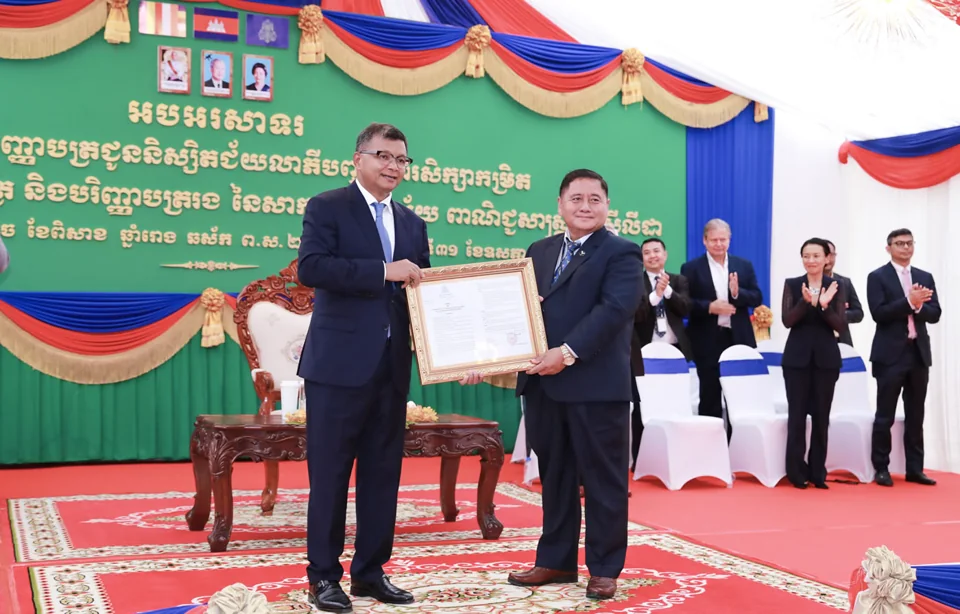
ACLEDA Training Center became a legal entity in 2011, bringing together the bank’s training division and the ACLEDA-ASEAN Regional Microfinance Training Center. It subsequently developed into ACLEDA Institute of Business under a January 2016 sub-decree. The institute’s transformation into ACLEDA University of Business was recognised through Sub-Decree No.27 dated 12 February 2024. The sequence distinguishes the institution’s long training history from the later establishment of its institute and university identities.
The university’s recognition announcement identifies associate, bachelor’s and master’s study within its academic offer. Its profile also describes continuing professional training for organisations and individuals, retaining a connection with the practical educational role from which the institution developed.
Sources: Institutional profile ↗ · Recognition as a university, February2024 ↗

Institutional purpose and professional education
The university operates as a private limited company under Cambodian law, with ownership held by ACLEDA Bank and ACLEDA Financial Trust. Its stated mission brings together knowledge, professional skills, creativity, practical experience, ethical awareness, networking, and research and publication skills.
The mission describes on-campus and online education as routes through which students can develop these capabilities. Good corporate governance, respect for a diverse and multicultural society, legal responsibilities and environmental awareness are included in the institution’s account of professional education.
Quality, integrity and professional skills are presented as core values. The university describes education as preparation for lifelong professional activity, with academic learning connected to conduct and practical capability. This framework is particularly relevant to the business and financial fields associated with its origins, while also supporting a wider range of academic disciplines.
Sources: Vision and mission ↗
Degrees and the curriculum structure
AUB organises its academic year around two semesters using a semester-block programme. Its published curriculum list covers associate, bachelor’s and master’s qualifications. Associate subjects include accounting, English, export-import management, finance and banking, insurance, logistics and marketing.
At bachelor’s level, the listed fields range across accounting, business and enterprise management, business economics, business information technology, computer science and engineering, and data science. Other options include finance and banking, financial technology, international business, law, marketing, risk management and insurance, and supply-chain management and logistics.
Language-related bachelor’s pathways include English for business communication, translation and interpreting, and teaching English as a foreign language. The master’s curriculum list identifies finance, finance and banking, and management. This breadth connects the institution’s business foundation with technology, language and legal study, giving its academic offer several distinct professional and disciplinary directions.
Sources: Curricula ↗
Library access and learning resources
The university library serves students, trainees, lecturers and ACLEDA employees. Staff provide guidance on library use, locating books, searching for academic material and using the available resources. The published rules distinguish borrowing arrangements for different categories of reader, with students and trainees able to borrow two titles for fourteen days.
Library computers are available for study, research and typing. Readers identify themselves on entry and follow rules intended to preserve a quiet study environment and protect books and equipment. The library also describes the process for returning and reborrowing material, including giving another reader priority when a requested item is already in use.
These arrangements make the library a shared resource for formal degree study and professional training. The service combines access to materials with practical assistance from staff, supporting students who need help navigating resources as well as readers working independently.
Sources: Library ↗
Research communication and publication
The AUB Research Series publishes academic and business research. Its stated purpose includes connecting policymakers, planners, bankers, entrepreneurs, lecturers, students and researchers around current issues. The series is intended to encourage research culture in Cambodia and support the use of evidence in policy, project intervention and innovation.
Manuscripts in English are invited from undergraduates, graduates, faculty members and the wider public. The described subject range includes business, human-resource management, marketing, finance, banking, economics, e-commerce and supply-chain management. It also extends to arts and humanities, teaching and learning, educational technology, science, mathematics and engineering. This creates a publication channel whose scope reaches beyond a single faculty or professional sector. The series publishes information about its editorial arrangements, author guidance, submission, ethics and publication process.
Sources: AUB Research Series ↗
Training designed around organisations
Tailor-made training forms a separate part of AUB’s provision. The university describes working with organisations to assess their learning needs, design curricula and deliver capacity-building events. A course can be developed for one organisation or for groups working together, including associations, networks, funders, nongovernmental organisations and project consortia.
The published description allows training topics, timing and location to be selected in consultation with the client organisation. Translation into Lao, Mandarin Chinese and Vietnamese can be provided during sessions. Field visits may be incorporated to examine practical ACLEDA operations, such as credit, savings, internal audit and treasury management. The approach connects discussion and instruction with observation of professional practice, reflecting the institution’s continuing role in organisational learning alongside its degree programmes.
Sources: Tailor-made professional training ↗