Visa


About Armenian State Pedagogical University after Khachatur Abovian
A university devoted to education
Khachatur Abovian Armenian State Pedagogical University, known as ASPU, is based in Yerevan, Armenia. Its published address is 17 Tigran Mets Avenue. The institution was founded on November 7, 1922, as a pedagogical institute, with educator Arshavir Shavarshyan at its head. It took the name of Armenian educator and writer Khachatur Abovian in 1948, and its history records the change from institute to university in 2000. Teacher education remains central to its identity, alongside work in science, the humanities, culture and the arts. The university describes professional radio and television production among its educational activities, as well as scientific facilities including a telescope. Its own primary and high schools also form part of its account of the connection between university education and school practice.
Sources: About ASPU ↗
Learning aims and institutional values
ASPU's mission covers bachelor's, master's and doctoral education for specialists working across education, social sciences, humanities, natural sciences, culture and the arts. The university places professional knowledge alongside social responsibility in its description of the qualities it seeks to develop. Its stated approach emphasizes a student-centered environment, flexible educational programs and courses informed by projects and real cases. Research and attention to local and international practice are also included in that approach. Its values give particular attention to academic honesty, transparent and accountable activity, access to knowledge and freedom in methods of learning and teaching. Partnership and participation are presented as ways to develop a professional community. Innovation and internal quality assurance are further stated priorities, supporting the university's aim of improving its educational work over time.
Sources: Mission and values ↗
A library with a long institutional history
The university library dates from the institution's foundation in November 1922. Its early collection grew through contributions from Yerevan State University and the manuscript repository of the Mother See of Holy Etchmiadzin. It received scientific library status in 1989. The library's account describes a collection spanning specialist literature, fiction, textbooks, instructional manuals, journals, maps, dissertations and newspapers. A lending department, reading halls and specialized study rooms support different forms of use. University funding and donations continue to contribute to its holdings. Electronic resources include textbooks, academic material and dissertations in Armenian, Russian and other languages. The combination of reading spaces, printed holdings and digital material reflects its role in supporting both coursework and research within an institution whose disciplines extend well beyond a single teaching subject.
Sources: University library ↗
History, collections and accessible interpretation
ASPU founded its History Museum in 2004, and the present exhibition opened in 2012 during the university's ninetieth-anniversary celebrations. Academic and methodological oversight comes from the Chair of Museology, Library Science and Bibliography in the Faculty of Culture. The museum combines its permanent historical role with temporary exhibitions drawing on its own collections and those of other museums. It describes audio interpretation in Armenian and English through the IZI Travel application, together with sign language interpretation, Braille signage and tactile elements. Its educational work includes lectures, training courses, conferences and teaching manuals. Cooperation with schools is another part of its activities. The museum therefore provides a setting in which university history, cultural interpretation and practical questions about presenting collections to different audiences can meet.
Sources: ASPU History Museum ↗
Connecting study with practical experience
The Practicum and Career Center grew from a Practicum Department established in 2013. The department became a center in November 2015 and joined with the Career Center in January 2016. Its stated responsibilities connect academic preparation, supervised practical experience and professional development. They include informational and methodological support for organizing practicum, coordination of continuing and concluding assessment, and the development of feedback mechanisms for evaluating students' work. The center also seeks to share useful experience and incorporate it into institutional practice. Professional orientation and career planning for students and graduates are among its purposes. It describes active participation in practical programs as a means of connecting learners with professional settings, while its assessment work links those experiences back to the university's educational processes and students' developing capabilities.
Sources: Practicum and Career Center ↗
Special and inclusive education
The Faculty of Special and Inclusive Education was established in 2011, building on an earlier history of preparing special education specialists through the university's pedagogical structures. It includes the Chair of Special Pedagogy and Psychology and the Chair of Speech Therapy and Rehabilitation Therapy. Its published bachelor's fields include Special Education, Speech Therapy and Occupational Therapy. The master's listing includes those areas as well as Art Therapy and Educational Psychology. The faculty describes collaboration with educational and healthcare institutions, international conferences and research intended to improve teaching methods. An accessible environment and professional support are explicit parts of its mission. Its educational work brings theoretical study together with attention to practice, research and the needs of people with disabilities and special educational needs.
Sources: Faculty of Special and Inclusive Education ↗
Discussion of science and ecological education
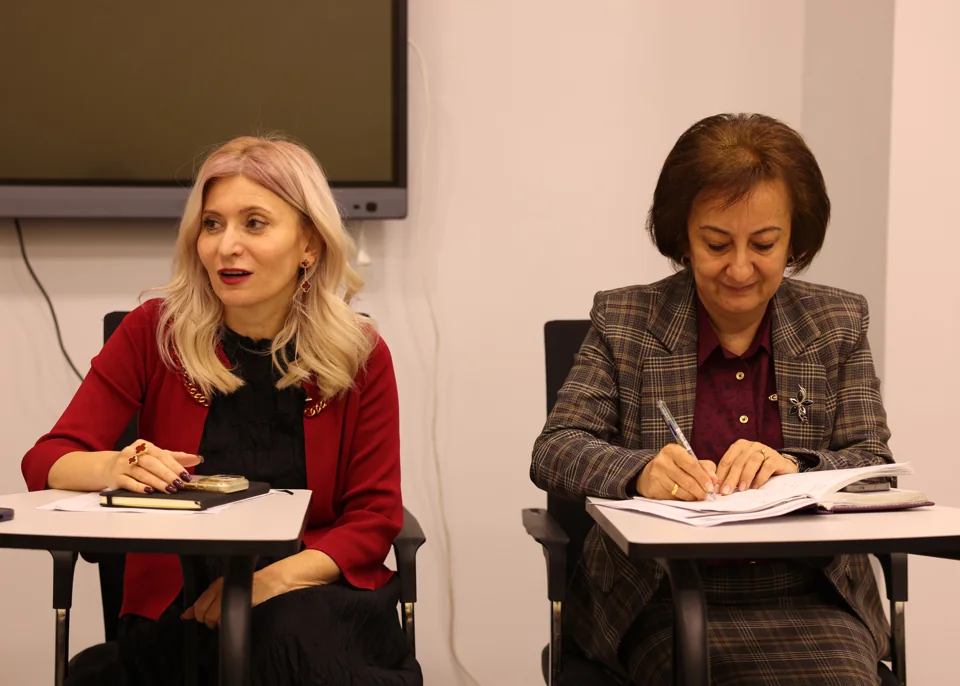
A university report dated November 4, 2026 describes discussions with the Faculty of Biology, Chemistry and Geography and the Chair of Ecology and Sustainable Development. The meeting addressed the review of educational programs and the importance of practical and laboratory work in teaching science. Participants also considered how ecological education could be incorporated into programs with different professional orientations. Cooperation with schools and the identification of teachers’ professional needs were further topics. These discussions were framed around developing teaching, additional education and training, with attention to how the university’s scientific work relates to its pedagogical mission.
Sources: Natural science and ecological education discussion, November 2026 ↗