Visa

About Armavir State Pedagogical Academy
The academy name and the university today
Armavir State Pedagogical Academy is a former name of the institution now known as Armavir State Pedagogical University in Russia. Its charter records the academy designation under an October 2010 ministerial order and the restoration of the university name under an order dated 19 August 2015. The institution’s legal history therefore connects these names within the same educational lineage.
That lineage reaches back to the transfer of the Besskorbnaya pedagogical technical school to Armavir in August 1923. A two-year teacher-training institute opened on the basis of the pedagogical school in 1948. It became a pedagogical institute in 1954 and received the university name in 2003, before the subsequent academy period.
A mission centred on preparing teachers
Teacher preparation is the university’s stated priority. Its mission connects the institution with regional education systems, employers, public education authorities and community organisations. The intended result is a graduate able to combine professional teaching knowledge with broader capabilities needed to work in changing educational settings.
Its strategic priorities include educational research and the introduction of research findings into teaching at different levels. They also cover developing teaching materials, applying new educational technologies and contributing to the design of educational standards and development programmes. The university describes collaboration between general schools, vocational education and higher pedagogical education as part of a continuous system. This places its work within the wider educational network of the region, rather than limiting its role to delivering university classes alone.
Sources: Mission and values ↗
Learning through the pedagogical technopark
The Technopark of Universal Pedagogical Competencies provides spaces for interdisciplinary projects, research and experimentation with educational equipment. Its description connects practical work with bachelor’s and master’s teaching, encouraging prospective teachers to explore how technologies can be incorporated into learning. Laboratory and practical classes sit alongside the development of teaching materials for university students, schoolteachers and additional-education staff.
The technopark includes an interdisciplinary practical-training cluster, an information-technology cluster, competitive robotics, lecture spaces, an interactive video studio and a demonstration-examination room. Published activity areas include virtual and augmented reality in education, natural-science investigations, mechatronics, robotics and programming. The video studio supports visual educational content and online learning events. Seminars, workshops and other public educational activities extend the facility’s work beyond scheduled degree classes.
The Sosnovsky Pedagogical Quantorium
A separate teaching facility, the Pedagogical Quantorium named after Vladimir Timofeyevich Sosnovsky, was established in 2022. Its purpose is to strengthen the university’s scientific, methodological and technical resources for preparing students and practising teachers. Natural-science, technological, mathematical and digital literacy are central themes, approached through educational research and project work.
The Quantorium’s tasks include training students to teach science and technology subjects using contemporary equipment. It also provides a framework for professional development for teachers working in schools and additional-education settings. Career-orientation work with schoolchildren forms another part of its remit, including activities involving pedagogical classes. The centre’s name commemorates a former rector whose academic and professional career was closely associated with the institution and the development of teacher education in the region.
Sources: Sosnovsky Pedagogical Quantorium ↗
Library services for study and research
The university library combines printed educational and scientific literature with electronic information services. It supports students and employees through lending and consultation, information about available services and access to educational and research resources. Readers can request printed publications virtually, while the library also develops electronic resources of its own.
The Foliant automated library system and an electronic catalogue support access to collections and full-text resources. The library’s structure separates reader services, scientific bibliography, library information technologies, and the acquisition, processing and cataloguing of materials. These functions connect the work of selecting and organising resources with helping readers use them. The published library description also identifies participation in the university’s wider educational activities, making information support part of both academic study and institutional life.
Sources: University library ↗
An example of digital-resource instruction
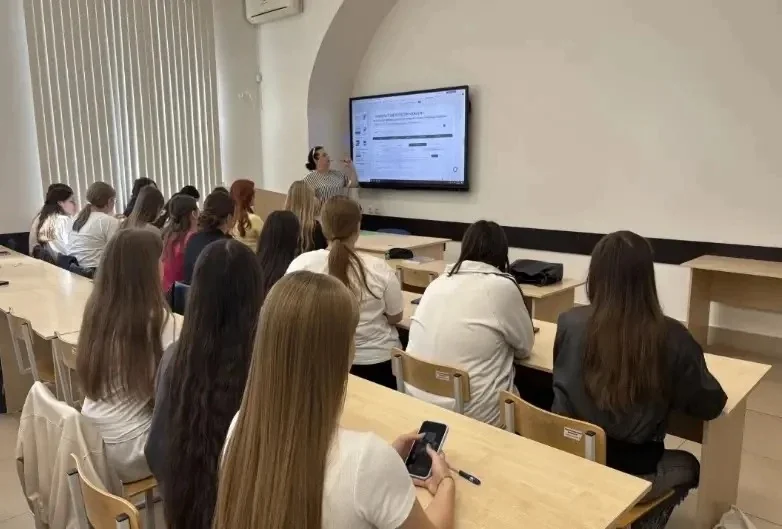
A university report published on 3 November 2026 describes practical library sessions for first-year students at its university college. The sessions introduced the IPR PROF educational platform and addressed the process from finding information to citing it. This was an orientation activity for students entering a new learning environment.
The platform was presented as a source of textbooks, journals and practical materials for vocational education, covering general subjects as well as specialised disciplines. The report also highlighted upper-school textbooks from the Prosveshcheniye publisher. Students received individual access to the platform. This event illustrates the library’s instructional role: providing resources was accompanied by guided use, helping new learners become familiar with the digital tools involved in their coursework.
Sources: Digital-resource orientation,3November2026 ↗
Introducing prospective students to university life
The Career Center organised the “Future Student of AGPU” forum on 31 October 2026, described in a report published on 2 November. Participants came from Armavir and several surrounding towns and districts. The programme combined a university tour with stations run by faculties and student organisations, allowing visitors to ask questions about study and encounter aspects of teaching practice.
Practical workshops formed a further part of the day, which concluded with a concert. The report presents the forum as an opportunity to explore both academic directions and the wider university environment. Such activities connect career orientation with direct experience of classrooms, students and departments, giving prospective applicants a concrete introduction to the institution before making their educational choices.
Sources: Future Student forum,2November2026 ↗