Visa

About Academy of Labour and Social Relations
A Moscow institution concerned with work and society
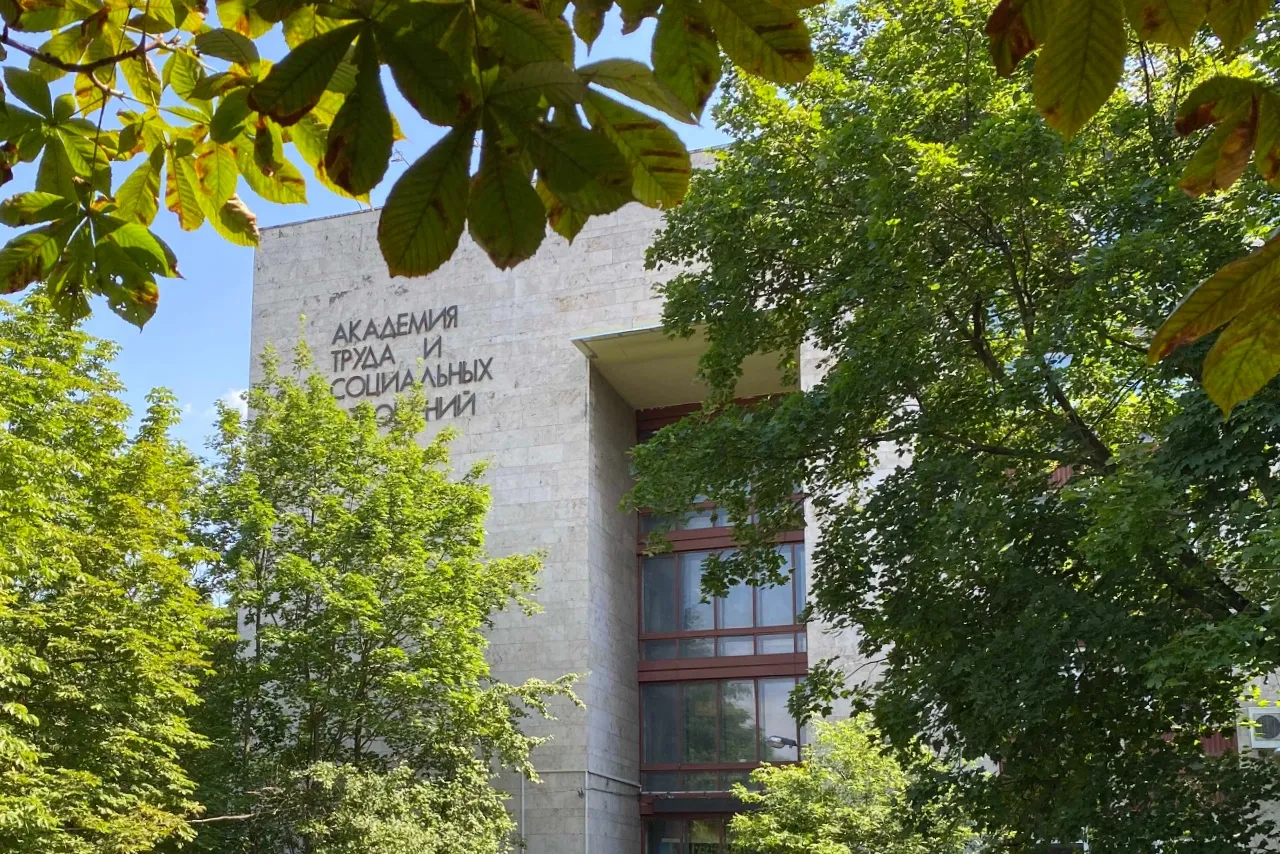
The Academy of Labour and Social Relations is a Moscow higher education institution whose identity is closely connected with trade unions and the study of working life. Known in Russian as Akademiya truda i sotsialnykh otnosheniy and abbreviated ATiSO, it records its foundation date as 26 March 1919. Its institutional information identifies the Federation of Independent Trade Unions of Russia as its founder. The academy’s main address is 90 Lobachevsky Street, Moscow.
Its academic structure includes economics, law, social sciences and technologies, and secondary vocational education, alongside postgraduate and continuing professional education. This range allows labour and social relations to be approached through several disciplines. Economic study considers organisations, finance and the workforce, while legal education examines the rules governing employment and other areas of public and private life. The academy also maintains a distinct institute devoted to the education of trade union personnel and activists.
Sources: Institutional information ↗ · Faculty directory ↗

Economics and organisational study
The economics faculty dates its establishment to 1930. Its current presentation describes a combination of foundational economics and practical analytical study, with full-time and combined full-time and part-time formats. The fields it highlights include labour economics, business analytics, finance and credit, enterprise economics, organisational management, innovation, economic security, and state and municipal administration.
The faculty’s departmental organisation brings together economic theory and labour economics, mathematical methods in economics, and corporate governance and finance. These areas connect the study of employment with quantitative analysis and the financial and managerial decisions made within organisations. The faculty is based in building 1-A at the academy’s Lobachevsky Street address. Its published description also presents research and interaction with practitioners as parts of the learning environment, alongside the formal teaching programme.
Sources: Economics faculty ↗
Legal education and practical settings
The law faculty combines academic legal study with contributions from practising lawyers and other professionals. Its training facilities include a teaching courtroom, a forensic science classroom and the academy’s legal clinic. These settings give students opportunities to encounter legal procedures and professional tasks alongside classroom discussion. Faculty and student research is supported through scientific and practical conferences and a student scientific society.
The published programme range extends from secondary vocational legal education to bachelor’s and master’s study and postgraduate research. Bachelor’s pathways include jurisprudence and labour law with social security law. The master’s list includes corporate law, criminal law, labour law, and budgetary, tax and banking law. Private law, public law, and labour law with the trade union movement form the faculty’s departmental structure. Electronic library access supplies a further resource for legal study and research.
Sources: Law faculty ↗
Education for the trade union movement
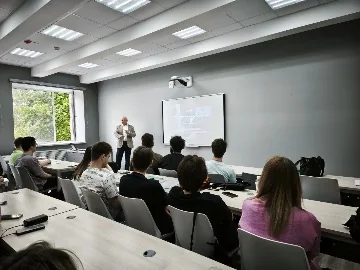
The Institute of the Trade Union Movement is a structural unit of the academy, established by a decision of the federation’s executive committee on 24 May 2006. It organises additional education, professional development and professional retraining for trade union personnel and activists. Its training system spans four levels, beginning with initial preparation for newly elected chairs, deputy chairs and activists during their first year in office.
The institute has used distance learning and electronic education through an iSpring Online platform since 2016. Its programmes draw on academy departments, including those concerned with labour economics, personnel management, finance, accounting and law. The educational content reaches beyond union organisation to include employment law, communication psychology, business ethics and legislative change. The institute also undertakes methodological and analytical support, research into social and labour relations, and coordination among institutions involved in trade union education.
Library collections and electronic resources
The academy library originated in 1919 as a resource for students of the trade union instructor school. From that small beginning, it developed collections supporting the institution’s educational programmes and research. Its facilities include lending and storage areas, a reading room and a specialist electronic resources room. Holdings encompass textbooks, teaching materials, research publications, reference works, fiction and periodicals, in both print and electronic forms.
An academy electronic library, created in 2008, provides full-text institutional publications, including staff monographs, conference materials and teaching resources. Readers also have access to external electronic library services and legal information resources. The catalogue operates within the MARK-SQL library system, while additional databases record academy publications and work associated with its labour economics research school. Exhibitions and bibliographic services help connect readers with material relevant to teaching and scholarly work.
Sources: Library ↗
Research and wider academic connections
Research concentrates on social and labour relations, economics and law. The academy publishes annual research plans and reports, maintains a Council of Young Scientists, and records institutional publications through its electronic catalogue. Its labour economics and population research school was formally established by the academic council in February 2022. Its stated subjects include productivity, employment structures, vocational education, working conditions and the protection of workers’ social and labour rights.
A labour law research school received formal approval in 2024, building on earlier scholarly activity. Its interests include social partnership and legal regulation of employment and social protection. International activity is supported by a Centre for International Programmes and Additional Education, while the academy separately publishes information on agreements with foreign educational organisations. Together, these research and educational structures reflect the institution’s continuing concentration on the relationships between work, organisations, legal frameworks and social development.
Sources: Research activity ↗ · International activity ↗