Visa
About Academic University
Academic University in Saint Petersburg
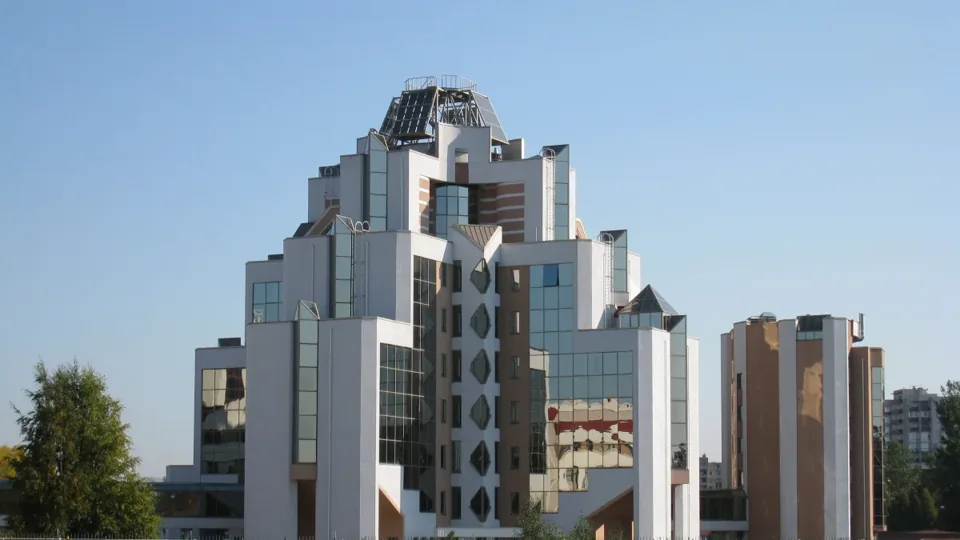
Academic University is the directory name for Alferov University in Saint Petersburg, Russia. Its full institutional identity links higher education and science with the Russian Academy of Sciences. The university is located on Khlopina Street and takes its present name from physicist Zhores Ivanovich Alferov, its founder and first rector. His educational model sought to connect the preparation of young researchers with active scientific investigation.
The university’s mission centres on developing research capabilities and supporting scientific and technological development. Its educational approach connects specialised school education, university study, postgraduate research and laboratories. The associated Physical-Technical School lyceum is part of that wider progression. Rather than treating a university course as an isolated stage, the model aims to bring learners into contact with research questions and scientific practice across successive levels of education. Its disciplinary emphasis includes physics, information technologies, semiconductor science and nanotechnology.
Sources: University mission and educational model ↗ · History of the university ↗
Institutional history and the Alferov name
The university was formally established on 8 October 2002 by a resolution of the Presidium of the Russian Academy of Sciences. Its predecessor was the Saint Petersburg physical and technological research and education centre founded at the Ioffe Institute in 1997. Later in 2002, an educational and scientific complex brought together the university, the Ioffe Institute, a microelectronics technology centre and the Physical-Technical School.
Further organisational changes followed. The university received federal higher-education status in 2006 and national research university status in 2010. The Saint Petersburg National Research Academic University name formed part of its institutional identity from 2015. It transferred to the Ministry of Science and Higher Education in 2018 while retaining that name. In September 2019 it was named after Alferov. These milestones distinguish the earlier research-centre origins from the formal creation of the university and its later development as an institution combining education with science.
Sources: History of the university ↗
Research facilities and scientific cooperation
The university’s scientific work includes semiconductor materials, optoelectronics, microfluidics and technologies connecting electronics with biological systems. Its research overview describes materials for laser structures, solar cells, photodetectors and light-emitting devices. Other work involves laboratory-on-a-chip systems, nanoporous membranes and sensing interfaces. Instrument development includes equipment for maskless laser lithography and controllers for fluid pressure.
Specialised clean-room facilities and molecular-beam epitaxy equipment support the preparation and investigation of semiconductor structures. The research account also describes equipment for processing materials after growth, connecting synthesis with later device-development stages. Scientific collaboration involves universities and Academy institutes, including the Ioffe Institute, Saint Petersburg State University, ITMO University and Peter the Great Saint Petersburg Polytechnic University. Students, doctoral researchers and pupils from the associated lyceum participate in research activity. This places technical facilities within a network of academic cooperation and education rather than presenting laboratories solely as equipment collections.
Nanophotonics and light-emitting devices
The Nanophotonics Laboratory was founded on 11 December 2009. It investigates the optical and structural properties of semiconductor heterostructures, optical resonators and microresonators. Light-emitting semiconductor devices, including microlasers, are a central interest. Experimental investigation is combined with theoretical modelling of the physical processes underlying these structures and their emission.
The laboratory contributes to bachelor-level preparation in applied mathematics and physics, master’s education in electronics and nanoelectronics, and doctoral work in semiconductor physics. Its published projects address photonic circuits for transmitting and processing information and optoelectronic devices based on new resonator and waveguide designs. Measurement facilities examine electrical behaviour, emission spectra and the spatial distribution of emitted light. The equipment description also includes optical spectroscopy and automated measurement systems. These resources connect research questions about semiconductor structures with practical methods for characterising devices and evaluating how changes in design affect their performance.
Sources: Nanophotonics laboratory ↗
Nanobiotechnology across physical and biological sciences
The Nanobiotechnology Laboratory dates its foundation to 2008. Its research programme combines materials, electronics and biological investigation. Published themes include biosensors using semiconductor and metal nanostructures, protein-based sensors and microfluidic systems. The laboratory also studies methods for introducing molecules and genetic material into mammalian cells, alongside the electrical behaviour of interfaces involving metals, electrolytes and cells.
Its equipment brings several forms of analysis into the same research environment. Confocal microscopy supports fluorescence imaging, while spectroscopy provides information about molecular and optical properties. Protein-analysis instruments, gel-electrophoresis equipment, cell incubators and centrifugation resources support other stages of experimental work. The published methods also include computational chemistry and structural investigation of candidate compounds. These activities demonstrate the laboratory’s interdisciplinary scope: physical measurement and material design are used alongside biological techniques to investigate sensors, cellular systems and experimental technologies.
Sources: Nanobiotechnology laboratory ↗
A student scientific community
The Student Scientific Society was established through the initiative of students involved in research, innovation and science communication. Membership is voluntary. Its stated principles include self-government, openness, mutual respect and a constructive culture of scientific exchange. The society gives students an organised setting for participation beyond their regular academic classes.
Student scientific conferences have taken place within this framework since 2023. Their stated purposes include practising public speaking, communicating scientific ideas and responding to questions from an audience. The university’s student-science page links accounts of several conferences, bringing attention to participation from school pupils through postgraduate researchers. These gatherings make research communication part of student development and provide opportunities to discuss work with people at different stages of scientific education.
Sources: Student science and scientific society ↗