Visa
About Arab International University
A private Syrian university
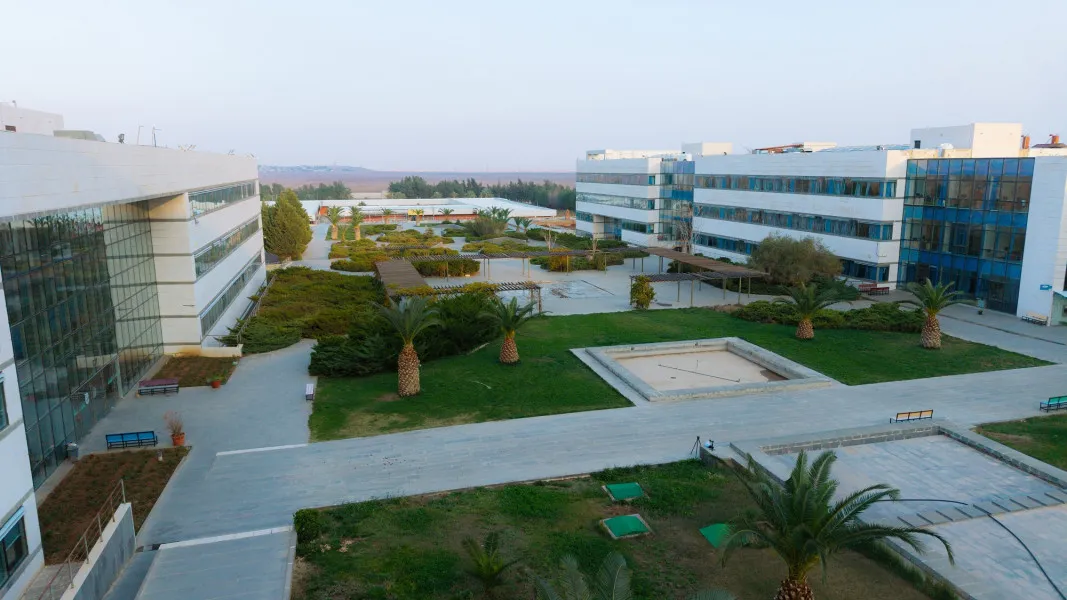
Arab International University, abbreviated AIU, is a private Syrian university whose published campus address is on the Daraa Highway at Ghabagheb. Its institutional mission combines teaching with scientific research intended to address the needs of society. The university describes the development of students' applied skills as one of its educational objectives, alongside maintaining study plans that respond to scientific developments. Its mission also emphasises the human, material and organisational resources supporting teaching. Research within specialised units and the publication of scholarly work form further stated priorities. International partnerships and exchanges of experience are part of the same institutional outlook. These aims connect the university's educational work with research and service to the community, providing a common framework for its academic activities.
Sources: AIU mission and vision ↗

Courses within a credit-hour system
AIU's study guide explains an academic structure based on credit hours. Courses are assembled into an integrated study plan, with each course assigned a credit value. The guide distinguishes theoretical and practical teaching, and explains that a course may combine the two. Course outlines identify their credit hours, the type of teaching involved, any prerequisite subject, a description of the content and its distribution across the semester. The academic year includes autumn and spring semesters and an optional summer semester. The guide also distinguishes a semester grade-point average from an accumulated average covering a student's studies. This structure links individual course choices with a longer sequence of study, while prerequisites specify relationships between subjects that must be considered when planning registration.
Sources: Studying at AIU ↗
Academic guidance within faculties
Academic advising is organised within AIU's faculties and is intended to help students understand both their study plans and the rules governing academic progress. The university describes guidance on the credit-hour system, registration, examinations, postponement of study and graduation requirements. Advisors help students select suitable subjects and consider their academic major. They also follow attendance, assessments and midterm results to identify difficulties that may need attention. The published framework assigns students to advisors and provides for meetings during the semester. Advising activities are documented in reports submitted to the faculty board, with observations and recommendations then brought together for the university council. The arrangement connects individual academic planning with a faculty-level process for reviewing student support and the operation of the advising system.
Sources: Academic advising ↗
Libraries supporting different disciplines
The university's library network combines a central collection with resources connected to particular faculties. Its Central Library is described as holding books, references and scientific journals across disciplines. A digital-library and internet laboratory provides access to databases and electronic information resources. The faculty collections cover pharmacy, information and communications engineering, architecture and arts, civil engineering, business administration, dentistry and law. Their subject coverage ranges from networking and software to design, planning, construction materials, economics and legal sources. The published library guide places several collections in the Circular Building, with others in the buildings associated with their faculties. This arrangement brings general academic resources together with more specialised literature, supporting both teaching and research in the university's different fields.
Spaces for architecture and visual arts
AIU describes its architecture studios as places for developing design and urban-planning skills through projects, analysis and drafting. Students work individually and in groups on drawings, models and analytical studies under academic supervision. The university also emphasises discussion and architectural criticism within this setting. Its arts studios provide space for experimentation in drawing, painting, sculpture and graphic design, using different materials and tools. The published account links studio work with the development of visual expression and an individual artistic approach. Together, these spaces support practical work alongside the conceptual and theoretical aspects of architectural and visual-arts education.
Sources: Architecture and arts studios ↗

Language learning and subject-specific study
The Foreign Languages Center describes English teaching organised into four levels, supported by placement testing to identify an appropriate starting point. Its account connects reading, writing and speaking with students' ability to undertake academic work in English. Teaching materials include the Pathways series, practical reading activities, educational videos and online exercises. After the general levels, the centre describes specialised English connected to particular fields of study, as well as preparation related to English-language examinations. Its wider language remit includes introductory German, French and Spanish, together with Aramaic. These activities place language learning alongside the university's subject teaching, combining general communication work with attention to the language needed for academic study. Placement and progression through levels provide an organising structure for learners with different backgrounds.
Sources: Foreign Languages Center ↗
International academic connections
The International Relations Office coordinates the university's links with academic and research institutions outside Syria. Its published responsibilities include preparing cooperation agreements, organising visits, supervising exchanges and coordinating participation in conferences and exhibitions. It also identifies joint research and international training for academic and administrative staff as areas of work. The office's account lists agreements with institutions in the Arab region and Germany, including Princess Sumaya University for Technology, Petra University, Yarmouk University, the Lebanese University, Heilbronn University, Martin Luther University of Halle-Wittenberg and Leipzig University of Applied Sciences. It describes participation in European cooperation frameworks including Erasmus+, alongside projects concerning digital education, sustainable management and equality. The office connects these activities with academic, cultural and research exchange, and with communication between the university and international partners.
Sources: International Relations Office ↗