Visa

About Anyang University
An applied university in Henan
Anyang University, known in Chinese as Anyang Xueyuan, is an applied undergraduate institution in Henan, China. Its predecessor was the Humanities and Management College of Anyang Normal University, established in 2003. In 2016 it became Anyang University through a Ministry of Education approved conversion. Its history therefore connects it with Anyang Normal University while its present institutional identity is separate. The university describes an academic structure bringing together education, humanities, engineering, business, economics, law, science and the arts. Teacher preparation exists alongside programmes serving other professional fields. Its teaching framework combines general education, specialist study, practical education, and innovation and broader personal development. The institutional introduction also describes modular course design, varied assessment and practical training involving laboratories, enterprises, teams and projects.
Sources: University introduction ↗
Two campuses and a varied academic offer
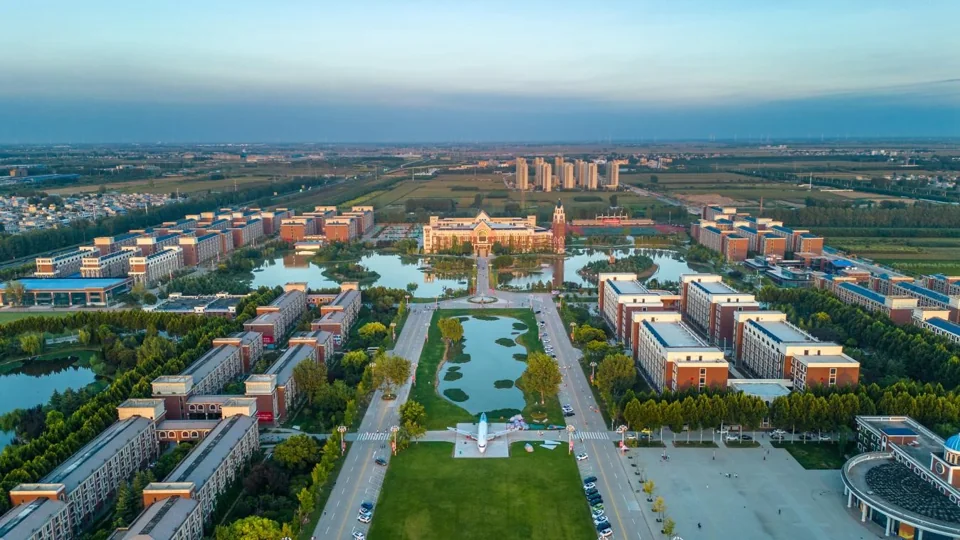
The university operates campuses in Anyang and Yuanyang. Its 2026 admissions charter locates the Anyang campus at 599 Zhonghua Road South and the Yuanyang campus at 6 Renmin Road West in Yuanyang County, Xinxiang. Programme allocation is campus specific. The Anyang list includes Chinese language and literature, law, English, preschool education, accounting, logistics management, visual communication, cultural heritage conservation, music and several engineering subjects. Yuanyang offerings include finance, taxation, tourism management, civil engineering, statistics, computational finance and intelligent construction, alongside computing and other subjects. The same charter also lists shorter higher vocational programmes at Anyang, including unmanned aircraft technology, digital media operations and aircraft maintenance. These parallel routes give the institution a broader educational scope than an exclusively teacher training college.
Sources: 2026 admissions charter and campus programme allocation ↗
Computing, mathematics and practical laboratories
The College of Computer Science and Mathematics traces its origins to a mathematics and information department established in 2003 and adopted its present name in December 2021. Its September 2026 introduction groups its subjects around software systems, intelligent connected technologies and mathematical applications. Listed fields include computer science, software engineering, network engineering, the Internet of Things, artificial intelligence, mathematics, statistics and data computing. Practical facilities described by the college include computer organisation and microcomputer principles laboratories, network cabling training, data annotation and processing facilities, and teaching skills rooms for teacher education. A Baidu artificial intelligence innovation centre, a mathematical modelling association and a mathematics research institute add settings for work beyond scheduled lectures. The college also connects project training with programming and digital technology competitions.
Sources: Computer Science and Mathematics college introduction ↗
Language, literature and legal studies
The humanities portfolio includes Chinese Language and Literature with a teacher education orientation. Its programme description emphasises literary analysis, writing, reading classical texts and understanding language. The curriculum brings together modern, ancient, contemporary and foreign literature, literary theory, modern and ancient Chinese, linguistics, aesthetics and teaching methods. Comparative literature and the study of historical texts extend this foundation. Law is presented as an applied programme connected with the needs of northern Henan. Its listed subjects cover jurisprudence, constitutional law, Chinese legal history, civil and criminal law, commercial law, intellectual property, procedure and professional ethics. International law and private international law provide additional perspectives. Together these descriptions show substantial textual and analytical study alongside the university's engineering and computing provision.
Sources: Chinese Language and Literature and Law programme descriptions ↗
Engineering with an aviation emphasis
Aviation is a distinctive part of the university's applied teaching. The Aviation Engineering college's September 2024 introduction describes aircraft design and manufacturing, mechanical and electronic engineering, and electronic information among its undergraduate fields. Its practical teaching facilities span electrical and electronic experiments, sensors, programmable controllers, communication principles, mechanical drawing and hydraulic and pneumatic systems. More specialised spaces support engine and transmission disassembly, vehicle maintenance, unmanned aircraft system design and cabin crew training. The college records the establishment of a general aviation industry college in 2021 and describes cooperation with aviation, machinery, numerical control and vehicle enterprises. These activities are presented as ways to connect classroom learning with practical work. The college also records an aviation culture and arts festival held at the university in 2021.
Sources: Aviation Engineering college introduction, September 2024 ↗
A museum that contributes to teaching
The university museum began preparations in 2012 and opened with provincial and municipal cultural heritage approval in 2014. It took its current name following the institution's 2016 conversion. Its introduction places it on the second floor of the library's eastern main building, after an earlier location in the administration building. Collections encompass stone objects, pottery, oracle bones, bronzes, porcelain, inscription rubbings and rare books. Museum work includes collection protection, research, exhibitions, interpretation and cultural education. The museum links with the Fine Arts college and a cultural relic identification and restoration studio. It describes practical teaching connections with Chinese literature, conservation, calligraphy and Chinese painting. From 2022, cooperation with public arts teaching also brought classes into the museum to examine objects through their history, functions and artistic qualities.
Sources: University museum introduction ↗
Continuing education and adult study
The Continuing Education college was established in May 2018 as a management and service unit for the university's continuing higher education. Its introduction describes coordination of admissions, teaching administration and student records, supported by an administrative office. It draws on the university's ordinary full time subjects and teaching resources while organising routes for learners entering from different educational stages. The published structure includes routes from upper secondary education to undergraduate or shorter higher education and routes from junior college to undergraduate study. Its subject coverage includes literature, law, engineering, education, management and economics, with examples such as Chinese literature, law, computer science and preschool education. The college's stated regional orientation is northern Henan and the wider province.
Sharing approaches to teaching and research
An academic event reported in December 2025 gives a concrete example of staff development. On 5 December, the Computer Science and Mathematics college hosted a lecture on university teaching and research in the era of large artificial intelligence models. The invited speaker came from the separate Anyang Institute of Technology. Discussion covered teaching innovation reports, recorded classroom teaching, student centred lesson design and connections between course content and industry practice. The report also described learning analytics, interdisciplinary research and data processing as topics for discussion. This was a professional exchange about possible teaching approaches rather than evidence that every method had already been adopted throughout the university.
Sources: December 2025 academic teaching and research lecture ↗