Visa
About Antalya Bilim University
A university in Antalya
Antalya Bilim University is based in Antalya, Türkiye. Its published contact address is in Çıplaklı, Döşemealtı, on Akdeniz Boulevard. The university’s academic organisation spans engineering and natural sciences, economics and social sciences, law, fine arts and architecture, tourism, health sciences and dentistry. An Institute of Graduate Studies forms part of its structure alongside schools for foreign languages, civil aviation and vocational education.
The university provides students with academic calendars, course information, a learning management system and library services. Its student-facing organisation also includes disability support, student representation, dormitory information and cultural and sporting activities. These services accompany the work of its academic units and provide several points of contact for students during their studies.
Educational purpose and institutional priorities
The university’s mission treats differences as a source of enrichment and connects education and research with the development of individuals and society. It identifies following and contributing to scientific and social developments as part of its role. Innovative programmes are intended to create opportunities for critical, original and scientific thinking.
Its vision is expressed as an ambition to become an internationally competitive university through innovative, practice-oriented research and education, with a particular emphasis on entrepreneurship. The quality policy identifies several means of pursuing that ambition: responding to stakeholder needs, using technology effectively, supporting staff development, improving educational quality and strengthening research. It also calls for sustainable application of relevant regulations and standards and continuing improvement of institutional processes. These statements set out the university’s intended direction rather than presenting its goals as already completed achievements.
Sources: Mission, vision and quality policy ↗
Computing laboratories and project work
The Faculty of Engineering and Natural Sciences describes computing facilities that support programming and practical technical study. Its teaching-laboratory page identifies three computer application laboratories, with software for Java and Python development and other applications used in computer engineering education. Students can also use these facilities for their everyday academic work.
An additional systems laboratory supports electronics-related courses through experimental teaching sets and associated equipment. Practical work for digital systems and microprocessors takes place in that laboratory. The faculty also describes a machine-learning laboratory designed for students to undertake projects together with academic staff. This separates ordinary course-based exercises from opportunities for collaborative project work. Taken together, the published facilities connect software development, electronic systems and machine learning, illustrating several different ways in which computing students encounter practical work alongside their taught subjects.
Sources: Engineering teaching laboratories ↗
Physics learning through experiments
The engineering faculty’s physics-laboratory description explains how practical work accompanies Physics I and Physics II. Students work in pairs on experiments linked to the subjects taught in those courses. The listed topics range from Newton’s laws, momentum and free fall to projectile motion, angular velocity, acceleration and centripetal force.
Electrical and magnetic topics include electrostatics, series and parallel circuits, resistor-capacitor circuits, transformers, coils and magnetic induction. A current balance and Helmholtz coils are also included in the description. The practical programme therefore brings together mechanics and electromagnetism, giving students a setting in which to relate classroom concepts to experimental observation and measurement.
Sources: Physics laboratory description ↗
How the library develops its collections
The library’s collection-development policy supports teaching, research and community service through printed, electronic and audiovisual resources. It describes acquisition through purchases, subscriptions, donations and exchanges, with priorities informed by user needs, usage information and the available budget. Requests from university members and decisions by the Library Advisory Board guide collection development.
For printed books, selection considers the authority of authors and publishers, currency, relevance and suitability for the intended users. Journal subscriptions are assessed against academic subjects, scientific quality, interdisciplinary use and cost. Electronic-resource selection also considers accessibility, platform reliability, remote access, reference-management compatibility and licensing arrangements. The policy provides for copies of university theses to enter the library, with electronic availability governed by the permissions associated with each work. It also sets criteria for donations and for withdrawing outdated, damaged or incomplete material, explaining how the collection is maintained as well as expanded.
Tourism and culinary education
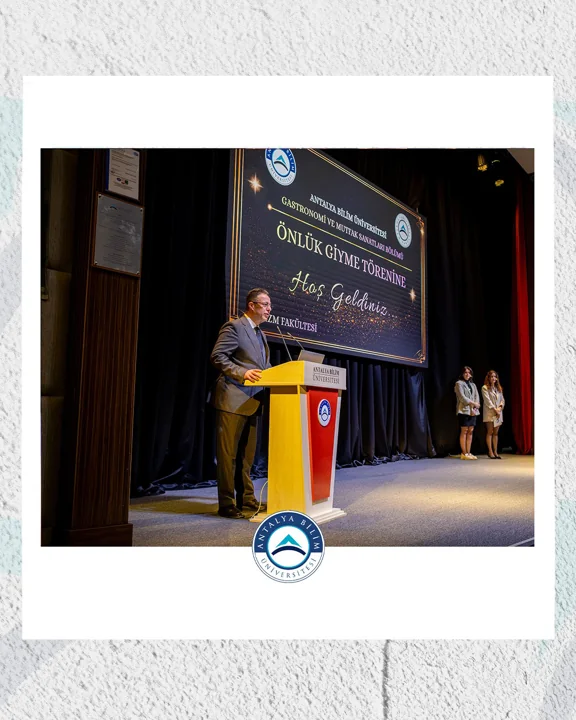
The Faculty of Tourism was established in 2010. It first admitted Tourism Management students in the 2012–13 academic year, followed by Gastronomy and Culinary Arts students in 2017–18. Its history page describes English-medium undergraduate education that begins with foundational theoretical knowledge in tourism management and gastronomy.
Practical experience forms a substantial part of the published study structure. Students undertake placements during the summer periods of their second and third years, totalling 120 days. The faculty also describes two further options: cooperative education, through which the final year can be spent working in industry, and a management-shadowing programme equivalent to a 15-credit course over one term. Its stated educational aim is to develop people able to analyse current conditions and plan strategically for the future. This places management knowledge, culinary study and professional experience within a connected faculty framework.
Sources: Faculty of Tourism history and study structure ↗
Cooperation with workplaces
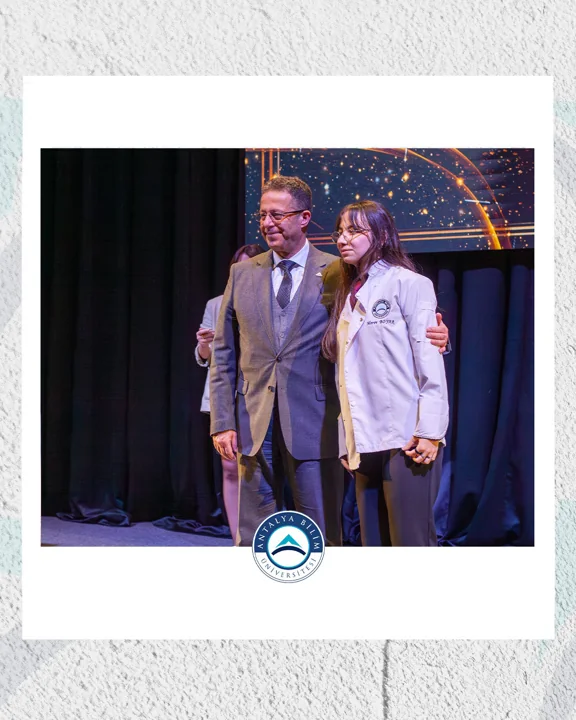
A university report from 2025 describes students beginning professional placements through its Cooperative Education Model. The partnerships named in the report extend across aviation, telecommunications, hospitality, engineering services and public administration. Examples include Turkish Aerospace, SunExpress, Turkcell, Kone, hotel businesses and the Antalya Provincial Health Directorate.
The model involves students participating in the everyday processes of the organisations where they are placed. The university presents this as an opportunity to apply theoretical learning in a working environment while developing professional and communication skills. The report also records cooperation with organisations outside Türkiye, reflecting the international dimension of some placements. It describes continuing discussions with additional partners as a future direction for the model. The account provides a concrete example of how the university connects its practice-oriented educational aims with organised workplace experience before graduation.
Sources: Cooperative education and professional placements ↗