Visa

About Abdullah Gül University
A public university with an emphasis on social contribution
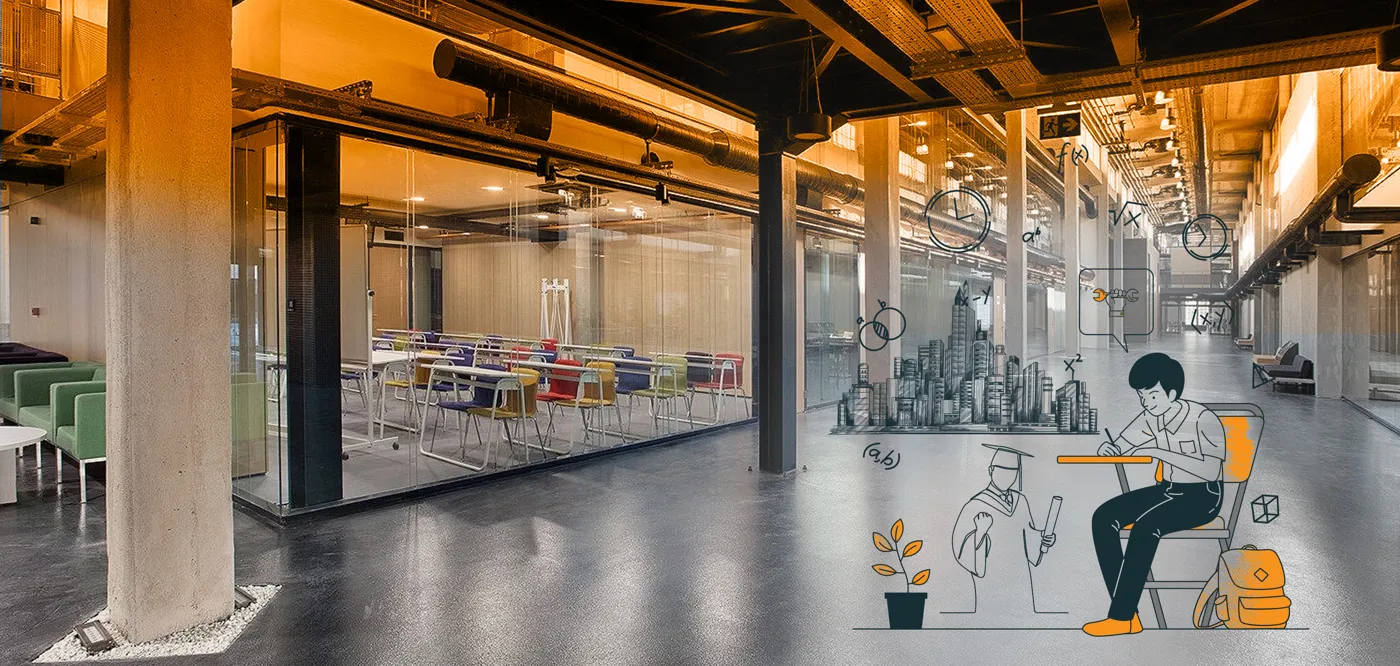
Abdullah Gül University, commonly known as AGU, is a public university in Kayseri, Türkiye. Its official academic catalogue records its establishment through legislation published in July 2010. The university's mission connects scientific research and education with contributions to both knowledge and society. It describes research in terms of balancing fundamental and applied work and selecting questions that can contribute at local, regional, national and international levels. Its educational goals emphasise learning centred on the student, the relationship between theory and practice, critical thinking and continuing personal development. Ethical values and social responsibility are also part of that framework. AGU's stated approach to public contribution involves cooperation with businesses, industry, public bodies and civil society. These principles provide a useful context for the institution's academic organisation: its programmes and research are intended to connect disciplinary expertise with the wider challenges and needs of society.
Sources: University foundation history in the academic catalogue ↗ · University mission and vision ↗ · School of Foreign Languages introduction ↗
Academic fields from engineering to social sciences
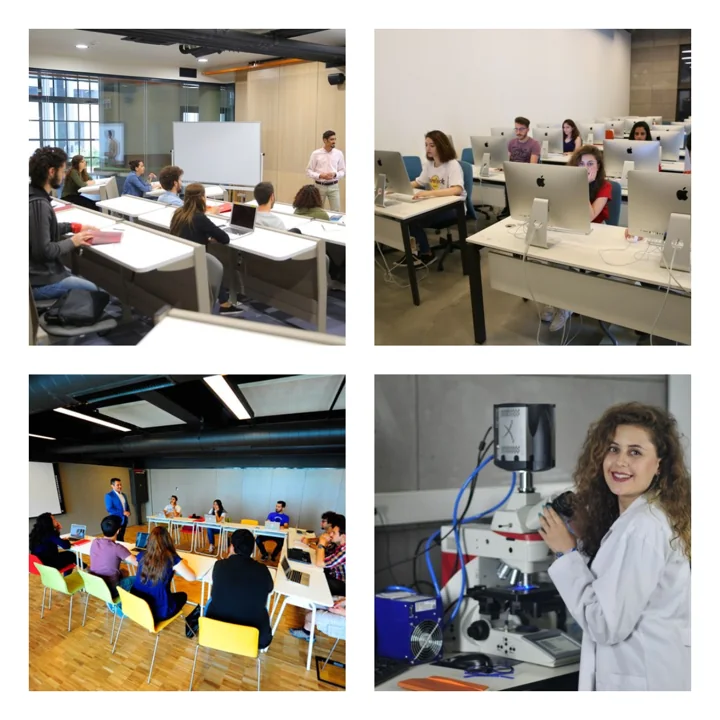
The university's international academic overview brings together several areas of undergraduate study. Engineering includes civil, computer, electrical and electronics, industrial, mechanical, and materials science and nanotechnology subjects. Architecture provides another route, while managerial sciences encompasses business administration and economics. Life and natural sciences includes molecular biology and genetics and bioengineering. Political science and international relations and psychology appear within humanities and social sciences. The same overview identifies graduate study across engineering, science, architecture and interdisciplinary subjects, together with data science for business and economics. This range allows applicants to explore both technical and social questions within a single institution. The overview also states that undergraduate students participate in the Global Challenges core curriculum, connecting their specialist studies with shared learning. Individual programme and graduate-school information remains the source for the precise curriculum and requirements of a chosen qualification.
Sources: Faculties and courses ↗
English-medium education and language preparation
The School of Foreign Languages describes AGU as a university where programmes are taught in English. It presents language learning as preparation for participation in academic and professional environments rather than as an isolated subject. Its preparatory programme emphasises autonomous learning and support for each student's development. Small learning groups are intended to help students practise reading, writing, listening and speaking while increasing their awareness of how language is used. The school's introduction also stresses communication in a global setting, describing its approach in terms of World English. Independent learning is a recurring theme: students are encouraged to manage their own learning processes as well as participate in guided instruction. This provides a foundation for following degree courses in English and continuing to use the language beyond university. Specific proficiency and preparatory-study arrangements should be checked through the university's current language and admissions guidance.
Sources: School of Foreign Languages introduction ↗
Global Challenges as a shared curriculum
AGU's Global Challenges curriculum, identified through GLB course codes, links university education with the United Nations Sustainable Development Goals. The official explanation describes a sequence in which students encounter the goals and their subtopics, explore more specialised themes and then apply their learning through projects. First-year courses introduce the framework, second-year courses address particular challenges and the later project course brings earlier learning into practical settings. The classes include students from different departments, supporting an interdisciplinary approach to understanding problems and developing responses. This structure gives students a shared educational experience alongside their specialist degree subjects. It also demonstrates the university's attempt to connect its socio-technical educational model with issues affecting communities and the environment. The curriculum is presented as compulsory undergraduate learning, with project work providing a way to move from knowledge about global challenges towards collaborative investigation and proposed solutions.
Sources: Global Challenges core curriculum ↗
A research environment built around cooperation
The university's research ecosystem description identifies several structures supporting research and collaboration. These include the Technology Transfer Office, graduate schools, research centres, the Scientific Research Projects Office and the Library and Documentation Department. Its central research facility provides thematic laboratories and equipment intended for use in research involving both academia and industry. AGU encourages multi-partner projects with researchers from other universities and supports efforts to obtain external funding. The research overview also describes relationships with industrial organisations and support for project development, training and consultancy. These mechanisms are intended to help connect research outputs with economic and societal benefit. They illustrate an institutional framework rather than an assurance that every researcher will receive funding or commercialise a result. For students interested in advanced study, the relevant department, graduate school and research-support offices provide the starting points for exploring current projects and supervision.
Sources: Institutional research ecosystem ↗
Industrial heritage adapted for campus life
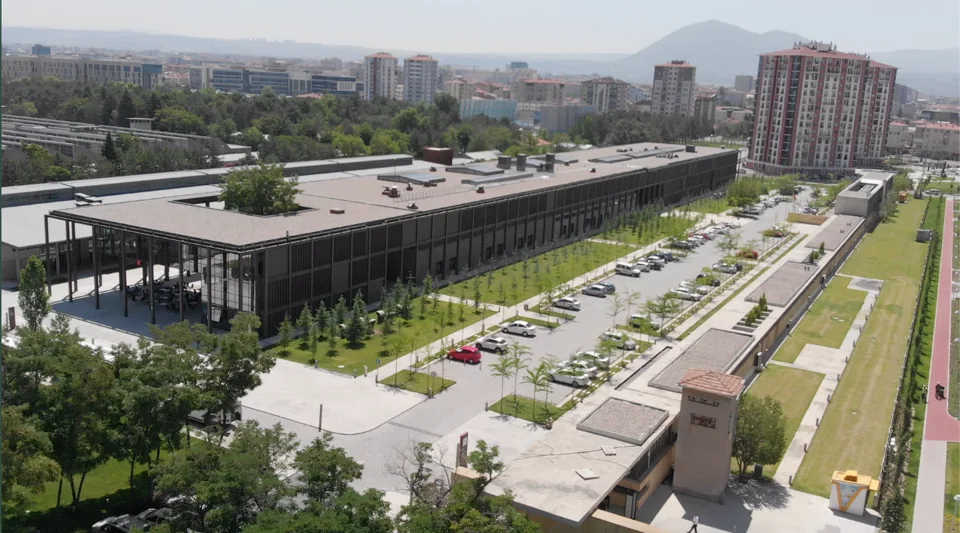
Sümer Campus gives AGU a physical setting closely connected with Kayseri's industrial history. The university's construction and technical works account explains that the former Sümerbank textile factory site was allocated to AGU in 2012. Restoration and adaptation have brought educational uses into historic buildings, with work coordinated through the relevant cultural heritage preservation authorities. The university describes an open-campus approach intended to connect classrooms, workshops, laboratories, library and social spaces. A former cotton warehouse was adapted as part of the rectorate, administration and classroom complex, which began serving the university in 2014. Later restoration brought the Great Warehouse, fire-station and office buildings into use for teaching, workshops, dining and student-related functions. The campus account also identifies outdoor sports areas and a fitness building. These adaptations show how preserving an existing site and developing spaces for contemporary education have formed part of the same campus project.