Visa
About Antalya Belek University
A university in Kadriye, Serik
Antalya Belek University is based in Kadriye, within the Serik district of Antalya, Türkiye. Its published address is Celal Bayar Caddesi, numbers 5–6. The university was formerly known as Antalya AKEV University. Its Engineering–Architecture Faculty’s institutional history records the change to Antalya Belek University through a regulation published in the Official Gazette on February 9, 2023.
The same history dates the faculty’s establishment within the then Antalya AKEV University to April 23, 2015. The university’s current academic structure spans arts and design, humanities, economics and administrative sciences, engineering and architecture, and vocational education. Its current website lists fields including psychology, sociology, gastronomy, interior architecture, communication design, international trade and business, management information systems and software engineering. Vocational choices extend into computing, design, construction, tourism, aviation-related services and other applied subjects.
Sources: Engineering–Architecture Faculty Strategic Plan 2024–2028 (2025) ↗ · Antalya Belek University: official institutional website ↗
Mission and educational priorities
The university’s mission connects education with research, entrepreneurship and contribution to society. It describes an intention to develop students as questioning, innovative and creative people, while pursuing cooperation with industry and sustainable projects serving wider communities. International cooperation, publications and institutional agreements are also identified as parts of that ambition.
Its vision emphasizes research, science and technology alongside ethical awareness and learning throughout life. The published values include participation, sharing, social responsibility and accountability. Cultural and artistic sensitivity sit alongside concern for the environment and nature. Student focus, attention to quality, problem solving and respect for human rights complete this institutional framework. These are the university’s stated educational priorities and provide context for its combination of academic study, applied subjects and engagement with external organizations.
Sources: Vision, mission and core values ↗
Gastronomy combining culture, management and kitchen practice
The Gastronomy and Culinary Arts Department opened in the 2017–2018 academic year within the Faculty of Art and Design. Its published profile describes a four-year undergraduate programme taught in Turkish. The curriculum brings together culinary practice with subjects such as marketing, menu planning, food history, colour and design, food hygiene and sanitation, and food legislation.
Practical study includes basic and advanced kitchen techniques, cold-kitchen preparation, pastry, breadmaking, and Turkish and international cuisines. The department identifies a main professional kitchen and a pastry kitchen as its teaching spaces. English and professional English form part of the educational provision. The programme also describes workshops, seminars, activities through the gastronomy student community and visits to organizations in the food and hospitality sector. Through this mix, the department presents gastronomy as a field involving cultural understanding, design, food production and management, with classroom learning connected to practical preparation.
Library spaces and borrowing services
The university library provides different settings for study, including quiet areas, spaces where conversation is permitted, individual study areas and group work areas. Its description also identifies a computer laboratory and a reading room. Behind these public spaces, library work includes cataloguing, classification and electronic resource management.
The collection is organized using the Library of Congress classification system. Readers can search for materials using library computers or mobile devices and can ask library staff for assistance. Borrowing requires the university identity card, and the rules distinguish materials available for ordinary loans from reference and special collections retained within the library. The service also offers forms for requesting user education, suggesting works, donating materials and seeking cooperation with other libraries. Together, these arrangements combine access to a physical collection with guidance and ways for users to contribute requests.
Sources: About the library ↗
Digital collections and paths to research material
The library’s electronic resource directory organizes several routes to academic information. Its document-supply section includes national services for obtaining material and sharing resources between information centers. DergiPark, TR Dizin and the TO-KAT collective catalogue appear alongside these services, connecting readers with journals, indexed research and the holdings of different libraries.
Open-access resources include the university’s own digital archive, Türkiye’s Harman academic archive network and TÜBİTAK’s Aperta repository. The directory also introduces collections of maps, museum and archival material, dictionaries, newspapers and audio books. Its EKUAL section points readers toward academic journal, book, dissertation and citation resources across disciplines. This structure helps users distinguish discovery tools, document delivery, open collections and specialist databases. It complements the physical library by providing starting points for finding literature, exploring cultural sources and tracing academic work in digital form.
Sources: Library electronic resources ↗
A documented example of institutional development
A university report dated November 3, 2026 describes the introduction of an Integrated Quality Management System, known by the Turkish abbreviation BKYS. Following installation and the formation of a quality management team, the university arranged online training for unit managers and unit quality coordinators. The session was delivered by a quality management specialist from Kırşehir Ahi Evran University, which developed the system.
The training addressed the system’s structure and its use within higher education quality processes. It focused on the planning stage of the Plan–Do–Check–Act cycle, including performance targets, planned activities, risk identification and controls. Participants were also shown planning and implementation functions within the performance management module. The report describes the intended use of the system for monitoring and evaluating academic and administrative work, giving a dated example of how the university is developing its internal management processes.
Sources: Integrated Quality Management System training: November 2026 ↗
Culinary learning beyond the teaching kitchen
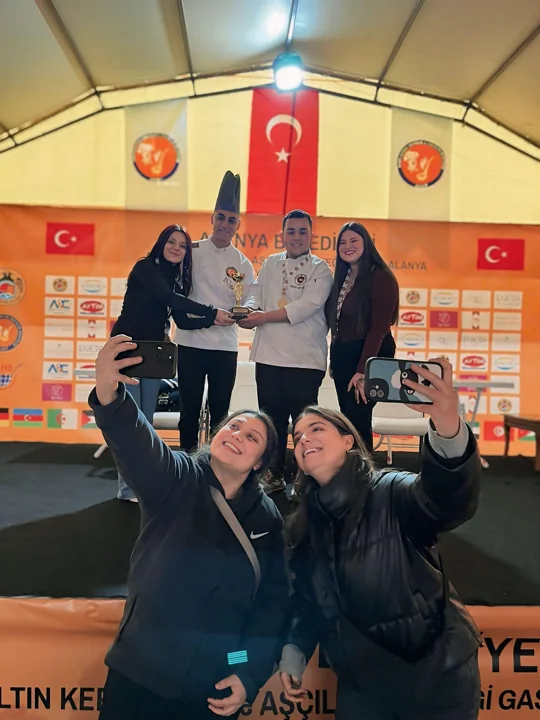
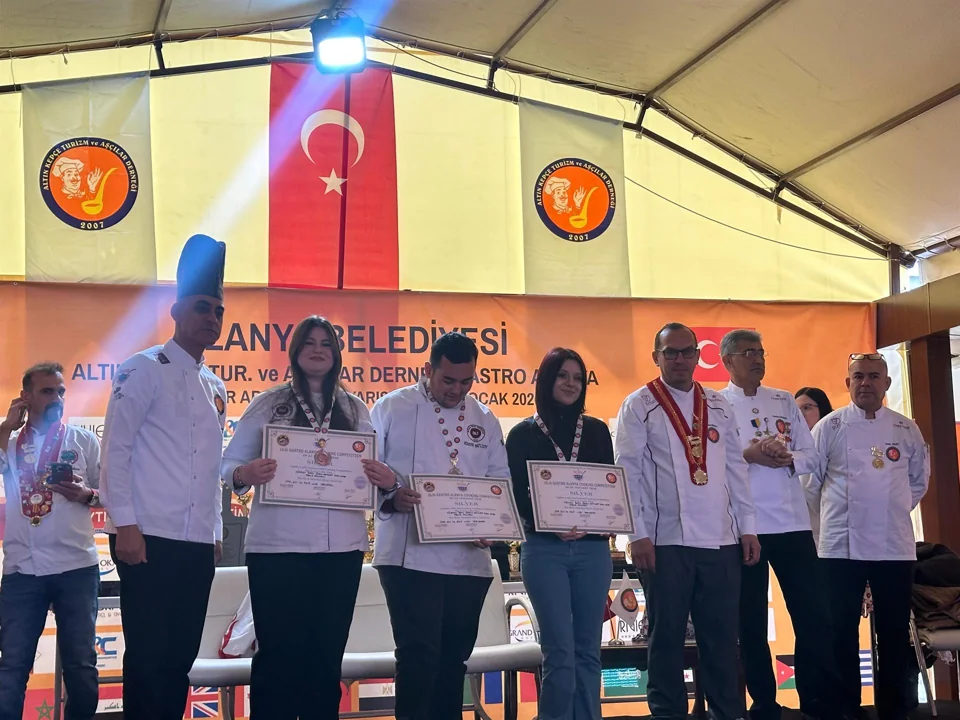
A report published on January 28, 2026 documents participation by university students and academics in the tenth international cooking competition in Alanya. The event took place on January 20–22 and involved the university’s Gastronomy and Culinary Arts Department and its vocational cooking programme.
The competition brought participants together around culinary preparation and presentation, with work assessed by a professional jury. The university’s gallery shows members of its group at the event and participants holding certificates and a trophy. The report provides an example of students and teaching staff taking their culinary work into a setting beyond the university, meeting other participants and encountering different food cultures through a shared professional activity.
Sources: Gastro Alanya cooking competition: January 2026 ↗