Visa
About Anshan Vocational and Technical College
Vocational education in Anshan
Anshan Vocational and Technical College, known in Chinese as 鞍山职业技术学院, is a public higher vocational institution in Anshan, Liaoning Province, China. Its address is 690 Qianshan West Road. The college’s academic organization brings together intelligent manufacturing, health and nursing, digital technology, modern services and education, and animal-related vocational studies, alongside general education and innovation and entrepreneurship.
The official introduction describes a campus organized into teaching, practical training, residential, sports and landscaped areas. Shared facilities include a library, sports venues, dining facilities and a driver training area. The academic range includes manufacturing and electrical automation, industrial robotics, computing, digital media, vehicle technology, early childhood education, culinary studies and animal husbandry. Practical training is supported by centers covering areas such as manufacturing, information technology, transport and construction. This combination places occupational skills and applied learning at the center of the college’s educational provision.
Sources: College introduction ↗
Mechanical manufacturing and automation
The Mechanical Manufacturing and Automation programme studies manufacturing technology and automated production systems. Its September 2026 introduction describes project-led, task-based teaching, with an emphasis on connecting course content to industrial work. The educational objectives include mechanical design, manufacturing, automated production system design, practical ability and engineering understanding.
The listed curriculum includes mechanical drawing, technical measurement and tolerances, mechanical design fundamentals, manufacturing processes, metal materials and heat treatment. Machine tools, fixture design, CAD/CAM applications, numerical-control machining processes and programming provide further technical content. Elective and practical subjects extend into modern manufacturing, fault diagnosis and maintenance of numerical-control machine tools, microcontrollers, introductory 3D printing and industrial robot programming. The combination gives the published programme a progression from drawings and materials toward production methods and automated equipment. Its description also identifies competitions and practical activities as ways for students to apply what they study.
Sources: Mechanical Manufacturing and Automation:programme introduction ↗
Electrical automation and integrated practical work
Electrical Automation Technology is another area within the School of Intelligent Manufacturing. The programme introduction published in September 2026 lists electrical control, programmable logic controller applications, power supply and distribution, automatic speed regulation, automatic control systems, industrial networks and configuration technology among its core courses.
The stated learning objectives encompass engineering analysis and design, programming, commissioning and maintenance of electrical and automatic control systems. The programme describes education combining school and enterprise resources, work and study, theory and practice, and task-based learning. It also records a joint training project with Ansteel that links equipment manufacturing, automation and field engineering. These descriptions show how the school relates technical subjects to equipment operation and industrial settings. Classroom instruction, laboratory work and contact with production enterprises are presented as connected parts of the training approach, with practical skills developed alongside the underlying technical concepts.
Sources: Electrical Automation Technology:programme introduction ↗
A library with academic and cultural functions
The college library combines social science and natural science collections with spaces for reading, practical activity and cultural events. Its introduction describes a multifunctional building containing specialist reading areas, a Chinese classics reading space and a makerspace. An art gallery, a large multipurpose auditorium and an academic lecture hall broaden its role beyond book lending.
The library has also introduced a bookstore within its building through cooperation with Liaoning Publishing Group. A dedicated second-floor area houses Shengwen Northern New Life, supplementing the library’s own resources. Its account of public activities includes a calligraphy and painting exhibition and hosting an Anshan citywide reading launch associated with World Book Day. The library therefore serves both as a study resource for the college and as a venue for cultural engagement and events.
Sources: Library introduction ↗
Reading spaces linked to vocational subjects
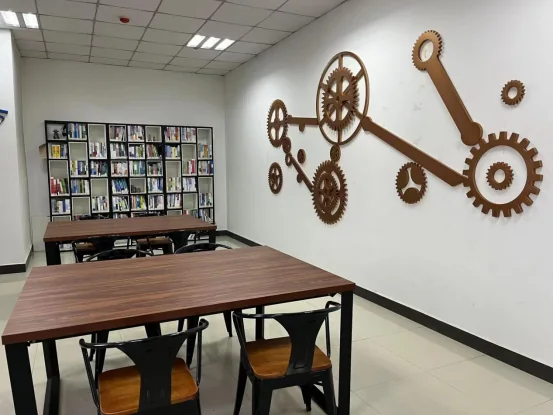
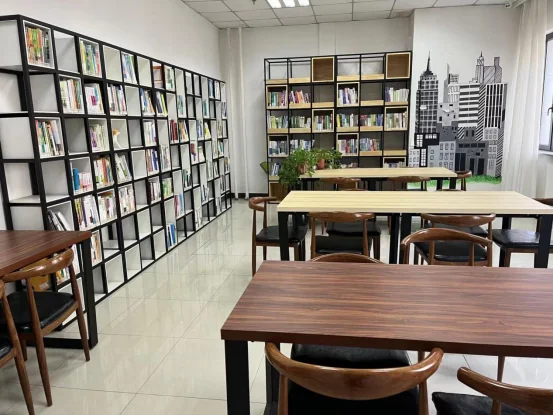
A library notice published in November 2024 introduces subject-oriented reading spaces for modern services, information technology, equipment manufacturing and ideological and political education. Each combines relevant books with places where teachers and students can read and study.
The notice also describes possibilities for teachers to lead practical activities and arts-and-crafts competitions in these spaces. It invites organized subject learning and extracurricular interest activities, connecting the collections with active learning. The photographed rooms contain bookshelves, shared tables and seating, with wall decoration reflecting different subject themes. They illustrate how the library accommodates small-group study alongside its wider lending and reading facilities.
Sources: Professional reading spaces:library introduction ↗
Electronic books and mobile reading
The library’s September 2024 description of electronic book borrowing machines outlines several ways to read beyond a conventional printed collection. The service offers electronic titles across literature, history, humanities, social sciences and other general-interest categories. Its description includes a regular process for refreshing the selection and assembling topical reading collections.
Readers can scan a book’s QR code through the Chaoxing mobile library application to place it on a personal digital bookshelf. Downloaded books can be read offline. A different route uses an ordinary QR-code scanning tool to open an online reading page, which can then be bookmarked for later use. The notice also describes reading directly on the borrowing machine itself. These options give the service several points of access, linking a physical library installation with readers’ own mobile devices and digital reading preferences.
Sources: Electronic book borrowing machines ↗
Learning to find and evaluate information
An information literacy database recommendation published by the library in November 2024 describes a learning resource introduced through a Liaoning higher education digital resource cooperation project. The resource uses short animated videos to explain individual information literacy topics. Practice questions, expert lectures, presentation materials and themed modules accompany the videos.
The subject areas include search techniques, information resources and retrieval systems, knowledge management, scholarly resources, academic writing and research tools. Case-based learning places the concepts within particular situations and encourages readers to practise searching. The notice distinguishes access through the campus network from off-campus use through registered accounts. Its educational focus is on helping teachers and students develop methods for locating and using information, adding an instructional element to the library’s collections and reading spaces. This is a documented example of the library supporting the process of learning as well as access to reading material.
Sources: Information literacy education database:2024 recommendation ↗