Visa


About Ansgar University College
A Christian university college in Kristiansand
Ansgar University College, known in Norwegian as Ansgar høyskole, is a private higher-education institution in Kristiansand, southern Norway. It is owned and operated by Misjonskirken Norge, the Mission Covenant Church of Norway. The college describes a setting in which faculty and students come from different evangelical churches and denominations. Its name refers to the ninth-century bishop Ansgar, associated with the spread of Christianity in the Nordic countries. Theology, music and psychology are central academic fields.
Sources: Information in English: institution, ownership and campus ↗
From mission school to a broader college
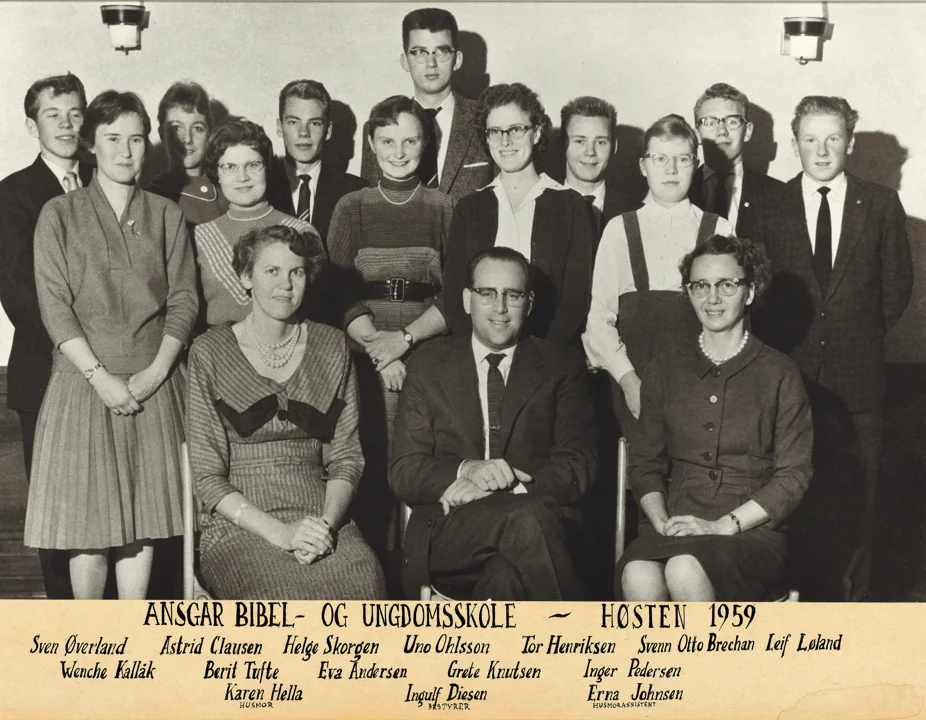
Ansgar's institutional history begins with a mission school established in 1913. Following a period without teaching, educational activity resumed in 1959 as a Bible and youth school. The present Bible school continues that strand of the organisation's history. In the early 1960s, a theological seminary developed, initially offering two years of education and subsequently four years for pastors and preachers.
Ansgarskolen moved from Oslo to Kristiansand in 1988. During the 1990s, the college's theology and Christian-studies provision developed within the higher-education system. The following decade brought bachelor's programmes in music and psychology and a master's programme in theology. Its history therefore encompasses both specialist ministerial preparation and a widening range of academic subjects. The school describes its Christian understanding of human life as a continuing foundation across that development.
Sources: Short institutional history ↗
Theology taught through texts and practice
The campus Bachelor in Theology is a three-year, full-time programme carrying 180 credits and taught in Norwegian. It introduces biblical studies, practical theology, systematic theology and church history. The programme situates these disciplines within an evangelical and free-church Christian tradition, while also examining the church's role in contemporary society and the variety of church communities.
The course structure begins with biblical introduction, Christian history, mission studies, contemporary church life and philosophy. Later study includes biblical theology, hermeneutics, theological methods and leadership. Students can pursue biblical or practical-theology directions or an open specialisation. Biblical study can include New Testament Greek; practical theology addresses worship, preaching, pastoral leadership, care and diaconal work, with practice distributed through the degree. The stated learning aims include critical reflection, communication and ethical questions in church and organisational settings. Academic knowledge and reflection on personal belief are consequently both visible within the programme's educational design.
Music performance and production
The Bachelor in Music and Music Production brings together instrumental work, ensemble playing, musical communication and studio practice. The three-year programme carries 180 credits and is taught in Norwegian. It includes composition, songwriting and arranging alongside recording techniques and music technology. Its educational account gives attention to both an individual musical voice and the practical processes involved in creating a finished production.
Early courses combine production with instrumental performance, music theory, aural training, music history and analysis. Subsequent work includes ensemble leadership, academic writing, knowledge of the music sector and entrepreneurship. Later production modules lead towards a bachelor's project, while music-industry practice forms part of the curriculum. The programme identifies tools such as Logic, Sibelius and Pro Tools within its learning objectives. It also presents collaboration, the ability to explain musical decisions, and the planning of independent and group work as elements of musical competence.
Psychology and research methods
Ansgar's Bachelor in Psychology is a three-year, full-time programme of 180 credits, taught in Norwegian. It introduces psychology through the study of behaviour and mental processes. Research methods run through the degree, connecting explanations of thought, emotion and experience with ways of investigating them. The programme also places human development within social and cultural settings.
The course structure includes social and developmental psychology, cognitive neuroscience, personality and abnormal psychology, communication and relationships, and community psychology. Later choices address subjects such as cultural diversity, health and ageing, religion, organisations or research practice. Advanced research methods and applied methods precede the bachelor's dissertation. The college's stated learning objectives include evaluating academic material, reflecting on communication and values, and recognising ethical questions within the discipline. Elective credits provide room to shape the later part of the degree, while the dissertation gives students a sustained academic writing task.
Sources: Bachelor in Psychology ↗
Library resources and study spaces
Mosvold Library supports the college's theology, music and psychology teaching with books, databases, printed and electronic journals, newspapers, organisational periodicals and films. A dedicated music-literature section serves music students. Reading places within the library are complemented by group rooms on the floor above, while wireless internet is available throughout the premises.
The quiet reading room also houses the book collection of Hallvard Hagelia, formerly professor of Old Testament at Ansgar. These books can be borrowed. Although the library primarily serves students and staff, external users may also use it, and borrowing is self-service. The library received the Mosvold name on 26 January 2012 in memory of Torrey and Margaret Mosvold, who supported the school. Its combination of subject resources, quiet study and shared working spaces makes it part of everyday academic life beyond scheduled teaching.
Sources: Mosvold Library ↗
Campus and institutional values
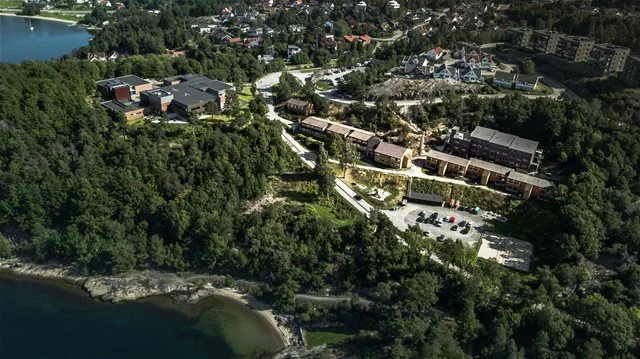
The college is situated on a hillside above the Topdal fjord, on the outskirts of Kristiansand. Student accommodation stands beside the school in several buildings. The campus also includes a chapel open to students and visitors, a reception and parking areas. The accommodation is used by Ansgar Summer Hotel during the summer. These facilities place residential, academic and devotional activities within the same campus setting.
Sources: Information in English: institution, ownership and campus ↗
Purpose and educational outlook
Ansgar describes its purpose as educating knowledgeable, engaged people who value relationships and can contribute to church, culture and society. It connects that purpose with a Christian foundation and academic standards. Knowledge, relationships and engagement are the values named in its institutional account. These stated priorities provide a common framework for subjects whose practical settings range from musical creation to theological interpretation and the study of human behaviour.
Sources: Institutional purpose and values ↗