Visa
About Agricultural University of Norway
The agricultural institution at Ås
Agricultural University of Norway is a historical English directory name associated with Norges landbrukshøgskole, or NLH, at Ås. Its institutional roots reach back to the Higher Agricultural School, which opened in 1859. The original school combined teaching with farm operations, reflecting the need for scientific and practical education in Norwegian agriculture.
A major reorganization in 1897 established NLH with scientifically based education in agriculture, forestry, horticulture, land consolidation and dairying. The institution also had a research role in the subjects it taught. Its courses and organization continued to change as the needs of the agricultural sector developed.
The official history describes a particularly active period of curriculum development after 1971. More varied study options emerged in natural-resource management, planning, economics, technical subjects and the sciences. Five-year engineering education began with a cohort admitted in 1989, and a science-degree programme followed in 1994. Teacher education also developed. This was a gradual broadening of the institution's agricultural foundations into a wider environmental, technical and scientific academic profile.
Sources: NMBU institutional history ↗
From NLH to UMB and NMBU
The historical name needs to be distinguished from the institution operating today. In 2005, NLH received university status and became Universitetet for miljø- og biovitenskap, abbreviated UMB. In 2014, UMB and the Norwegian School of Veterinary Science merged to form the Norwegian University of Life Sciences, NMBU.
The veterinary school had developed separately in Oslo, with its teaching establishment completed in 1935. Its move to Ås took place in 2021, after the creation of NMBU. These stages explain how the present university combines agricultural, environmental, biological and veterinary traditions. The old NLH name represents an earlier part of that history. The buildings and alumni connections described here illustrate both the earlier institution and the continuity carried forward by its successor.
Cirkus and the historic teaching courtyard
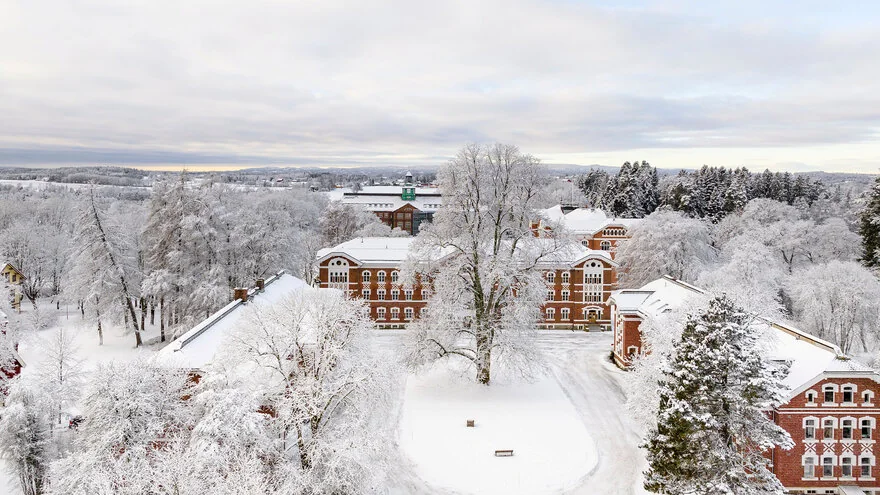
Cirkus was one of the three school buildings ready for the opening of the agricultural school in 1859. It began as the main building and included accommodation for the director. A substantial renovation and extension in 1901 changed its scale and functions, adding space at both ends and replacing the old upper structure with additional floors.
Its later arrangement combined student rooms, staff residences, an assembly hall and reading rooms. The building also accommodated people whose practical work supported school life, including laundry and bakery staff. Electric lighting and central heating formed part of its early twentieth-century facilities.
Architecturally, Cirkus stands prominently in the courtyard and also faces the larger park. Its decorated façades, projecting sections and varied windows distinguish it from simpler service buildings. The building's changing uses provide a tangible account of how teaching, accommodation and the daily operation of the institution once occupied the same campus setting.
Sources: Cirkus: main building and student accommodation ↗
Smia: practical work within the school
Smia, the smithy and workshop building, also dates from 1859. It served both the school and its farm, originally accommodating activities such as carpentry, metalwork, brewing, baking and storage. This combination of uses illustrates the practical infrastructure required by an agricultural teaching establishment.
The building is described as timber-framed masonry with red brick and decorative painted woodwork. Its position beside the pond helped complete the courtyard arrangement. Over time, different rooms were used for dairy work, workshops, stores and accommodation.
A new chapter began when the building was adapted for a student bookshop and copying centre in 1987. The work preserved important original structures while changing its purpose. NMBU's heritage account records continued bookshop and printing uses in 2024. That is a successor-era use of a much older agricultural-school building, linking the campus's material heritage with later student services.
A building for student culture
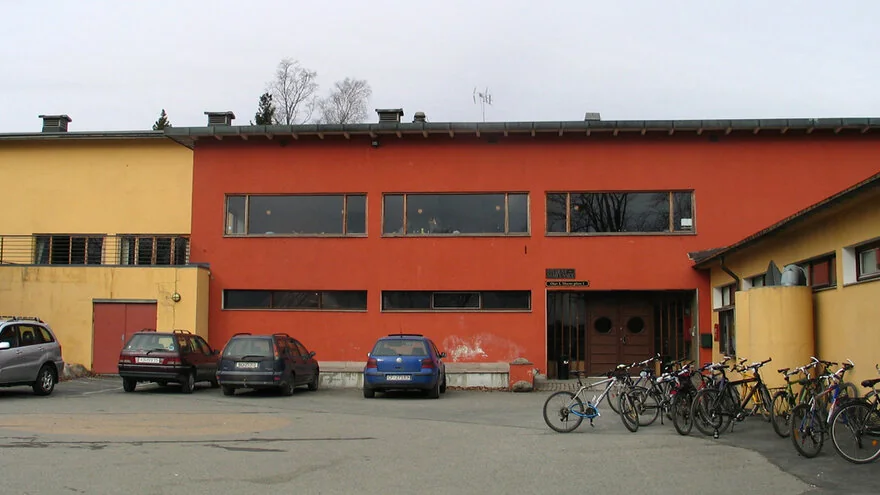
Samfundet gave students their own society building in 1934. Designed by architect Thorleif Jensen, it represented a commitment to life beyond formal academic teaching. Its origins included student fundraising and support from lottery proceeds, while a gymnasium provided space for physical activity.
The building's functionalist architecture used clear geometric forms and a relationship between practical purpose and design. Its spaces included halls, meeting rooms, offices and facilities connected with student social life. The university's history places its development within a wider tradition of singing, sports, cultural activity and student organization at Ås.
The building was subsequently rebuilt and extended, including work during the 1970s and 1980s and the addition of a concert hall in 1994. These changes show student culture developing alongside the institution's academic expansion. The historical account treats Samfundet as an important part of the identity of the Ås student community, rather than simply an architectural landmark.
Sources: Samfundet: student society building from 1934 ↗
Continuing connections through the successor university
NMBU's alumni community carries the institution's earlier histories into the present. Its official description emphasizes knowledge sharing, professional exchange and opportunities to develop skills. It connects former students working in different industries, organizations and public institutions in Norway and internationally.
The alumni page places this community within the combined agricultural and veterinary traditions of today's university. Its subject interests include food production, land and resource management, environmental challenges, economics, renewable energy and human and animal health. These are themes of the successor university's wider network. They provide a contemporary context for understanding the enduring professional connections associated with study at Ås and with the institutions that became NMBU.
Sources: About NMBU Alumni ↗