Visa
About Agder University College
The university college and its successor
Agder University College was the Norwegian institution known as Høgskolen i Agder, or HiA, that preceded today's University of Agder, UiA. It was formed in 1994 when six colleges in the Agder region merged. The new institution initially had campuses in Kristiansand, Grimstad and Arendal, bringing together several traditions of professional and academic education.
The successor university's historical timeline traces roots including teacher education established at Holt in 1839, nursing education in Arendal from 1920, engineering in Grimstad from 1967, and Agder Regional College in Kristiansand from 1969. During the HiA period, a new campus at Gimlemoen in Kristiansand opened in 2001. The college's first defence in its own doctoral programme, in Nordic linguistics, followed in 2005, when it also applied for university status.
HiA received university accreditation in June 2007, and the government set 1 September 2007 as the start of the university. The institution subsequently developed under the University of Agder name. The current campuses, services and strategy described below belong to that successor university; the historical college name identifies the earlier stage of the same institutional development.
Sources: Facts and institutional history ↗
The present Kristiansand campus
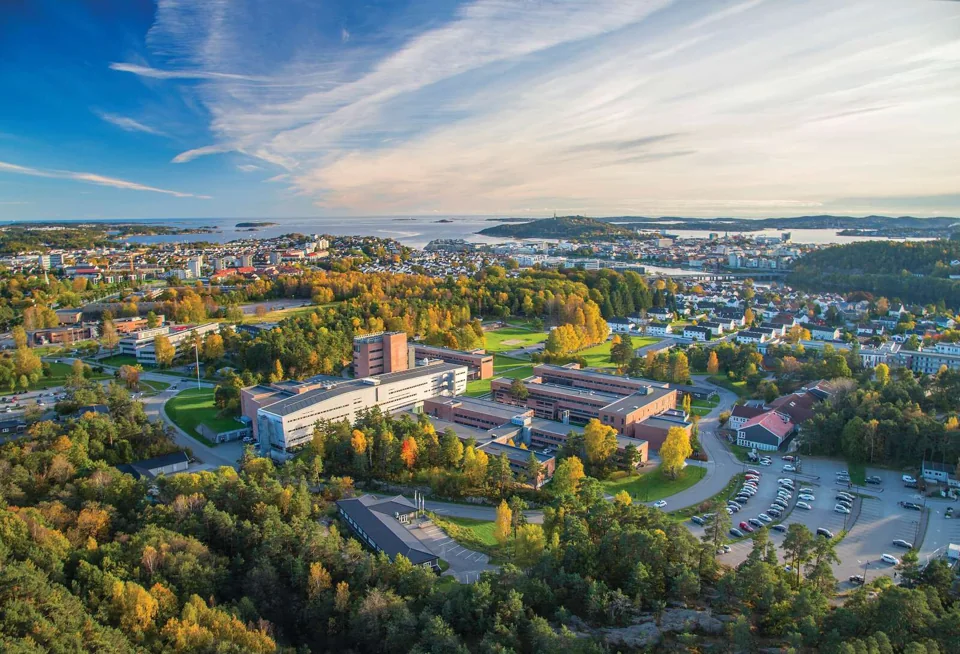
The University of Agder's Kristiansand campus is arranged as a compact academic setting, with teaching and shared facilities close together. The university describes its layout as following an American campus model, intended to encourage contact between students and staff across disciplines. The city centre is a short bicycle journey away.
The campus page offers virtual visits to a range of facilities, including the library, music rehearsal rooms, a teaching laboratory, multimedia and control rooms, and major shared halls. These include the Henrik Ibsen Auditorium and Vilhelm Krag Hall, also called Vrimlehallen. An international meeting space, the Global Lounge, is another part of campus life. The collection of specialist rooms and common areas reflects the variety of activities taking place within the campus.
Sources: Campus Kristiansand ↗
The present Grimstad campus
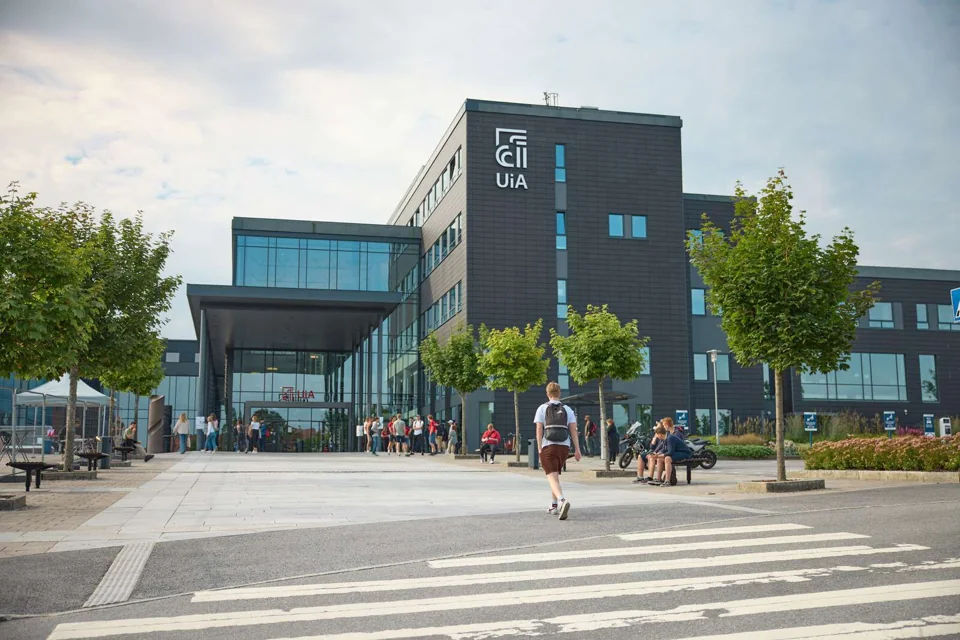
The successor university's Grimstad campus is located within Sørlandets Teknologipark. It shares this setting with businesses and research environments working in technology and health technology. Its compact arrangement is designed to make movement between facilities straightforward and to support interaction across subjects.
The campus website introduces both academic facilities and shared spaces through photographs and virtual tours. Its examples include the Health Lab and Gata, the main internal thoroughfare. Like Kristiansand, Grimstad has a Global Lounge and connections to the university's broader student and international services. The city centre is within a short bicycle ride. The campus therefore combines university facilities with proximity to a wider technology and research environment.
Sources: Campus Grimstad ↗
Libraries for study and research
The University of Agder Library serves both campuses, providing physical and digital collections alongside places for individual reading and collaborative work. Its services include courses, guidance and assistance with finding academic information. Library staff help users with information searching, referencing and the use of resources.
In Kristiansand, the library includes study spaces, group rooms, computers and a quiet reading room. Its collections span fields such as business, social sciences, humanities, health and sport, natural sciences, arts and education. Artworks from the university's Beat Art Collection are also displayed in the library.
Grimstad's library similarly provides individual and collaborative study areas, books, journals, databases and other scholarly resources. Wireless access is available, and the university offers both online guidance and drop-in assistance. These services link the libraries' role as physical learning spaces with support for working confidently with scholarly sources.
Sources: About the University Library ↗
The successor university’s strategic direction
UiA's strategy for 2025–2028 places collaboration at the centre of its approach to knowledge. It describes research, academic and artistic development, and research-based education as connected responsibilities. Its stated values include academic quality, openness, trust and respect, together with support for academic freedom and an inclusive learning and working environment.
The strategy identifies interdisciplinary interests in health and education, art and culture, democracy and citizenship, technology and preparedness, climate and energy, and sustainable innovation. It also emphasizes international cooperation through networks, mobility and the European university alliance FORTHEM.
For education, its priorities include active learning, stronger connections between study programmes and research, more flexible provision and lifelong learning. It seeks greater student participation in research, innovation, artistic development and the shaping of learning environments. These are strategic commitments of the current university, rather than descriptions of programmes offered by HiA before 2007. They show how the institution's contemporary ambitions extend across professional education, academic inquiry and engagement with society.
International and Norwegian students together
The Global Lounge provides a meeting place for international and Norwegian students at both campuses. It is supported by international interns and offers opportunities to meet people, join events, play board games and ask practical questions about university life. Students interested in exchange can also use it as an informal point of contact.
The service is open to staff as well as students. Its website connects visitors with the International Office, drop-in exchange advising and information for new students. Events are shared through the international student channels, while visitors can also ask the interns directly about upcoming activities. The lounges bring social contact and practical information into the same setting, helping connect the university's international work with everyday campus experience.
Sources: The Global Lounge ↗