Visa
About Annasaheb Magar Mahavidyalaya, Hadapsar, Pune
A college in Hadapsar, Pune
Annasaheb Magar Mahavidyalaya is a Pune District Education Association college in Hadapsar, Pune, Maharashtra. It is affiliated to Savitribai Phule Pune University. Its mission connects higher education with the parent association's commitment to public welfare. The college's academic life includes humanities, sciences, computing and community service, with departmental teaching supported by a central library and opportunities for research.
English language and literary study
The Department of English traces its undergraduate English programme to 1996 and its master's programme to 2000. Its account also records the sanctioning of doctoral study in English in 2023. The department's stated aims join language competence with literary understanding, critical awareness and a disposition towards research. Reading and interpreting literature form part of this educational purpose alongside proficiency in using English.
Activities listed by the department include a reading club, language surveys, a certificate course on varieties of English pronunciation, and the use of audiovisual techniques for experiential learning. Visits to the British Library and to Savitribai Phule Pune University's Jayakar Library place language and literary study in contact with wider information resources. The department identifies creative expression, analysis of English language and literature, and an understanding of culturally diverse societies among its learning objectives. These are educational aims within its undergraduate and postgraduate teaching.
Sources: Department of English ↗
Chemistry teaching and laboratory work
Chemistry is offered through undergraduate, master's and doctoral study. The department lists Organic Chemistry and Analytical Chemistry among its postgraduate options, together with a certificate course in laboratory and industrial safety. Its educational account emphasises the behaviour of natural and synthetic materials, developments in chemical technology, and continued research in the subject.
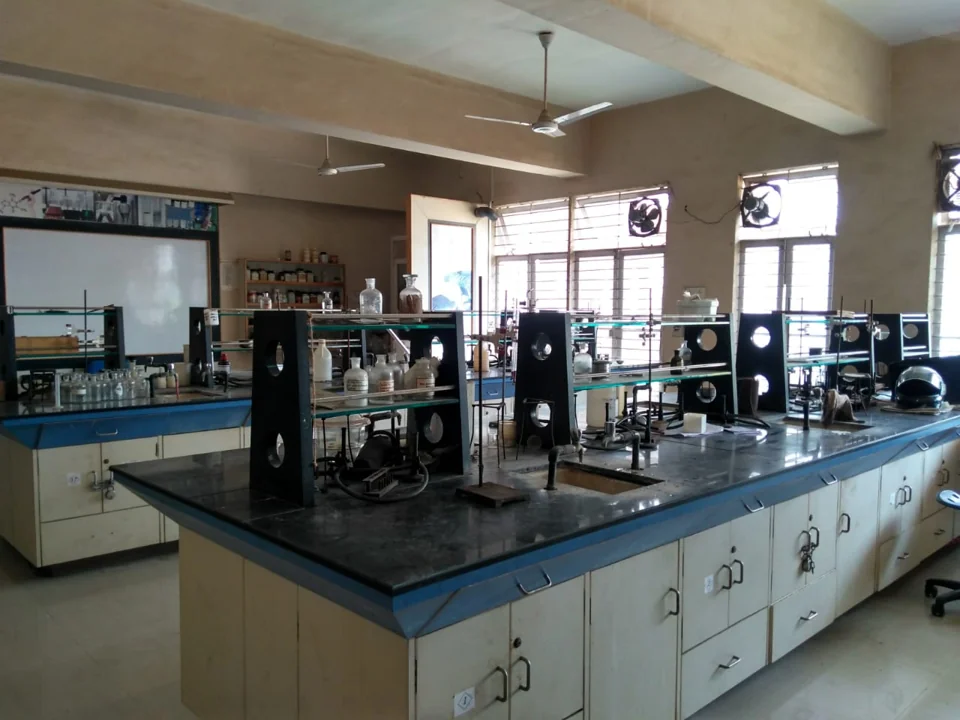
Practical work has a substantial physical setting in the department's laboratories and separate research laboratory. Its facilities description includes infrared spectroscopy with ATR, ultraviolet spectrometry, a rotary evaporator, a muffle furnace and routine instruments such as pH meters, colorimeters and conductometers. Reference material is available through both the central and departmental libraries. The department also describes short research projects as part of master's-level study and mentoring for students. These facilities connect chemical theory with observation, measurement and laboratory practice. The safety course complements that practical emphasis by making laboratory and industrial safety a distinct subject of study.
Sources: Department of Chemistry ↗
Computing and student development
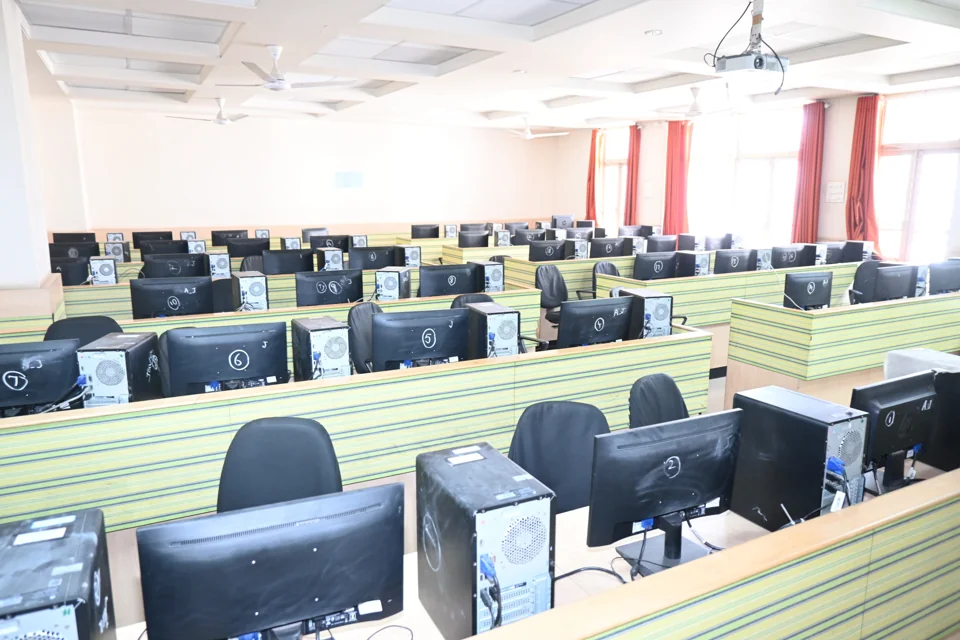
The Computer Science department records the beginnings of its B.Sc. programme in June 1989 and its M.Sc. programme in June 1998. Its mission combines a foundation in computing theory with practical software development, problem solving and analytical skills. It also identifies professional ethics, teamwork and research capability as aspects of computing education, with particular attention to technological awareness among young people from rural communities.
Departmental practices include mentors and class guardians, remedial teaching, additional courses on emerging technologies and guest lectures. Tests, assignments and presentations form part of its account of continuous assessment. Parent meetings provide another channel for discussing student progress. The department lists coding contests, hackathons, project exhibitions and technical events among opportunities for participation. Its programme objectives include communicating in technical settings and applying computer science principles to practical problems. Academic support and activities therefore sit alongside the subject curriculum in the department's description of student development.
Sources: Department of Computer Science ↗
A library supporting several kinds of study
The central library opened in 1971, alongside the college itself. It holds books, journals, periodicals and electronic resources, with separate functions for acquisition, processing, circulation, reference, reading and internet access. Library automation includes a web catalogue for searching bibliographic records. The library also describes access to N-LIST electronic material and remote access to its subscribed database resources.
Services include book lending, reference assistance, a book bank, bibliographic support, reprography and interlibrary loans. Reading and information literacy activities include a reader club, exhibitions and orientation. Students, teaching staff and non-teaching staff can obtain membership under the library's arrangements. Reference books and periodicals are generally retained for use within the library, while borrowing requires a valid college identity card or admission receipt. The library's combination of printed collections, digital access and user assistance supports both coursework and more independent reading across departments.
Sources: Central Library ↗
Community service through NSS
The college's National Service Scheme links student development with work in the community. Its stated objectives include understanding local needs, taking civic responsibility, sharing responsibilities in groups, developing leadership and learning to mobilise community participation. Service is presented as a way for students to learn from the people with whom they work, as well as to contribute their own knowledge and effort.
The college's published activity account for 2019–20 records tree planting, a leadership development workshop, street-play training, a blood donation camp and a one-day camp at Pimpri Sandas. It also records a special camp there from 22 to 28 January 2020, and volunteers participating in flood relief work at Kolhapur. Cleaning and distribution activities during the Pune–Pandharpur Wari appear in the same historical account. These documented examples show the range of community, environmental and organisational work undertaken through the NSS programme.
Sources: National Service Scheme ↗
Research within the college
The research policy published in the college's 2022–23 institutional policy collection addresses work by students, staff and associated external experts or guides. It places research ethics, publication ethics and academic integrity within the framework of the University Grants Commission and the affiliating university. A faculty research committee is assigned a role in supporting research activity and ensuring that grants are used for the purposes for which they were released.
The policy encourages seminars, conferences, workshops and research projects. It also calls for relevant research themes, support for essential research infrastructure, and transparent decisions about financial and other assistance. Another stated aim is for faculty research to inform teaching so that students encounter its findings within their learning. Outreach and non-financial consultancy are included as ways of sharing the expertise available in the institution. This policy gives research an organised place alongside classroom, laboratory and community activity.
Sources: Institutional Policies: Research Policy, printed pages20–22 ↗