Visa
About Annamalai University
Origins and institutional development
Annamalai University is based in Annamalainagar, immediately east of Chidambaram in Tamil Nadu, India. It came into existence on 1 January 1929 through the work of philanthropist Rajah Sir Annamalai Chettiar. Its roots lay in Sri Minakshi College, Sri Minakshi Tamil College and Sri Minakshi Sanskrit College, which he had established at Chidambaram during the early 1920s. An agreement with the government in 1928 provided the basis for bringing those institutions into the new university.
The university’s legal framework changed when the Annamalai University Act, 2013 came into force on 25 September 2013, replacing the earlier legislation. A further change in 2021 expanded its role from a unitary university to an affiliating institution with jurisdiction covering Mayiladuthurai, Cuddalore, Villuppuram and Kallakurichi districts. Its history therefore encompasses both residential teaching at Annamalainagar and a wider regional relationship with affiliated colleges. The university’s account of its origins also emphasises educational access and the promotion of Tamil language and literature.
Humanities and social sciences
The Faculty of Arts dates from the university’s foundation in 1929. Its academic account brings together language and literary studies, history, political science and public administration, economics, commerce, sociology and social work, population studies, business administration, library and information science, rural development and philosophy. This range connects the interpretation of culture with the study of institutions, communities and economic life.
The English department’s research areas include British and American literature, African American literature, Indian writing in English and Commonwealth literature. Political science and public administration include themes such as human rights, leadership, governance and Gandhian studies. The faculty’s history records the establishment of Sociology in 1954 and Library and Information Science in 1979. It also describes seminars, guest lectures and discussion activities as ways of extending academic exchange. Rural-development work adds a further connection with surrounding communities through training and engagement with agriculturalists.
Sources: Faculty of Arts ↗
Marine study at Parangipettai
Marine science has a separate geographic setting at Parangipettai. The Centre of Advanced Study in Marine Biology began there in 1957 as a field laboratory associated with Zoology. It became a separate department in 1961 and received Centre of Advanced Study status in 1963. The university elevated it to a separate faculty from the 2010–2011 academic year.
Its coastal setting provides access to estuaries, mangroves, backwaters and coastal waters. The faculty describes facilities for analytical work, cell and tissue culture, marine botany, plankton identification and culture, and aquaculture demonstrations. A museum maintains reference collections of regional flora and fauna, and a library supports marine-science research. The published academic profile spans fisheries, ocean science and technology, marine biology and oceanography, coastal aquaculture, marine microbiology and marine biotechnology. Field collections and laboratory investigation are thus connected within an environment where coastal ecosystems themselves form part of the setting for learning.
Sources: Faculty of Marine Sciences ↗
Campus infrastructure for learning
The university describes its campus infrastructure as a combination of older buildings and later additions. Shared conference halls are complemented by departmental seminar spaces. Classrooms, laboratories, computer facilities, library collections and online resources form part of the physical and informational support for teaching and research.
The infrastructure account identifies a central instrumentation laboratory for advanced work in the natural sciences, alongside a general library and digital information facilities. The library provides access to electronic research literature, while departmental facilities add more specialised settings for academic activity. The same account identifies sports courts, tracks and gymnasium facilities associated with Physical Education. Hostels and a guest house are listed within the campus infrastructure network. Together, these facilities describe the broader environment of a residential university, where subject-specific spaces sit alongside shared resources for academic discussion, independent study and recreation.
Sources: Campus infrastructure ↗
Student information and support
The university’s student-support account describes an information desk in the Administrative Block as a source of guidance about campus life. Central and departmental libraries support reference work, with computer and internet services available as part of the learning environment. A scholarship section provides information about financial-support schemes.
The Equal Opportunities Cell’s described responsibilities include support for Scheduled Caste and Scheduled Tribe students and preparation activities for examinations such as NET, SLET and civil-service tests. Other support structures include grievance arrangements, language laboratories, a placement cell, alumni associations and counselling. Student participation also extends to physical education, music and community engagement. The university identifies the National Cadet Corps, National Service Scheme and Youth Red Cross among its extension activities. These services and organisations give the residential community several points of contact beyond individual departments, connecting academic life with guidance, welfare, cultural interests and service.
Sources: Student support ↗
Natural farming and public engagement
The Centre for Natural Farming and Sustainable Agriculture was established in February 2022 within the Faculty of Agriculture. Its stated work includes practical demonstrations, farmer training, advisory services and the development of natural-farming approaches. The centre connects research with opportunities for farmers to observe and discuss agricultural practices.
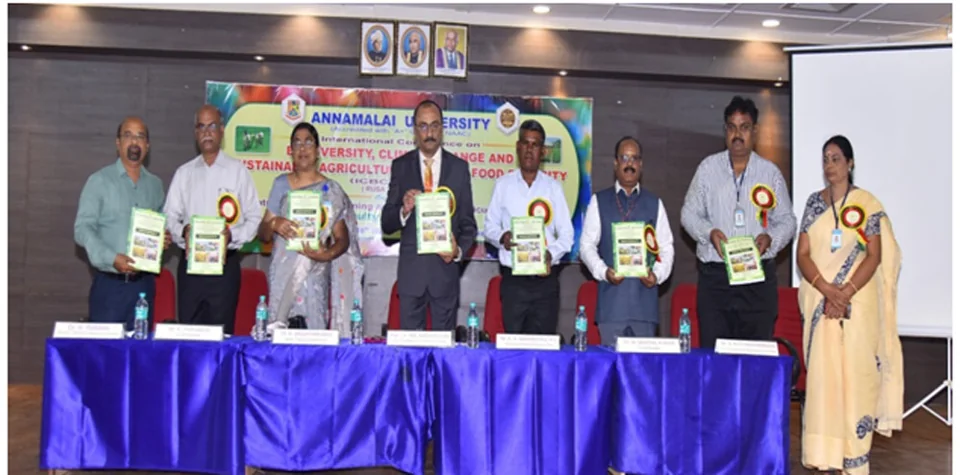
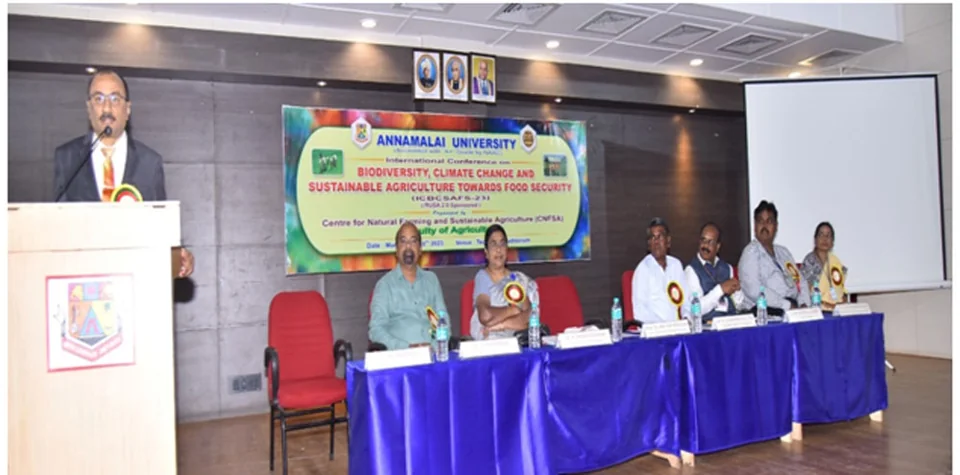
Its historical activity reports include a conference on biodiversity, climate change and sustainable agriculture held on 9–10 March 2023. It also records training and demonstrations with partner organisations, including programmes in Tamil Nadu districts and online learning activities. These examples show how university-based agricultural expertise has been shared through conferences, practical instruction and engagement beyond the campus.
Sources: Centre for Natural Farming and Sustainable Agriculture ↗