Visa
About Annai Velankanni College
Identity and regional purpose
Annai Velankanni College is in Tholayavattam, Kanyakumari district, Tamil Nadu. It is established and administered by the Friends of Kottar Society and identifies itself as a Christian minority institution under the religious jurisdiction of the Latin Catholic Diocese of Kuzhithurai. Its educational purpose is connected with the social and educational advancement of the region’s Latin Catholic community while also extending opportunities to people of other backgrounds.
The college’s institutional account emphasises service to rural and less-developed areas. It describes academic preparation alongside intellectual, ethical, social and spiritual development, placing these aims within India’s multilingual, multicultural and multireligious setting. The college is dedicated to Annai Velankanni, the Blessed Virgin Mary, who is venerated in the region as the Mother of Good Health. This religious identity accompanies an educational purpose centred on access, community welfare and personal formation.
Sources: Institutional history and purpose ↗
Mission and educational outlook
The college’s motto is Seat of Wisdom. Its mission statement connects the use of knowledge with the development of young women and men as leaders and agents of change. Equality, justice and liberty form part of that stated vision. The mission also gives priority to people facing economic, social or cultural disadvantages and describes admission without discrimination on grounds such as religion, caste, language or locality.
Its aims extend beyond academic study to leadership, communication and creative expression. Collaboration with nearby villages, social work in times of disaster or other need, and moral and spiritual development are also included. Entrepreneurship and preparation for competitive public-service examinations appear among the educational objectives. Together, these statements present learning as a combination of disciplinary knowledge, personal responsibility and participation in the surrounding community.
Sources: Vision and mission ↗
Fields of study
The college’s published course directory spans arts, science, commerce and business. Its undergraduate list includes Tamil, English, mathematics, physics, chemistry, computer science, biotechnology, zoology and physical education, alongside business administration and commerce. This combines language and literary study with mathematical, laboratory-based and professional subjects.
The postgraduate list includes Tamil, English, mathematics, physics, chemistry, computer science, biotechnology and commerce. The directory also identifies doctoral subjects in Tamil, English, mathematics, physics, chemistry, biotechnology and commerce. This published range places language scholarship, scientific enquiry and commercial studies within the same institutional setting.
Sources: Published course directory ↗
Additional learning in 2020–2021
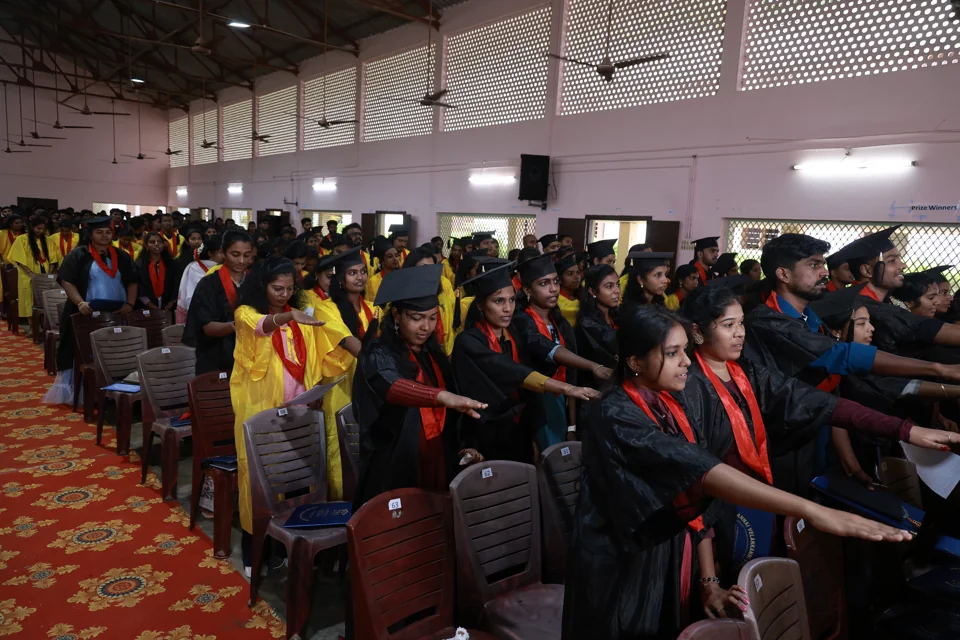
The archived add-on course list for 2020–2021 gives a more detailed picture of learning beyond the main degree subjects. These classes were listed as thirty-hour courses. Language and communication topics included journalism and Business English, while mathematical preparation included a course for competitive examinations.
Science-related offerings included food chemistry, biology for chemists, chemistry in everyday life, soil chemistry and environmental analysis, and industrial pollution and green chemistry. Electrical and electronic maintenance also appeared. Computing and administrative topics included office automation, e-governance and web design using HTML. Other listed classes addressed mushroom cultivation, vermi technology, aquaculture, digital marketing, taxation, insurance and risk management, and entrepreneurial skills. As a dated record, this list illustrates the practical and interdisciplinary subjects included in the college’s supplementary teaching during that academic year.
Sources: Add-on courses2020–2021 ↗
Scholarships and educational support
The scholarship page brings together government schemes, institutional support, endowments and academic awards. Its government information points to post-matric support for several categories of students, including minority communities, Scheduled Castes and Scheduled Tribes, and students with disabilities. It also identifies institutional scholarships associated with the Friends of Kottar Society, student welfare and departments.
The page records contributions from former students to support education. These include an endowment created by a former student for learners in financial need and the ALPHY endowment established by the 1989–1992 B.Sc. Physics cohort. Its award list recognises achievement in subjects including English, physics, chemistry, computer science, business administration, commerce and mathematics. These records show several forms of support and recognition around the college’s academic work, linking institutional provision with alumni contributions and subject-based achievement.
Activities and student participation
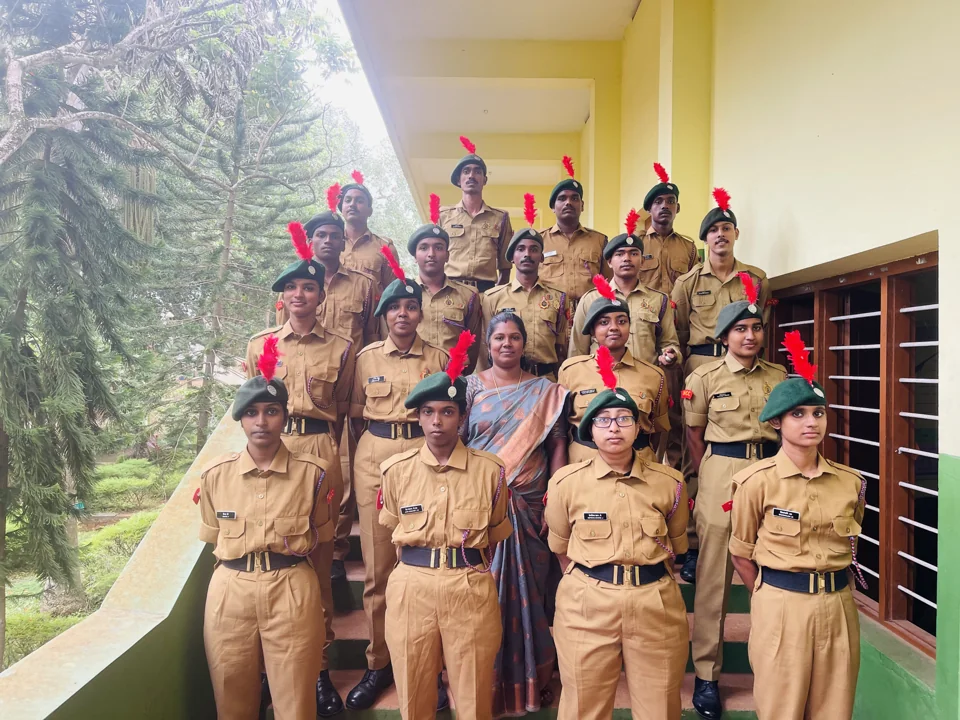
The Student’s Corner describes opportunities involving sport, social service and organised student groups. Its sports account identifies coaching in athletics, kabaddi, kho-kho and football. The page also includes the National Cadet Corps, National Service Scheme, Youth Red Cross and Women Cell among the college’s activities and support structures.
Community service is a recurring theme. The National Service Scheme is presented as an extension of student activity into the community, while the Youth Red Cross account refers to outreach and assistance during natural calamities. The Women Cell is described in terms of collaboration and the development of an inclusive, tolerant and gender-sensitive community. The same page points to sensitisation activities and an examination grievance mechanism, connecting student participation with aspects of welfare and institutional feedback.
Sources: Student’s Corner ↗
Quality-assurance objectives
The Internal Quality Assurance Cell’s published objectives concern the identification and institutionalisation of quality-assurance strategies. They also address values shaped by social, economic and environmental realities and by cultural diversity. Access to higher education for disadvantaged groups and the development of individual capabilities are included in this framework.
The objectives describe innovation, creativity and entrepreneurship as qualities the institution seeks to encourage. They also identify a move towards electronic documentation and data management. These stated priorities connect the college’s academic work with its wider commitments to social justice, educational access and organisational development. They provide a framework of intended institutional improvement alongside the college’s teaching subjects, practical classes and student activities.