Visa
About Ankara Üniversitesi Deniz Hukuku Ulusal Araştırma Merkezi
A specialist research centre in Ankara
Ankara Üniversitesi Deniz Hukuku Ulusal Araştırma Merkezi, generally known as DEHUKAM, is a specialist centre for maritime law and policy in Ankara, Türkiye. Its institutional account describes its creation within Ankara University as a way to bring together academics and others working in these fields. The centre’s published address is in the Emek neighbourhood of Çankaya. Its work encompasses scientific research, specialist education and cooperation with public bodies, organisations and researchers.
A significant institutional change took effect on 7 October 2020. DEHUKAM’s establishment account states that it gained national research centre status and legal personality under Law No. 6550 on support for research infrastructures. The resulting organisation retains Ankara University in its name while operating as a national research infrastructure. Its stated purpose includes developing maritime legal scholarship and supporting the preparation of specialists through academic activity and collaboration.
Sources: Institutional foundation and national centre status ↗
Research, expertise and scholarly cooperation
DEHUKAM’s founding purpose combines education and research in maritime law with the study of maritime policy. It envisages expert-led programmes, specialist library resources, national and international symposia, and joint work with comparable research centres abroad. Bringing researchers together is central to this approach: the centre describes coordination among specialists as a means of strengthening academic work across institutional boundaries.
Its account also explains why maritime questions have a broad place in its research agenda. It discusses shipping and international trade, the Turkish Straits, maritime jurisdiction and the use of marine resources. These subjects connect legal rules with policy choices and international relations. The centre identifies the preparation of expert contributions to meetings and treaty discussions as part of its intended role, alongside scientific events and the development of specialist knowledge.
Sources: Purpose of establishment ↗
Postgraduate education in maritime law
The centre’s education page describes an English-language, thesis-based master’s programme in maritime law under Ankara University’s Graduate School of Social Sciences. It records approval for opening the programme in July 2019. Both Turkish and international students form part of its intended academic audience, and the programme is presented as a way of developing researchers with specialised maritime legal knowledge.
Teaching is described as involving Turkish and international academics, including contributors with practical expertise in their subjects. The centre also expresses interest in institutional agreements supporting exchanges of students and teaching staff. Programme announcements are made through the graduate school and the centre’s own website. This educational arrangement connects DEHUKAM’s specialist research environment with the university’s postgraduate framework, bringing legal study and the development of research capacity into the same institutional relationship.
Sources: English thesis master’s programme in maritime law ↗
Voluntary research internships
DEHUKAM’s voluntary internship programme is directed at undergraduate and postgraduate students interested in maritime law, international law and international relations. Its published description extends participation beyond law students to related university subjects. The programme’s stated objectives include building awareness of maritime questions and developing academic research skills through work with specialists.
Activities include research, report preparation, legal analysis, following international maritime developments, and attending academic events or seminars. The programme page distinguishes an eight-week summer format, involving attendance four days a week, from twelve-week winter formats with weekly attendance. It describes three annual application periods and an assessment involving academic results, language ability, availability and interviews. Successful completion is documented with a participation certificate. The emphasis is on supervised research experience and engagement with the centre’s academic activities.
Sources: Voluntary internship programme ↗
A bilingual maritime law journal
DEHUKAM publishes the DEHUKAM Maritime Law Journal, or DEHUKAMDER, as an open-access, peer-reviewed academic journal appearing twice a year. Publication began in 2018. Its stated coverage includes international maritime law, marine insurance, maritime commercial law, and public and private maritime law.
The journal accepts work in Turkish and English. Its description explains that Turkish contributions are translated into English by a sworn translator and published in both languages. The centre directs article submissions through the journal’s DergiPark page. The journal therefore provides a regular publication channel alongside DEHUKAM’s conferences, research and educational work.
Sources: DEHUKAM Maritime Law Journal ↗
Education on marine litter and circular economies
A report published on 2 November 2026 documents the first training held through the Erasmus+ project Youth for a Plastic-Free Future: Raising Awareness on Marine Litter. DEHUKAM coordinated the sustainable consumption and circular economy programme in İzmir from 13 to 16 October 2026. Partners contributing to the event included Abat Oliba CEU University in Spain, the University of Montenegro and Italy’s FISPMED.
The sessions examined consumption habits, marine litter and circular economic approaches. Presentations, discussion and group exercises addressed consumer behaviour, marine ecosystems, waste reduction, action planning and business models. Participants also prepared a youth declaration with recommendations on sustainable consumption and the prevention of marine pollution. The report records a closing certificate ceremony, providing a concrete example of the centre’s educational cooperation beyond postgraduate legal teaching.
Sources: Marine Litter project training report, November 2026 ↗
Youth participation in Mediterranean climate discussions
A separate November 2026 report describes the final CASS training in the Youth4CliMed project. The programme took place in İzmir from 11 to 17 October 2026 under DEHUKAM’s coordination, hosted by Dokuz Eylül University. Project partners included PAP/RAC in Croatia, FISPMED in Italy and Abat Oliba CEU University in Spain.
The sessions considered young people’s participation in climate action in the Mediterranean. Topics included climate literacy, environmental rights, climate justice, digital advocacy, community participation and representation in policy discussions. Interactive activities accompanied the teaching. Participants jointly prepared a youth declaration setting out priorities and recommendations for a climate-resilient Mediterranean. The report places this event within a series of training activities, illustrating the centre’s work at the intersection of marine policy, environmental education and international collaboration.
Colloquia and international panels
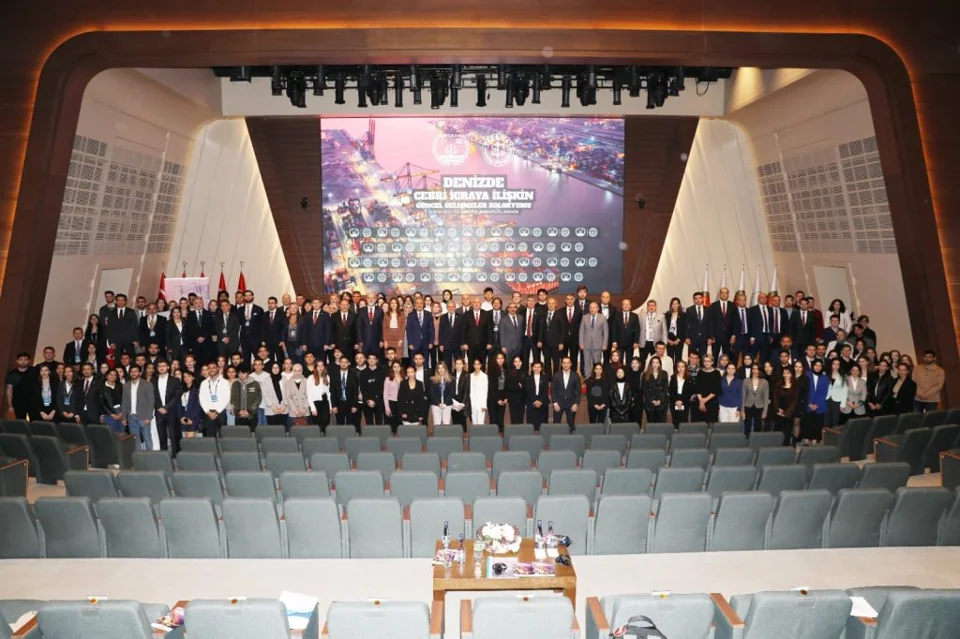
DEHUKAM’s academic event reports show several forms of scholarly exchange. On 12 October 2023 it organised a colloquium on developments in maritime enforcement at the Court of Cassation conference hall. Academics, judicial personnel, lawyers and maritime-sector representatives attended. A keynote discussion of the international judicial sale of ships was followed by three chaired sessions, bringing researchers and practitioners into a shared programme.
Sources: Maritime enforcement colloquium, October 2023 ↗
A maritime decarbonisation discussion
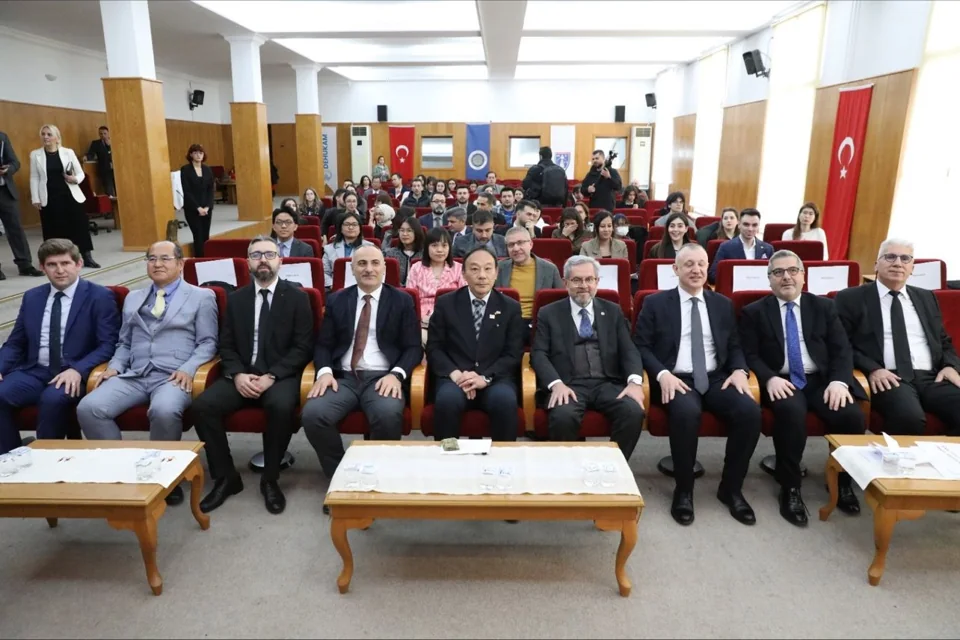
On 15 March 2024, DEHUKAM worked with Ankara University’s Asia-Pacific research centre and the Japanese Embassy on an international maritime decarbonisation panel. Held in Ankara University’s Faculty of Law, the event formed part of the centenary of Türkiye–Japan diplomatic relations. Presentations considered renewable energy and maritime transport in Pacific island countries, as well as the International Maritime Organization’s decarbonisation work through a life-cycle perspective. The panel illustrates the centre’s engagement with environmental questions affecting maritime activity.
Sources: Maritime decarbonisation panel, March 2024 ↗