Visa

About Ankara Science University
A foundation university in Ankara
Ankara Science University, known in Turkish as Ankara Bilim Üniversitesi, is a foundation university in Ankara, Türkiye. Its establishment was published in the Official Gazette on 17 April 2020, in issue 31102. The university’s founding organisation is Türkiye Verimlilik Vakfı, the Turkey Productivity Foundation, which was established on 21 April 2016. These dates distinguish the creation of the supporting foundation from the later establishment of the university.
The foundation’s stated purpose connects productivity with sustainable development, environmental awareness and improvements in economic and human life. The university’s account of its origins places its educational project within that wider concern for sustainability and the productive use of knowledge.
Sources: Institutional history and founding ↗
Educational purpose and interdisciplinary thinking
The university’s mission brings research, education and service together across science, technology, the humanities, arts and design. It presents innovation and creativity alongside continuity and respect for traditions. Critical thinking, ethical responsibility and sensitivity to social needs are part of the educational outlook described in its institutional statement.
The statement encourages work across disciplinary boundaries and cooperation with universities, research centres, public bodies and private organisations. It identifies the development of research areas, centres and projects, academic discussion and educational publishing as institutional aims. Its vision also gives attention to entrepreneurship, digital technologies, environmental responsibility and respect for differences. These priorities describe the direction of the university’s educational development: students and researchers are encouraged to connect specialised knowledge with wider questions about society, technology and the environment.
Sources: Mission and vision ↗
Engineering study and curriculum development
The Faculty of Engineering and Architecture began operating in the 2020–2021 academic year. Its introductory account records the first admissions to computer engineering, electrical and electronics engineering, industrial engineering and software engineering in that year. Information systems engineering followed in 2022–2023, while a Turkish-language computer engineering programme began admitting students in 2023–2024.
The faculty describes a curriculum that develops progressively from foundational science and introductory professional subjects in the first year to more specialised professional courses and electives in the second and third years. Students encounter further electives related to their interests in the seventh semester, before workplace education in the final semester. The original programmes are described as English-medium courses following preparatory education. The later Turkish-language computer engineering route therefore represents a distinct language option within the faculty’s development, rather than a change in the teaching language of every programme.
Sources: Engineering and Architecture: introduction ↗
The engineering 7+1 education model
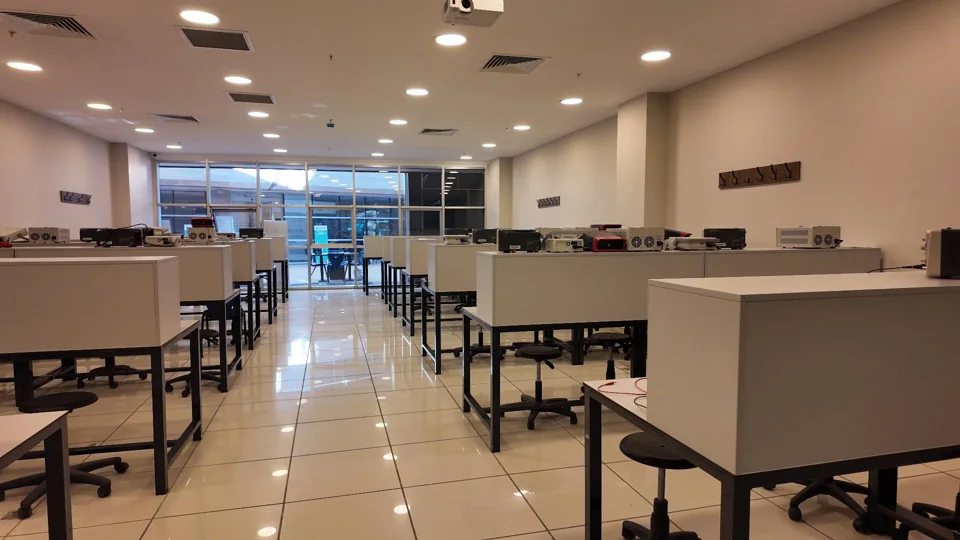
The faculty explains its workplace component through a 7+1 model: seven semesters of university study are followed by a semester in an enterprise. The campus-based portion combines theoretical and practical learning, while the enterprise period forms a separate, structured part of the engineering curriculum.
The published model places workplace education in the second semester of the final year. It specifies a fourteen-week period with four working days each week, arranged according to the academic calendar and the workplace education directive. This design gives the final semester a different setting from conventional classroom study. The model connects the preceding sequence of engineering subjects with participation in an organisation’s working environment and makes that experience an identifiable curricular component.
Creative practice, design and research
The Faculty of Fine Arts and Design describes education as a process of developing ideas, turning them into designs and bringing them into production. Its introduction connects artistic practice with scientific and technological research, while setting the broader goal of making art accessible within society. An open approach to thought and creative expression is central to this account.
The faculty organises its educational outlook around three related elements. One combines aesthetic understanding and professional skills with ideas and methods. Another develops research methods for disciplinary and interdisciplinary creative practice. The third involves teamwork with professionals, entrepreneurs and practitioners. The faculty’s published academic navigation identifies film design and directing, new media and communication, and interior architecture and environmental design. Together these subjects place moving-image work, contemporary communication and the design of physical environments within the university’s creative education.
Sources: Fine Arts and Design: introduction ↗
Graduate education across professional fields
The Graduate Education Institute’s introductory message describes provision spanning business administration, management information systems, computer engineering, electrical and electronics engineering, artificial intelligence engineering and engineering management. It also identifies film and new media among its fields. This range brings management, computing, engineering and creative subjects into the institute’s postgraduate environment.
Its account refers to Turkish- and English-language provision and to thesis and non-thesis options, with the form of study varying between programmes. The educational approach emphasises the relationship between theory and practice, critical thinking and interdisciplinary research. Laboratories, classrooms and library resources are described as supporting graduate study. Rather than presenting postgraduate education as an isolated continuation of classroom instruction, the institute frames it around the development of research capabilities and the application of specialised knowledge across professional and academic settings.
Student participation and campus life
The university’s social-life page describes activities extending beyond formal academic programmes. Its sports provision includes a padel court and spaces for volleyball and basketball, alongside sports and conditioning programmes. University teams participate in local leagues and competitions organised through sporting federations, giving organised sport a place within student life.
Cultural participation includes seminars and concerts. Student clubs provide another route into activities based on shared interests, with arts, culture and social responsibility among the areas identified by the university. These activities sit alongside academic study and give students settings in which to organise, collaborate and meet others with similar interests. The university’s account presents campus life through this combination of sport, cultural events and student-led participation, rather than through academic departments alone.