Visa
About Ankara Hacı Bayram Veli University
An Ankara university with several campuses
Ankara Hacı Bayram Veli University is a university in Türkiye’s capital with an academic emphasis on social sciences, culture and the arts. Established in 2018, it inherited academic traditions that the university’s introduction traces back to 1934. Its teaching is distributed across several locations rather than concentrated on a single campus. The general brochure places the rectorate in Çankaya, the Faculty of Letters and communication-related units at Itri, and law and economics at Beşevler.
Other locations give the university a presence across Ankara and its surrounding districts. Gölbaşı accommodates arts, design and tourism units, while Polatlı has its own academic buildings. The brochure also identifies a North Ankara location for theology. Alongside its campus descriptions, it lists reading rooms, an online library catalogue, electronic databases, student societies and sports facilities as parts of university life.
Academic purpose and institutional values
The university’s mission connects academic knowledge with cultural and artistic production. It describes national and international cooperation, interdisciplinary work and digital technologies as ways of developing that work and serving society. Its stated vision focuses on contributing to social development through social sciences, culture and art. These are institutional aims that explain the university’s academic direction and the relationship it seeks between scholarship and public life.
The published values also give prominence to students and participation. They include academic freedom, ethical conduct, cooperation with stakeholders and respect for fundamental rights. A research focus is accompanied by an emphasis on sustainability and proactive working practices. The university explicitly includes opposition to discrimination and concern for the environment and cultural heritage in this framework, linking its educational mission with responsibilities beyond individual courses.
Sources: Mission, vision and values ↗
Humanities and the Faculty of Letters
The Faculty of Letters illustrates how the university combines a recent institutional foundation with older academic units. Its predecessor opened in the 1978–1979 academic year as a Faculty of Statistics and Basic Sciences associated with the Ankara economics and commerce academy. It became a Faculty of Science and Letters in 1982, and a separate Faculty of Letters followed in 2011. The faculty transferred from Gazi University to Ankara Hacı Bayram Veli University under the legislation published on 18 May 2018.
Its subject range includes history, philosophy, archaeology, geography, anthropology, sociology and psychology. Language and literary studies encompass Turkish, contemporary Turkic languages, Western languages, Slavic languages and Eastern languages, alongside translation and interpreting. Art history and Turkish folklore extend that humanities range into visual and cultural traditions. The faculty’s candidate information describes four-year undergraduate education and identifies Turkish as its teaching language.
Sources: Faculty of Letters ↗
Economics, administration and organisational studies
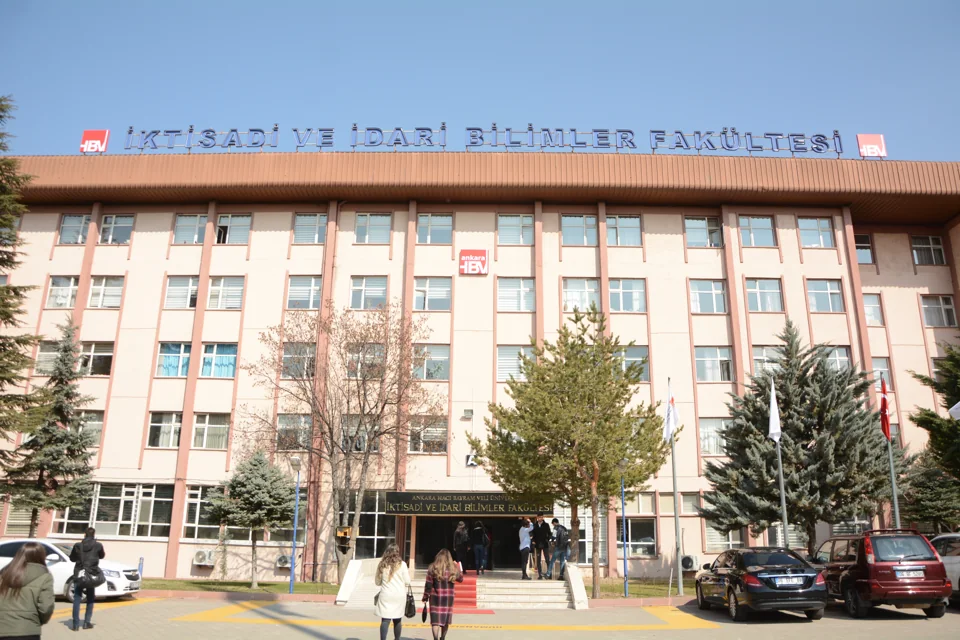
The Faculty of Economics and Administrative Sciences traces its ancestry to the Ankara Academy of Economics and Commercial Sciences, which began teaching in 1955. Several academy faculties and specialist schools were brought into Gazi University in 1982 to form the faculty. Its transfer to Ankara Hacı Bayram Veli University took place in 2018.
The faculty groups economic and organisational subjects within a broad social science setting. Its departments include economics, business administration, econometrics, public finance, labour economics and industrial relations, health management, political science and public administration, international relations, international trade and finance, and management information systems. The published account records double-major and minor arrangements from 2003. It also dates the provision of both English and Turkish tracks in business administration and international relations to the autumn semester of 2015–2016, while describing Turkish teaching in the other departments.
Sources: Faculty of Economics and Administrative Sciences ↗
Legal education at Beşevler
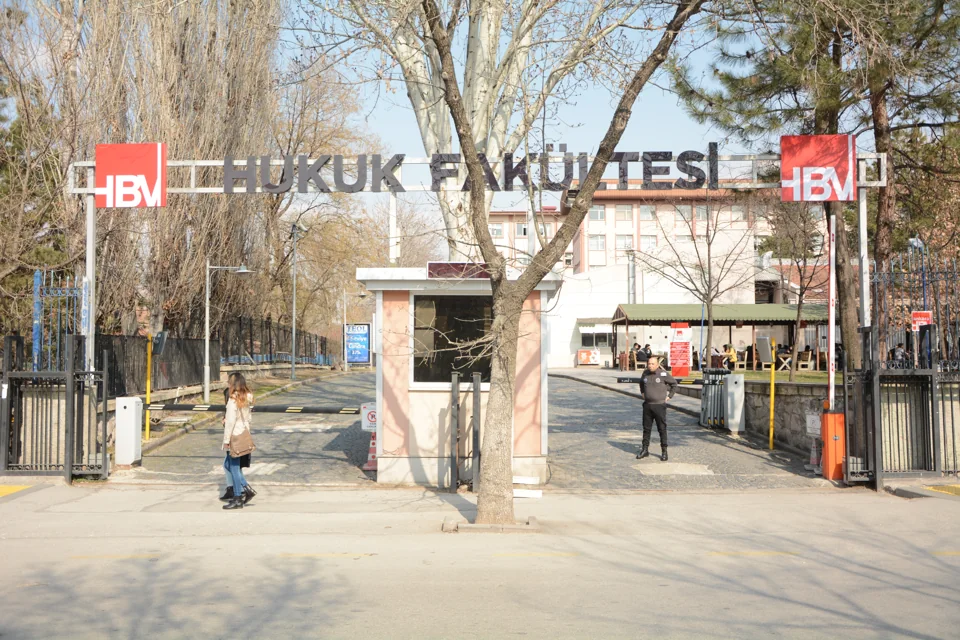
The Faculty of Law also moved from Gazi University in 2018. Its undergraduate curriculum is organised over four years and combines compulsory foundations in public and private law with more specialised elective subjects. The faculty describes a semester-based course structure and participation in Erasmus student exchange. Its account also places postgraduate study after the undergraduate degree, with master’s and doctoral education forming a further academic stage.
The faculty’s setting includes a reading room for quiet study, a canteen and dining facilities shared with the Faculty of Economics and Administrative Sciences at Beşevler. Student societies contribute to its academic and cultural activities. The published examples include panels, conferences, theatre, folk dance and music events. These facilities and activities place legal study within a wider campus environment, alongside classroom teaching and individual reading.
Sources: Faculty of Law ↗
Tourism and an older teaching tradition
The Faculty of Tourism’s history begins with efforts to train teachers for commercial education in the 1950s. A three-year secretarial teacher-training centre and a commerce teacher school opened in 1956. The institution later developed into a higher teacher school, and in 1965 its name expanded to include tourism while its study period became four years. This history links the present faculty to both vocational education and tourism studies.
Further reorganisations followed within Gazi University. Commerce and tourism education became a separate faculty in 1992, and the faculty’s move to Gölbaşı took place in 2003. A Faculty of Tourism was established in 2009 and transferred to Ankara Hacı Bayram Veli University in 2018. The candidate site lists gastronomy and culinary arts, recreation management, tourism management, tourism guiding and travel management among its departments.
Sources: Faculty of Tourism ↗
Languages, mobility and student arrangements
The university’s prospective-student guidance describes Turkish as the main language of education while noting that some programmes use English, German, French or Arabic. It also identifies elective language learning through the School of Foreign Languages, including Arabic, French, English and Russian. Double-major study and minor study are described as different arrangements: the former involves a second qualification, while the latter leads to a certificate alongside the main degree.
Transport and accommodation are addressed in practical terms. The guidance notes the proximity of Beşevler and Gazi Mahallesi faculties to metro and train stations, with bus and minibus services serving the same areas. It states that the university does not operate its own dormitory, and points to public and private student residences near its campuses. Its Erasmus description presents international mobility as a period of study at another institution, with applications organised through the university.
Sources: Prospective student questions ↗