Visa

About Anhui University of Traditional Chinese Medicine
History and university setting
Anhui University of Traditional Chinese Medicine is based in Hefei, Anhui Province, China. Its predecessor was a provincial advanced training class in Chinese medicine founded in 1952. Anhui College of Traditional Chinese Medicine was established with provincial approval in 1959, and the institution adopted its present university name in 2013. Its Chinese name is 安徽中医药大学. The university also established the Anhui Academy of Chinese Medicine in 2011.
The institution's September 2026 overview identifies four campuses: Shaoquan Lake, Meishan Road, Shihe Road and Liu'an Road. Its academic structure places Chinese medicine and pharmacy alongside science, engineering, management, economics and literature. Undergraduate, master's and doctoral education form parts of its provision. Affiliated hospitals connect the university with clinical teaching and research, while international relationships involve educational and medical organizations, student exchanges and training. These activities extend the institution's role beyond its main campus classrooms.
Sources: University introduction, September 2026 ↗
Humanities, languages and international education
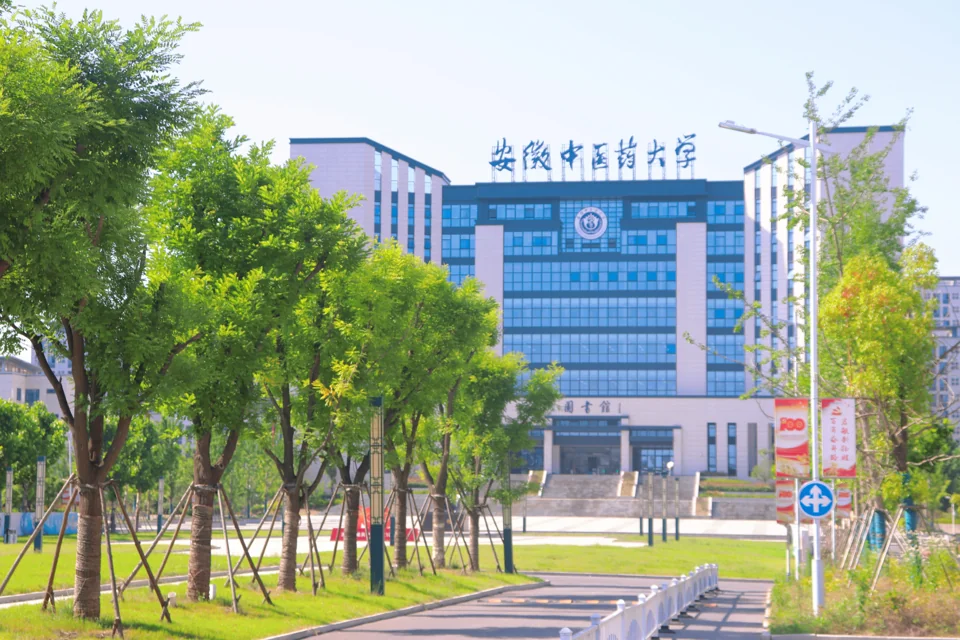
The Humanities and International Education College was formed in May 2017 by bringing together humanities, international education, foreign affairs and psychology functions. Its June 2025 introduction describes a unit combining academic teaching and research with responsibilities for international cooperation and overseas students.
The college provides undergraduate study in Chinese language education for international contexts and applied psychology. It also teaches shared university subjects, including English, Chinese, classical medical Chinese, public arts and student mental health education. Teaching spaces include language laboratories, psychology practice rooms, small-scale teaching demonstration rooms and rooms for music and visual arts. Research platforms address Chinese medicine culture, communication and language services. The college's responsibilities include international partnerships, visiting foreign specialists and the recruitment and educational management of students from outside mainland China. This combination brings linguistic, cultural and humanistic study into the wider university's specialist educational setting.
Sources: Humanities and International Education College introduction, June 2025 ↗
Computing and medical information engineering
The Medical Information Engineering College was established in 2002. Its June 2026 revised introduction describes a history of combining Chinese medicine with information technology. A modern industry college was developed with iFlytek in 2022. The university's network information centre, previously incorporated into the college in 2017, became separate again in March 2024.
Teaching organization includes medical technology, intelligent medicine and medical engineering, supported by an experimental and practical training centre. Its undergraduate subject range includes information management and systems, computer science, biomedical engineering, medical information engineering, data science and big data technology, artificial intelligence, medical imaging technology and intelligent medical engineering. The college also describes postgraduate work in intelligent science and technology and related interdisciplinary fields. Enterprise cooperation and practical projects are part of its teaching approach, linking computing, information management and software development with the specialist knowledge taught elsewhere in the university.
Sources: Medical Information Engineering College introduction, revised June 2026 ↗
Nursing education and practical learning
The Nursing College traces its origins to an advanced nursing diploma class opened in 1990. Undergraduate nursing recruitment began in 2000, an independent department was established in 2001, and the college name followed in 2004. Its December 2025 introduction records the start of postgraduate education in Chinese medicine nursing in 2012.
The college organizes teaching through foundational nursing, clinical nursing and Chinese medicine nursing departments. An experimental training centre and a nursing research centre support its work, with clinical nursing teams from the university's affiliated hospitals contributing to the educational setting. Its stated academic interests include nursing education, clinical practice and community nursing. Beyond campus instruction, the college describes public-service activities through its volunteer team, bringing first-aid education into schools, communities, enterprises and villages. Its educational work therefore includes classroom study, supervised practical preparation, research and community engagement within the wider university's health-related academic structure.
Sources: Nursing College introduction, December 2025 ↗
Supporting postgraduate supervision
On 30 October 2026, the Medical Economics and Management College organized a development meeting for postgraduate supervisors alongside a session on research integrity. The university's November report describes staff reviewing institutional postgraduate education rules and discussing responsibilities throughout the student training process.
The meeting addressed research ethics, academic integrity and the quality of dissertation supervision. Discussion included the preparation, revision and submission of dissertations for review, and the checking of research data and results. Staff also considered appropriate professional relationships between supervisors and students and the importance of communication and student wellbeing. Teaching administration, textbook selection and classroom work formed additional topics. The college described continuing supervisor development as part of improving its postgraduate education. The report provides a specific example of how staff training, academic standards and student support are considered together within the institution's graduate teaching arrangements.
Sources: Postgraduate supervisor development and research integrity, November 2026 ↗
Student participation in classroom teaching
A September 2026 teaching profile by Wu Yuanjie describes efforts to give students an active role in their learning. The account includes virtual simulation resources, online teaching collaboration between educators in different provinces, and the development of digital teaching tools. These are presented as teaching methods within the university, rather than as substitutes for its broader academic courses.
Classroom activities include student-designed cases, small-group discussions, presentations and peer feedback. Creative assignments allow students to explain course ideas through drawings, performances and other formats, followed by discussion with the teacher. The account also describes observation and feedback for younger teachers, including attention to lesson introductions, board work and interaction with students. Teacher-development sessions and repeated refinement of lessons support that work. Together, the examples show an emphasis on student participation and reflective teaching practice alongside the university's specialist subject content.