Visa
About Anhui Technical College of Mechanical and Electrical Engineering
The former college and its successor
Anhui Technical College of Mechanical and Electrical Engineering was a public vocational college in Wuhu, Anhui, China, known in Chinese as Anhui Jidian Zhiye Jishu Xueyuan. In May 2026 it became one of the two predecessor institutions of Anhui Applied Technical Vocational University, alongside the former Anhui Business College.
Sources: Successor university institutional profile: May 2026 merger ↗
An industrial education lineage
The mechanical and electrical college's archived institutional account traces its origins to the private Neisi Industrial Vocational School established in 1935. Its subsequent history passed through industrial, electrical power and electrical machinery schools in Wuhu. In 1978, Wuhu Mechanical School provided the basis for the establishment of Anhui Mechanical and Electrical Institute. The provincial government determined that Wuhu Mechanical School would be restored in 1986, and the school was upgraded to the vocational college in 2003.
Before the 2026 merger, the college described an engineering-centred educational role tied to regional industry. Its work combined vocational teaching with applied research, technical services and cooperation with manufacturing enterprises. The archived May 2026 profile identifies Wenchang and Fanchang campuses and partnerships in automotive production, robotics and intelligent manufacturing. This background explains the substantial engineering teaching infrastructure carried into the successor university.
Sources: Archived former college profile, updated May 2026 ↗
Electrical engineering and robotics
The electrical engineering school's May 2026 profile describes vocational subjects in industrial robotics, electrical automation, mechatronics, applied electronics and intelligent control. It also records undergraduate programmes jointly delivered with Anhui University of Engineering and Anhui University of Technology. Those joint arrangements formed part of the teaching portfolio described before the institutional merger.
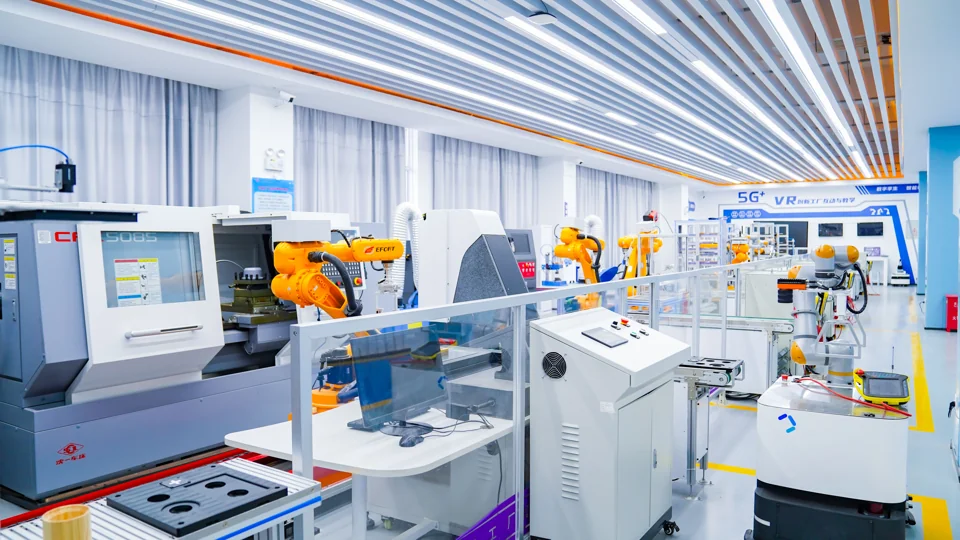
Practical education includes dedicated laboratories and training rooms and an industrial robot pilot testing base. Cooperation with Efort supports a robotics industry school, while a wider robotics partnership brings educational and industrial participants together. The profile describes project-based work on campus and workplace learning outside it, with observation, rotation and placement used at different stages. The school also undertakes technical training, teacher development and work on enterprise research projects. Its facilities connect control systems and electrical skills with the integration and use of industrial robots, rather than treating robotics as an isolated classroom subject.
Mechanical engineering and digital production
The mechanical engineering school lists subjects covering numerical control, mechanical manufacturing and automation, mechanical design and manufacturing, intelligent manufacturing equipment, intelligent machine tool applications, industrial product quality inspection and industrial engineering. This portfolio addresses both the production of components and the organisation, operation and assessment of manufacturing processes.
Its practical equipment includes numerical control lathes, milling machines, machining centres, multi-axis machines, combined turning and milling equipment, coordinate measuring machines, and intelligent manufacturing cells and production lines. These resources are described as serving production, teaching and research together. The school works with enterprises on training bases and has developed an industrial machine tool school with Huazhong CNC. Other collaborations concern digital design, additive manufacturing and intelligent production of automotive components. The resulting teaching environment links individual machining operations with digital design, measurement and larger manufacturing systems, reflecting the industrial specialism inherited from the former college.
Sources: Mechanical engineering school profile ↗
Automotive teaching and enterprise links
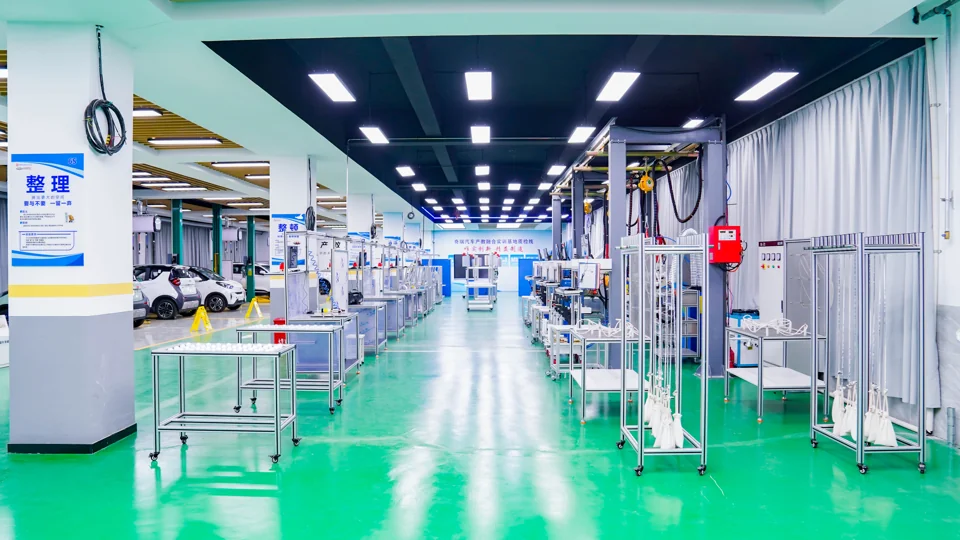
The automotive and rail school began recruiting students in 2004. Its May 2026 profile centres its development on automotive education and a new energy vehicle technology subject group. Practical resources include training laboratories, a factory within the school and an automotive safety performance testing line.
Enterprise cooperation includes Chery, Nio and Chery New Energy, with off-campus practice bases and a jointly developed Chery automotive industry school. The profile also describes company-linked classes and jointly organised field engineer education. These arrangements bring vehicle industry settings into the educational programme, complementing the school's campus equipment. Its teachers contribute to teaching resource libraries, online courses and textbooks as well as classroom and practical instruction. The school's account emphasises combining broader student development with technical skill, showing how workshop facilities, teaching materials and enterprise participation form connected parts of its automotive training approach.
Sources: Automotive and rail school profile, May 2026 ↗
Aviation, materials and fabrication
The aviation and materials school provides another strand of the former college's manufacturing identity. Its March 2026 profile lists intelligent welding technology, mould design and manufacturing, additive manufacturing technology, aircraft electromechanical equipment maintenance, and electromechanical equipment technology. It also records a joint materials forming and control engineering undergraduate programme with Anhui University of Engineering during 2020–2023.
Its facilities include digital mould design, three dimensional printing, precision machining, turboprop engine training and welding simulation spaces. Research centres address intelligent welding robots, precision forming and laser additive manufacturing of metal matrix composites. The school describes cooperation with companies and industrial parks through practice bases, teacher workstations, research and technical services. An additive manufacturing partnership links this work with a wider industry and education network. These activities connect material processing and equipment maintenance with the practical facilities used in teaching, while the dated undergraduate collaboration remains part of its historical account.
Sources: Aviation and materials school profile, March 2026 ↗
Internet and communications technology
The internet and communications school adds computing and connected systems to this engineering portfolio. Its March 2026 profile lists computer applications, Internet of Things applications, computer networks, cloud computing applications, industrial internet technology and artificial intelligence applications. Industry engineers participate alongside academic teachers in its staffing arrangements.
The school's practical infrastructure includes an ICT innovation base developed with ZTE, with systems for smart connected devices, cloud computing and big data, and mobile communications. Other partnerships support a cloud computing school and an industrial internet technology innovation centre. It also describes collaboration with Alibaba Cloud, China Telecom's Wuhu branch, Huawei and robotics partners. These links support different parts of the computing and communications curriculum, from networked devices and cloud platforms to industrial applications. Enterprise projects, research and teaching therefore sit alongside one another in a unit whose technology subjects complement the predecessor college's manufacturing and automation strengths.
Sources: Internet and communications school profile, March 2026 ↗