Visa
About Anhui College of Mining and Technology
A vocational institution with two linked names
Anhui College of Mining and Technology is located in Huaibei, Anhui Province, China. Its Chinese name is Anhui Kuangye Zhiye Jishu Xueyuan, and its official institutional overview dates the college’s establishment to 2009. The overview states that it operates as one institution under two names, the other being Anhui Huaibei Coal and Electricity Technician College. This relationship explains why both names appear throughout its official website. The institution’s published address is 22 Yingshan Middle Road, in Huaibei’s Xiangshan district.
The May 2025 overview describes an institution combining higher vocational education, technician education, continuing education and other forms of training. It identifies professional clusters in intelligent control, equipment manufacturing, information technology, business management, modern services and resource management. Practical-training facilities described in the account include industrial robotics, drones and mechanized mining. Alongside diploma-level education, the institution describes training connected with enterprise management, mining and emergency-related technical safety. Its work therefore extends across formal vocational study and training linked to industrial practice.
Sources: Anhui Mining College: Institutional overview, May 2025 ↗
Work, study and applied teaching
A May 2017 statement of educational characteristics describes the school’s orientation toward the mining region, Huaibei and the wider community. It discusses studying enterprise skill requirements and using that knowledge in the development of academic and training subjects. Cooperation with companies formed part of this published approach to combining work and study. The 2017 account names Huaibei Mining Group and Hefei Gree among the enterprises involved in its work-and-study and company-oriented training arrangements.
The statement also describes integrated teaching, in which understanding workplace requirements, learning operating standards and practising occupational skills are connected parts of instruction. Its discussion of broader student development includes career planning, psychological-health education, guidance and enterprise culture. Read as a historical account, these features show how the institution articulated the relationship between technical preparation, student development and the working environments its education sought to address. Practical application was presented alongside classroom learning and general educational responsibilities.
Classroom observation and teaching development
A November 2026 report describes classroom observations conducted from mid-September through the end of October. The academic-affairs office worked with the electromechanical engineering department, management and information department, and public-course teaching unit to examine teaching at the start of the semester.
Observers considered lesson preparation, classroom organization, interaction between teachers and students, information-technology use and students’ participation. The report describes immediate conversations with teachers after observed lessons, identifying strengths and areas needing improvement. The teams completed 31 classroom observations and examined connections between course content, workplace tasks, skills competitions and certificate-related learning. Visits were unannounced, with observers entering classrooms at random and remaining throughout a lesson. Teams also checked routine arrangements, including mobile-phone management and preparation before classes began. It also acknowledges limitations, including uneven use of digital teaching methods and participation in some classes. Follow-up observations, demonstration lessons, collective preparation and support for younger teachers were identified as subsequent work. This dated account shows the college’s reported process for reviewing teaching practice and using classroom feedback in staff development.
Sources: College: Classroom observation report, November 2026 ↗
Industry discussions about practical-training facilities
On October 22, 2026, representatives of the production-equipment branch of Huaibei Mining Co., Ltd. visited the institution for a discussion about cooperation. The college’s report records participation by its leadership and examination-information staff. The exchange addressed training-base construction, routine management and the organization of teaching and training.
The discussion included the shared use of resources, the development of practical-training projects and preparations connected with a provincial training-base application. Enterprise representatives contributed experience from equipment operation and workplace skill requirements. The report presents the meeting as an opportunity to consider future development of the institution’s practical-training resources. Participants also examined the preparation of application materials, the interpretation of assessment indicators and construction planning.
Sources: College: Production-equipment company discussion, October 2026 ↗
Student clubs and cultural participation
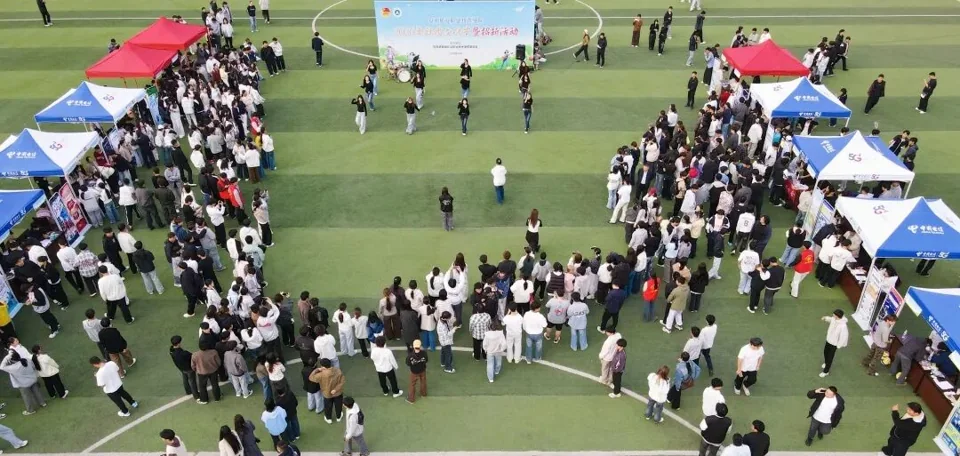
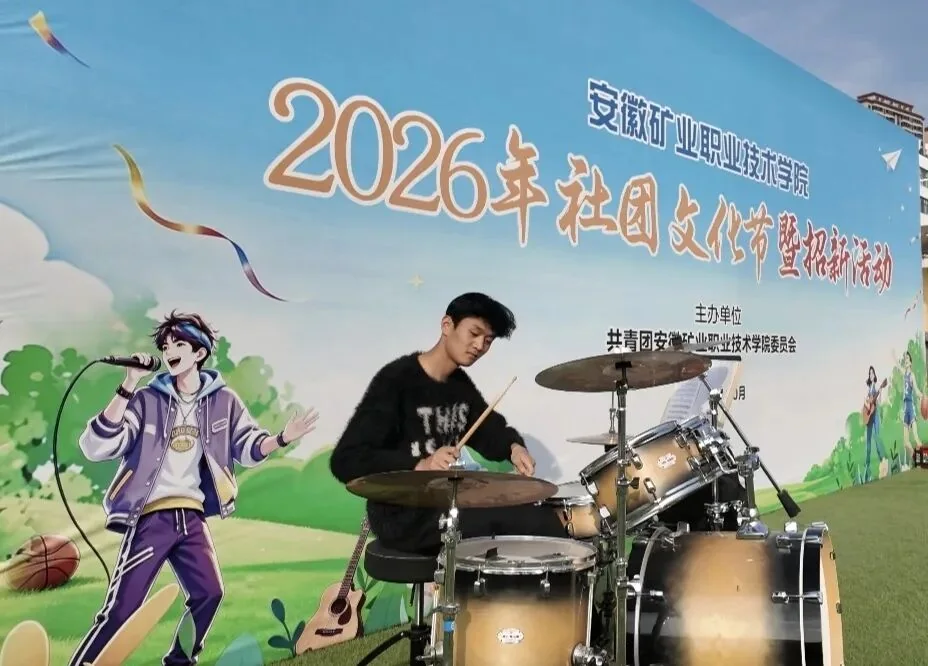
The college’s student community also participates in activities beyond technical study. A report published on November 1, 2026 describes a club-culture festival and recruitment event held on the sports field on October 28. Clubs gathered to introduce their activities and welcome new members.
The programme included singing, instrumental performance and dance. The account describes the festival as a setting for different organizations to present their interests and for existing and prospective members to meet. The two accompanying photographs show a wide view of the gathering and an individual musical performance. Together, the event and its published images document one example of the institution’s cultural and extracurricular life during the 2026 autumn term.
Sources: College: Student club festival, November 2026 ↗
Applying technical skills through competition
A November 3, 2026 report records participation by electromechanical engineering students in an Internet-of-Things skills competition whose domestic final concluded in Jingdezhen on November 1. The event concerned applications and development based on open-source HarmonyOS technology within a wider skills-development and technological-innovation competition.
The reported tasks involved data collection, application development, and hardware and software debugging. Industrial manufacturing, smart homes and smart agriculture were among the practical scenarios. The college describes students preparing with their instructors and applying classroom knowledge during training for the event. Its account also connects competition content with teaching development. This provides a dated illustration of the technical subjects students encountered and of how practical challenges can be brought into the institution’s reported educational activities beyond regular lessons.
Sources: College: Internet-of-Things skills competition, November 2026 ↗