Visa

About Anhui Business Vocational College
A vocational college with commercial-education roots
Anhui Business Vocational College is the directory’s English name for 安徽工商职业学院, a public higher vocational institution in Hefei, China. Its official profile traces its origins to a government training class established in 1950. Anhui Hefei Commercial School followed in 1959, and the institution became the present vocational college in June 2003. The profile identifies the college as administered by the Anhui provincial education authorities.
The college operates at Shuangfeng and Luyang campuses. Its institutional account, with statistics dated December 2025, describes a teaching approach combining theory, practical work, enterprise participation and work-related learning. It also records joint educational arrangements with Anhui University of Finance and Economics and Fuyang Normal University beginning from 2020. These institutional roots connect commercial education with the college’s wider development in technical and professional subjects.
Sources: A vocational college with commercial-education roots ↗
Academic organization and professional fields
The college’s teaching-unit directory identifies academic areas that extend beyond business alone. Its listed units include accounting, modern commerce, tourism and health, intelligent manufacturing and automotive subjects, digital creativity and design, information engineering and the low-altitude economy. Other teaching and support units address international exchange, continuing education, foundational learning and library services.
This organization provides a context for the college’s combination of commercial and technical work. Separate academic units can develop specialist teaching while contributing to the wider vocational institution. The directory also helps distinguish the college’s identity from similarly translated business colleges elsewhere in Anhui: this is the Hefei institution using the ahbvc.edu.cn website, with Shuangfeng and Luyang campus addresses published in its official footer.
Student and staff participation in sport
An October 2026 campus report describes the college’s twenty-second athletics meeting. Its account includes track races, high jump, long jump and shot put, together with events involving members of staff. The report presents participation, preparation and persistence as important features of the occasion, alongside competitive results.
The event also brought students and teachers together outside their usual classroom roles. Students supported staff taking part in races, while participants received recognition at award presentations. The report was produced through the college’s publicity service with contributions from student reporters. This dated example illustrates a part of campus life organized around shared activity, sporting interests and the documentation of student experience.
Technical education exchanged with Thailand
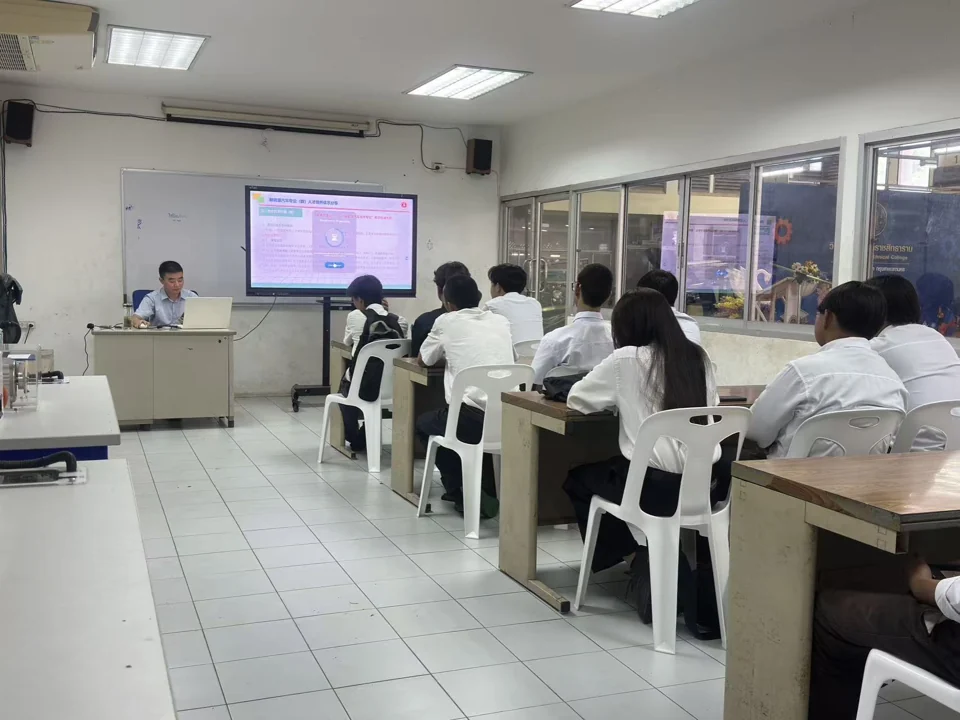
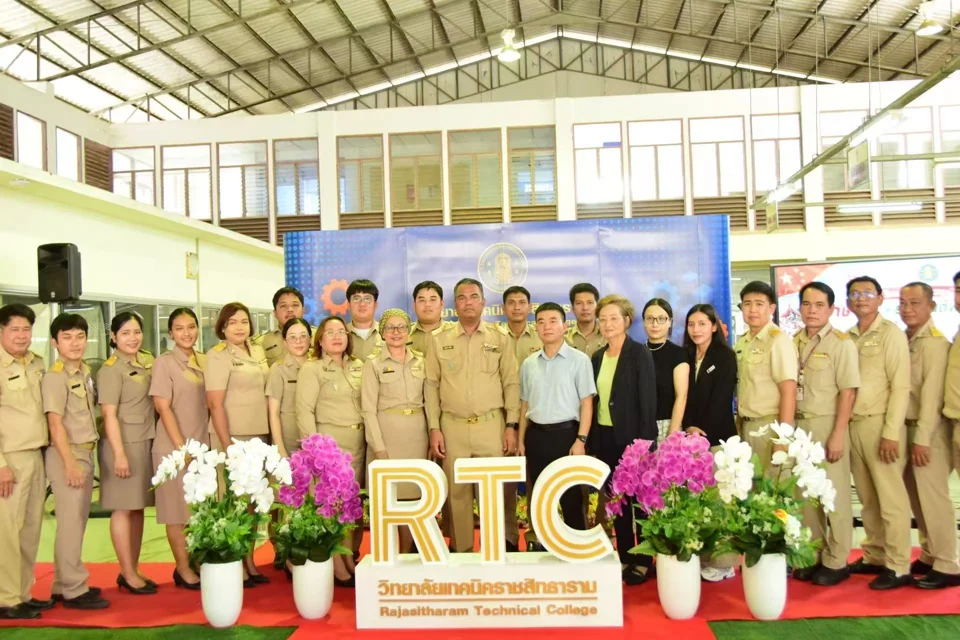
The college reported an overseas teaching project in October 2026 involving its intelligent-manufacturing and automotive teaching team. A first training programme took place at Rajasittharam Technical College in Thailand from 18 to 24 October. It followed the establishment of a Chinese-language and vocational-skills training base earlier that year.
Teaching addressed new-energy vehicle structures, battery and motor modules, and workplace safety. The report describes virtual-simulation resources and examples drawn from industry-related settings. Chinese and Thai teachers also discussed international curriculum design, cross-cultural teaching and the development of shared resources. According to the account, a vehicle-technology course developed by the college was incorporated into the partner institution’s training arrangements. The accompanying photographs record the visit and teaching in Thailand; they are not photographs of the Hefei campus.
Sources: Technical education exchanged with Thailand ↗
Developing a connected business curriculum
A November 2026 report from the modern-commerce unit documents a curriculum-development meeting held on 27 October. Its focus was a group of four shared courses: management fundamentals, electronic-commerce fundamentals, digital business-data analysis, and integrated capabilities involving artificial intelligence and modern business. The courses were discussed in relation to revised training plans for the 2026 student intake.
The meeting considered how to connect topics across courses, reduce duplication and clarify the progression of knowledge and skills. A proposed structure combined common foundations with modules adapted to particular professional directions. Teaching teams were encouraged to work across subject groups, develop resources and review approaches to assessment. These were reported curriculum-development activities and plans, demonstrating how the college was organizing changes in business education rather than proving their eventual effects on student outcomes.
Industry dialogue and practical teaching
The accounting unit’s November 2026 news describes a visit to Guohua Engineering Technology Group on 29 October. The discussion concerned cooperation in professional education, resource sharing and the relationship between teaching and engineering practice. The report places the meeting within a continuing institutional relationship rather than presenting it as the first contact between the organizations.
Earlier cooperation is described in curriculum work, staff exchanges and practical teaching. The new discussion addressed changes in the construction industry and the possible contribution of digital methods to professional preparation. The participants proposed building on complementary institutional and enterprise resources. This provides a specific example of the college’s approach to industry dialogue, with future cooperation described as an intention rather than a guaranteed placement or employment arrangement.
Teaching innovation through professional exchange
Another November 2026 report describes work by a four-person modern-commerce teaching team presented at a national teaching-skills competition in Zhuhai. The project concerned digital trade and cross-border supply-chain education. Rather than focusing solely on a course outline, the presentation connected teaching goals, learning scenarios and approaches to assessment.
The account describes a teaching report, a practical demonstration and questions from assessors. Artificial-intelligence tools and an English-language scenario formed part of the demonstration. The team also discussed how vocational teaching could respond to the needs of enterprises operating internationally. The college presents participation in such events as a way for teachers to examine and revise their educational methods. This dated activity complements the curriculum meeting and overseas training described elsewhere, showing different settings for professional exchange and teaching development.
Sources: Teaching innovation through professional exchange ↗