Visa


About Anhembi Morumbi University
A university rooted in São Paulo
Anhembi Morumbi University, known in Portuguese as Universidade Anhembi Morumbi, is a Brazilian higher education institution with its origins in São Paulo. Its institutional timeline begins in 1971, when the first Anhembi Morumbi institution opened. A significant expansion followed in 1998 with the opening of the Mooca unit in a former São Paulo Alpargatas factory building.
The university joined the Ânima education network in 2021. Its present institutional description places education within a wider mission of social and environmental progress, ethical values and entrepreneurship. The mission connects professional preparation with responding to the demands of a globalised world. Its account of university life also identifies community extension, teaching and academic evaluation as parts of institutional activity. This history links its São Paulo roots with a broader educational structure encompassing undergraduate and postgraduate learning.
Sources: Institutional history and mission ↗
A campus shaped by industrial history
The Mooca campus occupies a former Alpargatas factory building dating from 1908. Located on Rua Doutor Almeida Lima, it brings an industrial landmark into use as a setting for university education. The campus description identifies provision across architecture, design, fashion, health, communication and law, alongside other fields.
Its specialist facilities include a gastronomy centre, television and radio production spaces, a cinema, a communication agency and an experimental theatre. Architecture teaching has a dedicated studio, while aviation and hospitality education are represented by a flight simulator and simulated hotel. The university also lists a health-simulation centre and facilities serving the surrounding community. These different spaces illustrate the campus's combination of classroom learning with environments designed for practical work.
Sources: Mooca campus ↗
Learning through integrated curricular units
The university organises its curriculum around Unidades Curriculares, or curricular units. These units bring related content together around the development of competencies, rather than treating each subject as an isolated body of material. The curriculum description connects this organisation with active learning and the integration of theory and practice.
Materials include videos, texts, podcasts, infographics and digital books. A core curriculum introduces themes that extend across professional fields, including culture and the arts, ethics and logic, Portuguese and Brazilian Sign Language, sustainability, social analysis and digital thinking. Other units focus on the student's field and profession through projects, simulations and work in multidisciplinary teams. The Vida & Carreira component concerns personal development and the planning of educational and professional projects. Community extension is also represented through projects, courses, workshops, services and events connecting academic learning with society.
Sources: Integrated curriculum ↗
Library collections and academic support
The university library combines physical collections and reading spaces with digital resources. Its Pergamum system supports catalogue searches, reservations and loan renewals. The library describes individual and group study areas, as well as access to e-books, journal articles, technical standards and audiovisual material.
Among its listed digital services are Pearson, Minha Biblioteca and EBSCOhost. The library also directs users to the Ânima university repository, which preserves and makes institutional scholarly work more visible. Support for academic writing includes guidance on document presentation, reference management and citations. Users can obtain help with searching, take part in orientation visits and attend training on library services. Cultural exhibitions and BookCrossing activities add another dimension to the service, connecting the library's academic role with reading and community participation. The system lists service points at several university campuses in the state of São Paulo.
Sources: University library ↗
Research beginning in undergraduate study
Scientific research is presented as an activity that students can begin during their undergraduate education. The Pró-Ciência initiative introduces students to research under academic supervision and encourages them to connect theoretical learning with investigation. Its description allows for projects lasting up to twelve months, with an extension of up to six months following an activity report.
The university's Encontro Científico provides a setting for discussing and presenting research. Its stated objectives include circulating scientific knowledge, supporting continued academic development and encouraging investigation in areas needing further research. The research page maintains records of earlier meetings and identifies ethics structures concerned with research involving people and with activities involving animals. It also connects university research with the wider Ânima journal portal and repository. These arrangements support both the development of projects and the communication of their results within the academic community.
Student support and inclusion
The Núcleo de Apoio Psicopedagógico e Inclusão, known as NAPI, is the university's dedicated educational-support and inclusion service. Its account places equity, recognition of differences and student participation at the centre of its work. Support includes individual and group educational guidance, assistance to teachers and specialised educational services for students with disabilities.
The service also organises workshops, lectures and discussion groups on learning, inclusion, diversity and human rights. Its guidance covers study organisation and time management, as well as barriers to learning and participation. The university distinguishes NAPI's mental-health reception and referral role from psychotherapy, which the service does not provide. Students request appointments through the institutional student platforms. NAPI therefore forms part of the university's broader arrangements for supporting students' academic development, alongside the teaching, research and library services described on its official pages.
A historical venue for professional exchange
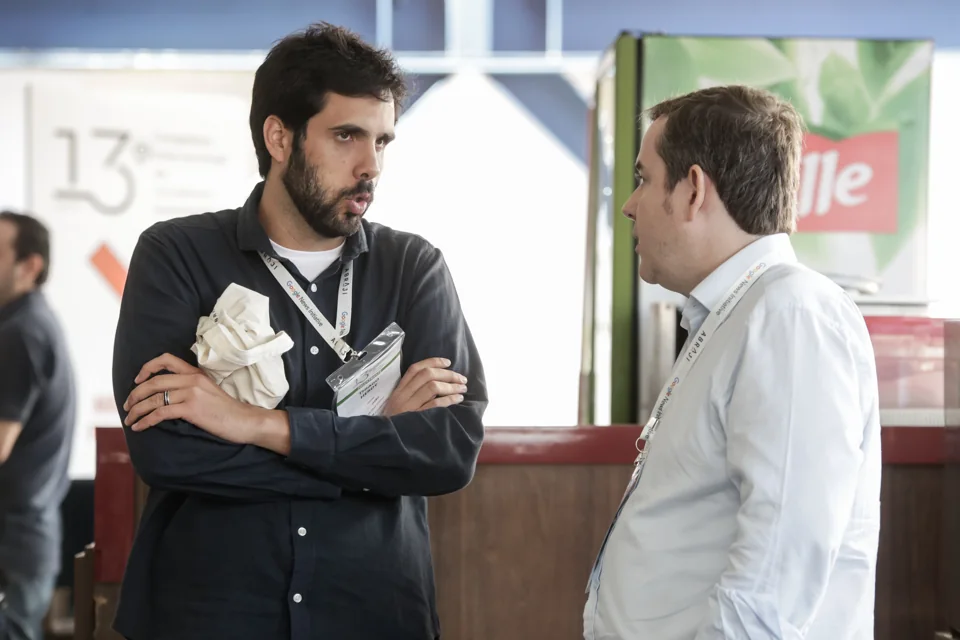
The university has also hosted events bringing professional communities together. Photographs published by the Brazilian Association of Investigative Journalism document its thirteenth international congress at Universidade Anhembi Morumbi in São Paulo, held from 28 to 30 June 2018. The two photographs accompanying this profile were taken on 29 June by Alice Vergueiro and show informal conversations during the event.
Sources: Thiago Herdy e Flávio Ferreira — Alice Vergueiro/Abraji, 2018 ↗ · Intervalo — Alice Vergueiro/Abraji, 2018 ↗