Visa
About Aeronautics Institute of Technology
A public institute focused on aerospace science
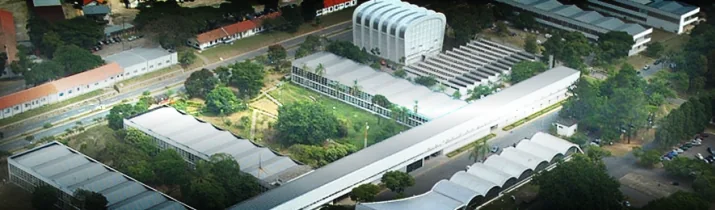
The Aeronautics Institute of Technology is known in Brazil as Instituto Tecnológico de Aeronáutica, or ITA. It is a public higher-education institution connected to the Brazilian Air Force Command and located within the Department of Aerospace Science and Technology, DCTA, at São José dos Campos in São Paulo state. Its educational work combines undergraduate engineering with postgraduate study, scientific research and specialist training. Aerospace science and technology provide a central institutional focus, while its teaching draws on engineering, computing and the fundamental sciences. ITA's remit includes preparing higher-level professionals and contributing to the development of knowledge and technology in fields connected with aerospace activity.
Sources: ITA institutional information ↗
Founding and the early educational model
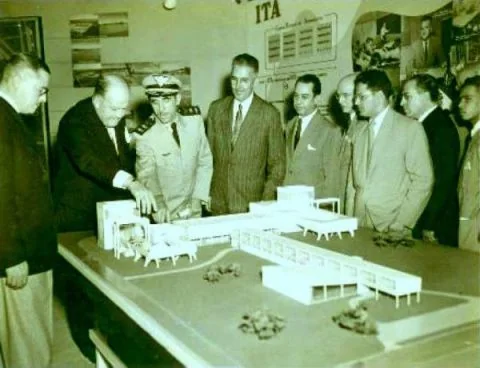
ITA was founded in 1950 through a project associated with Casimiro Montenegro Filho and international academic cooperation. Its official seventieth-anniversary account describes the contribution of Richard Harbert Smith of the Massachusetts Institute of Technology, who visited Brazil in 1945 to examine the feasibility of an aeronautical education and research organization. The resulting planning connected an engineering school with a wider technical center. São José dos Campos was selected for the project, and ITA developed within that setting. The institute's early model used academic departments and semester-based teaching. Its historical account also emphasizes a curriculum capable of change and a residential environment supporting close interaction between students and teachers.
Sources: ITA seventieth-anniversary history: first decade,2020 ↗
The development of its courses
The institute's engineering portfolio expanded over several decades. Its historical course account records electronic engineering from 1951, followed by mechanical engineering in 1962. The latter became mechanical-aeronautical engineering in 1975. An aeronautical infrastructure course also began in 1975 and later took the civil-aeronautical engineering name. Computing engineering was introduced in 1989, with aerospace engineering following in 2010. Postgraduate activities began in 1961, and the first master's theses were defended in physics and electronic engineering in January 1963. The first doctorate was defended in 1970. These stages show the institution's development from an early aeronautical focus into several connected engineering and scientific areas, alongside an expanding postgraduate role.
A shared scientific foundation
ITA's engineering teaching is organized around a five-year course structure. The first two years form a common foundation before students proceed to professional specialization. The foundation page describes four semesters of shared study. Mathematics includes calculus, analysis and linear algebra; physics covers mechanics, electricity and magnetism, waves and modern physics. Chemistry subjects include molecular structure, crystallography, chemical thermodynamics and electrochemistry. Computing introduces programming-related concepts, algorithms, data structures and computational mathematics. Engineering drawing, solid mechanics and thermodynamics also contribute to the foundation. Humanities teaching addresses historical, political and social questions, adding context to the technical knowledge engineers use within organizations and society. This common preparation underpins the later specialist courses.
Sources: Common foundation course ↗
Aeronautical engineering in practice
The aeronautical engineering course focuses on the design and construction of aircraft. Its professional studies cover aerodynamics, structures, engines and turbines, flight mechanics and aircraft design projects. The course page describes a required curricular internship in the fifth year, together with elective study and a graduation project. Environmental engineering, law, administration and economics contribute to a broader understanding of engineering practice. Students may complement formal study through scientific initiation, international exchange or extracurricular teams working in areas such as model aircraft, robotics and other technical projects. The institute also describes an integrated undergraduate-to-master's pathway that allows interested students to take postgraduate subjects during their engineering studies.
Sources: Aeronautical engineering ↗
Aerospace systems as another specialization
Aerospace engineering applies the institute's scientific foundation to the conception of aerospace systems. Introduced in 2010, the course includes subjects such as propulsion, aerodynamics, electronics, telecommunications, thermal engineering and structures. Systems engineering, project management, orbital mechanics and flight dynamics broaden this training beyond an individual component. As in aeronautical engineering, the professional phase follows the common foundation and includes an internship and graduation work. This structure connects study of separate scientific and engineering subjects with the task of understanding how they interact within a larger system. It reflects the difference between mastering a particular technical discipline and coordinating several disciplines in an engineering project.
Sources: Aerospace engineering ↗
Postgraduate physics and research
ITA's postgraduate physics program prepares master's and doctoral students for scientific research and technological development. Its program description, updated in September 2025, characterizes its work as technological physics: basic research is combined with scientific and technological questions connected to its wider aerospace setting. Faculty involvement draws principally from physics, chemistry and mathematics within the Fundamental Sciences Division. The program's stated mission emphasizes a strong foundation in basic science and the ability to conduct independent research. Its institutional setting links that scientific training with the research environment of DCTA, adding a fundamental-science dimension to the institute's engineering education and specialist technological work.
Sources: Postgraduate physics program,updatedSeptember2025 ↗
Library support for technical scholarship
The ITA Library supports academic work through catalogue searching, access to digital publications, interlibrary loans and assistance with bibliographic references. Its information system covers the collections of ITA and other DCTA libraries and supports online reservations and renewals. Librarians provide help locating material, using technical standards and preparing references, alongside guidance on intellectual property and copyright. The library also records academic work completed at the institute. Its digital library makes theses, dissertations and undergraduate graduation work available as part of the institutional scholarly record. Training sessions and research assistance complement access to books, journals and technical information, helping students use those resources during coursework and research projects.
Sources: ITA Library: services,collections and academic work ↗
Student affairs and academic support
ITA's Division of Student Affairs provides administrative and educational support. Its secretariat handles matters such as enrollment certificates, personal records and routine academic documentation. The academic support section works on the teaching and learning process, including support for faculty development and improvements in teacher-student relationships. Psychosocial support includes assistance for students encountering adjustment difficulties, academic challenges or social vulnerability, together with coordination of relevant referrals and mentoring activities. These functions place student support alongside the formal engineering curriculum. They address both the administrative processes needed to progress through study and the personal and educational difficulties that can arise during university life.
Sources: Division of Student Affairs ↗