Visa
About Angeles University Foundation
The foundation and its educational roots
Angeles University Foundation is a Catholic university in the Philippines whose development reflects several changes in institutional form. The Angeles family established the institution in May 1962. It gained university status in April 1971 and became a non-stock, nonprofit educational foundation in December 1975 through a deed of donation executed by its founders and their children.
The university’s history records its conversion to a Catholic university in February 1978. Its educational identity developed around Christian formation alongside academic and professional study. The same historical account describes the opening of the university’s medical centre in 1990 for teaching, training and research. The foundation name therefore belongs to the continuing university established by the Angeles family, linking its educational work with a nonprofit organizational structure and a Catholic institutional tradition.
Graduate and continuing professional education
The Graduate School is based in the AUF Professional Schools building on MacArthur Highway in Angeles City. It describes its purpose through advanced and continuing professional education, connecting theoretical study with technology, professional practice and research. Its stated priorities include critical analysis, leadership, community involvement and the further development of students’ research capabilities.
Its published programme list spans education, psychology, business and management, information technology, health sciences, nursing and criminal justice. Educational specializations include management, English, early childhood education, Chinese language teaching, and special needs and inclusive education. The technology offerings listed include information technology and data science, while the management fields extend to both master’s and doctoral study. This breadth places graduate education across several of the university’s academic areas.
Sources: AUF: Graduate School ↗
Business, accountancy and hospitality
The College of Business and Accountancy traces its beginnings to the College of Commerce established in 1962. Its history describes successive reorganizations involving business, economics, secretarial education and the computer centre. Accountancy was added in 1992, hotel and restaurant management in 1993, and tourism in 2005.
The college’s stated educational goals combine business and administrative knowledge with integrity, ethical standards, research and analytical thinking. Its programme page lists accountancy, management accounting, business administration, hotel and restaurant management, and tourism management. Student participation is also part of its published account: organizations bring together students interested in marketing, entrepreneurship, accountancy and tourism. Trade Wings is identified as the college’s student publication, giving writing and creative work a place alongside its professional subjects.
Computing concepts, infrastructure and media
The College of Computer Studies distinguishes several forms of computing education. Its computer-science description emphasizes computing theory, algorithms, complex software and software-engineering practices. Data science appears as an area of specialization concerned with extracting meaning from data through scientific methods, algorithms and systems.
Information technology is described through the planning, installation, operation and maintenance of computing infrastructure. The college identifies web and mobile technologies and IT infrastructure as specialization areas, covering subjects such as application development, databases, networking, server administration and cloud computing. Its multimedia-arts description adds graphic design, animation, visual effects and storytelling across media forms. The college also identifies computer, hardware and research laboratories within the Information Technology Training Center, linking its academic subjects with practical computing spaces.
Sources: AUF: College of Computer Studies ↗
Teacher education and cultural participation
The College of Education began within the College of Arts and Sciences in 1962 and became a separate unit in 1983. Its history records elementary-education study beginning in 1986 and secondary-education study in 1989. The college describes its mission in terms of preparing Christian educators and its goals through pedagogy, leadership, research and engagement with educational issues.
Its account of student organizations extends beyond subject teaching. Teacher’s Pen serves as the college publication, while Educational Leaders for Nation Building is identified with community extension. Other groups focus on Chinese language and culture, English, Filipino, visual arts, dance, singing and physical education. The Guardian Angel Society is described as organizing mentoring activities, seminars and exhibits. These published activities connect teacher preparation with language, communication, artistic participation and service.
Sources: AUF: College of Education ↗
Engineering, architecture and learning outcomes
The College of Engineering and Architecture lists architecture, civil engineering, computer engineering and electronics engineering among its academic programmes. Its stated aims connect technical education with environmental responsibility, research, community assistance and relationships with professional and educational organizations.
The college’s outcomes-based education framework describes how university-level graduate attributes connect to programme and course learning outcomes. These outcomes guide syllabus preparation, teaching methods, learning activities, assessment tools and curriculum development. The page distinguishes longer-term programme educational objectives from the knowledge, skills and behaviours expected at graduation and the more specific outcomes attached to individual courses. It also describes assessment as a basis for improvement. This provides a detailed account of how the college intends to organize and evaluate its teaching.
Classrooms, laboratories and shared learning spaces
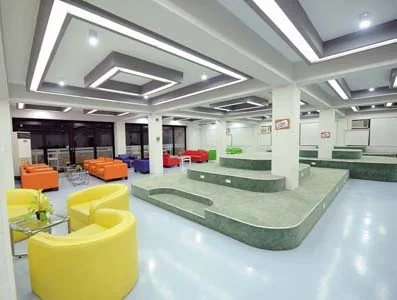
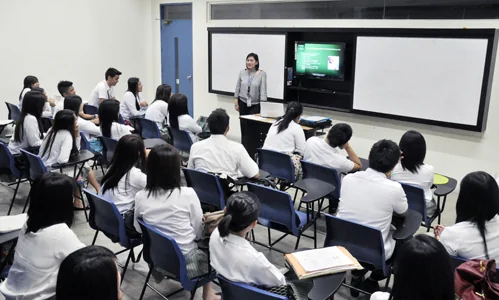
The university’s facilities account describes classrooms and lecture rooms equipped with display or projection technology. It also identifies a learning commons as a shared educational space, supported by wireless connectivity. The published photographs illustrate both a classroom in use and the seating and study arrangements within the learning commons.
Specialist spaces described elsewhere on the same facilities page include a digital speech laboratory and a digital-signal-processing laboratory used for electronics and computer-engineering skills training. The campus account also includes a language laboratory for Mandarin teaching, libraries within the Professional Schools building, and the four-storey Our Lady of Lourdes library building inaugurated in 1987. These spaces show the variety of settings the university describes for classroom teaching, technical practice and independent study.
Sources: AUF: Campuses and Facilities ↗